

Cruises are supposed to feel easy. You unpack once, the ocean shows up outside your window, and someone magically keeps your room tidy while dinner appears like clockwork. Then tipping enters the picture and suddenly you’re doing mental math at sea.
If you’ve ever wondered, “Am I supposed to tip this person?” or “Did I already pay for this in gratuities?” you’re not alone. Cruise tipping is confusing because it’s a mix of automatic charges, optional cash tips, and service fees that sometimes appear quietly on receipts. On top of that, different ships and different cruise styles handle it differently.
This guide gives you a simple, calm plan you can follow without overthinking it. You’ll learn:
- Who typically gets tipped on a cruise
- When to tip so it feels natural (not awkward)
- How much is reasonable in common situations
- Who you usually do not need to tip
- How to avoid double tipping by accident
- A day-by-day “tipping rhythm” that works for most cruises
The goal is confidence. You can be generous and respectful without feeling pressured or confused.

How cruise tipping really works (in plain English)
On land, tipping usually happens in the moment. You eat, you tip. Someone carries your bag, you tip. On a cruise, service is constant and team-based.
Most large cruise lines use a system where:
- A daily gratuity (sometimes called an automatic gratuity or service charge) is added to your onboard account.
- That money is distributed among many behind-the-scenes and guest-facing crew members.
- Some services may also include an automatic service charge on individual purchases (like drinks or spa treatments).
- You can still give extra cash tips when someone makes your trip noticeably better.
That last part matters. Extra tipping is not always required, but it can be a kind way to say thank you for standout service, special help, or repeated attention.
The big idea
Think of cruise tipping in two layers:
- Base layer: automatic gratuities (covers everyday service teams)
- Bonus layer: optional cash tips for personal service moments, special requests, or exceptional care
When you understand that, everything becomes easier.
Automatic gratuities explained (so you don’t double-tip)
Automatic gratuities are the cruise line’s built-in way of paying service teams who support your trip every day. On many mainstream cruise lines, these gratuities are charged per person, per day, and may be higher for suites.
Because these amounts change and vary, the smartest approach is this:
- Use the automatic gratuity as your “baseline tip.”
- Use extra tips as a personal thank-you, not an obligation.
Who automatic gratuities usually cover
This varies by cruise line, but it often includes:
- Your cabin steward (stateroom attendant)
- Dining room team (waiter, assistant waiter, support staff)
- Some behind-the-scenes dining and housekeeping teams
What automatic gratuities usually do not cover
Often, separate service charges apply to:
- Drinks at bars (especially if you buy drinks individually)
- Specialty dining service charges on some ships
- Spa and salon services
- Independent shore excursions (not booked through the ship)
Can you adjust automatic gratuities?
Some cruise lines allow you to adjust them at guest services. Whether you should do that depends on the situation.
In most cases, if the cruise was fine, it’s best to leave them in place. If there was a serious service problem that was not resolved, adjusting may feel appropriate. If you do adjust, it’s still thoughtful to tip directly in cash the crew members who did take good care of you.
The day-by-day tipping plan (so you never guess)
This is the simplest way to handle cruise tipping: match tips to moments when service is most personal.
Embarkation day (the “first impressions” day)
Porters at the terminal
If someone handles your luggage curbside or at the terminal, a small cash tip is customary.
- A common range is a few dollars per bag (often around $2–$5 per bag).
- If someone goes above and beyond (heavy bags, extra help, long walk), consider the higher end.
Shuttle drivers or transfer staff
If you take a shuttle or transfer where a driver loads and unloads bags:
- Tip the driver a small amount, especially if they handle luggage (often a few dollars per person or per bag).
Your cabin steward (stateroom attendant)
You don’t need to tip the moment you meet them. A friendly hello and a quick, clear request goes further than money on day one.
What you can do on embarkation day is set the stage:
- Introduce yourself
- Mention anything important (mobility needs, extra hangers, ice, CPAP distilled water, pillows, towel preference)
- Ask the best way to reach them if needed
If you know you’ll request extra help all week, an early “thank you” tip can be appreciated, but it’s not required.
Mid-cruise days (the “routine” days)
These are the moments where small tips make sense if they’re not already included.
Bar service
If you buy individual drinks, there may be an automatic service charge on the receipt. If that’s already added, you don’t need to tip again unless:
- You have a bartender who learns your preferences
- You ask for something special (custom drink, frequent service)
- You sit in the same lounge daily and get great attention
In those cases, a modest extra cash tip can make service feel warm and personal.
A common approach:
- $1–$2 extra per drink for standout service
- Or a small “thank you” tip after a great evening
If you have a beverage package, tipping rules can feel fuzzy. Many guests still tip a little extra for excellent service, but it’s optional.
Room service
Even when room service is “free,” it often arrives through hard work and timing.
- A typical tip range is $2–$5 per delivery, more if it’s large, late-night, or involves special requests.
Housekeeping beyond the basics
If you request extra cleaning, extra towels, extra ice, or have medical/mobility-related needs that require more attention, consider an additional thank-you tip during the week.
Port days (the “outside the ship” days)
This is where tipping surprises many people, especially seniors who want to do the right thing in different countries.
Ship-sponsored excursions
Often, guides and drivers are not part of the ship’s gratuity system. Tipping is usually expected.
Common ranges that feel reasonable:
- Group tour guide: about $5–$10 per person for a half-day style tour
- Driver: about $2–$5 per person if separate from the guide
For full-day tours or exceptional guides, many people tip more.
Independent tours (not booked through the ship)
Rules depend on the country and the operator. In many tourist-heavy ports, tipping is common and expected.
If you’re unsure, these clues help:
- Does the guide mention tipping at the end?
- Do other guests begin tipping?
- Did the guide provide a truly personal experience?
If the guide was excellent and you felt cared for, tipping is usually appropriate.
Wheelchair assistance or special mobility help
If a driver, guide, or staff member gives extra physical support (steadying you, ensuring safe boarding, taking extra time), a direct thank-you tip is often appreciated.
Final night and disembarkation (the “wrap it up” days)
This is where people often overtip because they feel emotional and grateful.
Here’s the calm way to handle it:
- Automatic gratuities have already covered the basics.
- Extra tipping is for people who made a real difference.
If you want to tip extra, the final evening is a natural time, especially for:
- Your cabin steward
- Your main dining room team (if you had set dining and the same staff)
You can give a simple envelope with cash and a short thank-you note. The note matters more than people realize.
Who to tip on a cruise (role-by-role guide)
This is the heart of the question: who gets tipped, and what’s reasonable.
Cabin steward (stateroom attendant)
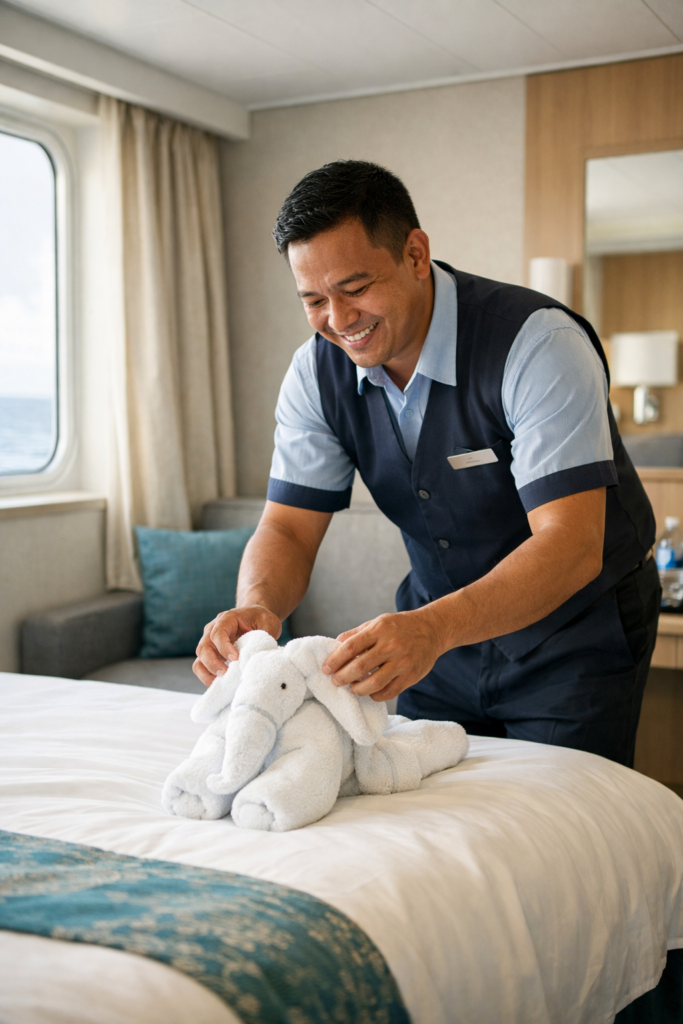
Your cabin steward is the person you’ll feel the most impact from. They keep your room comfortable, clean, and functional in a small space that can get messy fast.
What they typically do
- Daily cleaning and tidying
- Fresh towels and linens
- Keeping the bathroom stocked
- Ice requests and small cabin needs
- Special help (extra pillows, bedding changes, medical device support)
Do you need to tip extra?
If your cruise line charges automatic gratuities, the steward is usually included. Extra tipping is optional.
When extra tipping makes sense
- You make special requests (extra towels daily, extra cleaning, allergy-related cleaning)
- You need mobility-friendly arrangements
- They consistently surprise you with thoughtful care
- You travel with medical equipment or need extra help
Common extra tip approach
- Modest extra tip mid-cruise if they’re helping a lot
- A larger thank-you tip near the end if service was exceptional
A reasonable range many guests use is $10–$30 total per cabin per week as an extra thank-you, more for suites, longer cruises, or high-maintenance needs. If you’re traveling on a fixed income, even a smaller amount paired with a sincere note is meaningful.
A tip that often matters more than money
Tell them what you prefer early. Example:
- “We’re early sleepers, so quiet mornings are great.”
- “Extra ice would be wonderful.”
- “If you can keep the bathroom floor extra dry, that helps a lot.”
Clear preferences make their job easier and your week smoother.
Main dining room staff (waiter and assistant waiter)
If you have traditional dining (same time, same table, same staff), these are the people who become “your team.” They remember your preferences and pace.
What they do
- Handle dietary needs and substitutions
- Keep your dining experience calm and timed well
- Help with mobility or comfort at the table
- Make celebrations feel special
Is extra tipping required?
If automatic gratuities apply, the dining team is usually included. Extra is optional.
When extra tipping is most common
- You had outstanding service all week
- You had complicated dietary needs handled beautifully
- You felt genuinely cared for and remembered
How much is reasonable
Many guests who tip extra will give something like:
- A modest thank-you per staff member at the end of the cruise
- More if there was special attention or unusual effort
If you didn’t have set dining and mostly ate buffets or casual venues, extra tipping dining staff is less common.
Good to know
Some guests tip the maître d’ if they arranged something special (a special table, accessibility accommodations, a last-minute celebration). If they personally solved a real problem for you, a thank-you tip can be appropriate. If you barely interacted, it’s usually unnecessary.
Buffet and casual dining staff
Buffets feel “self-serve,” but the staff works hard behind the scenes and clears tables quickly.
In most cases:
- You do not need to tip buffet staff directly.
- Automatic gratuities and ship systems usually cover the team.
If someone personally assists you repeatedly (finding seating, carrying trays, special help), a small thank-you tip is kind but optional.
Bartenders and bar servers
Bars are one of the places where service charges and tipping overlap the most.
The first thing to check
When you sign a drink receipt, look for a line that says something like “gratuity” or “service charge.” If it’s already included, you’re covered.
When extra tipping makes sense
- A bartender remembers your drink and your name
- A server checks in often and keeps things easy
- You ask for special requests or custom drinks
- You spend a lot of time in one lounge and build a connection
Reasonable extra amounts
- Often $1–$2 per drink for great service
- Or a small amount after a great evening
You’re not trying to “buy” attention. You’re saying thanks for real human warmth.
Room service delivery
Room service can be one of the most comforting parts of cruising, especially for seniors who like a slow morning or an early night.
Even if there’s a delivery fee or service charge, many guests still tip a little because the delivery person is doing a direct service for you.
Common tip range
- $2–$5 per delivery
- More for large orders or unusual timing
If you only use room service once or twice, a small tip is plenty.
Spa, salon, and fitness services
Spa services often come with an automatic service charge added at checkout. If you see it, you don’t have to tip again.
Extra tipping is common if:
- The therapist was truly excellent
- They adjusted for pain, mobility, or comfort needs
- You rebook them for another service
Reasonable approach
- If gratuity is included, extra is optional and usually small.
- If gratuity is not included, tipping similar to land-based spa norms is common.
Shore excursion guides

This is one of the most searched tipping questions for cruises, and for good reason: it’s not always included, and it can vary by destination.
A simple way to think about it
Tip guides based on:
- Time spent with you
- Group size
- Quality of the experience
Common ranges that work in many places
- Half-day group tour: $5–$10 per person for the guide
- Full-day group tour: $10–$20 per person for the guide
- Driver (if separate): $2–$5 per person, more for full-day
Private tours
If it’s a private guide for your couple or family, tipping is usually per group rather than per person. Many guests tip a percentage or a meaningful flat amount based on how much effort and care the guide provided.
If you’re unsure
Ask yourself one question: “Did this guide make me feel safe, informed, and cared for?” If yes, tipping is a good idea.
Drivers, shuttles, and luggage handlers in ports
These tips are usually small but appreciated.
- Luggage handling: a few dollars per bag
- Shuttle driver with luggage help: a few dollars
- Private driver for an outing: tip like you would on land, based on time and service
Cabin butler or concierge (suite guests)
If you have a butler or dedicated concierge who handles personal requests, unpacking help, dining arrangements, or daily service touches, extra tipping is more common.
A good approach:
- Tip based on how much you used the service
- Tip more for repeated personal help, accessibility help, or special arrangements
If you barely used them, keep it modest. If they made your week feel effortless, a more generous thank-you can be appropriate.
Who you usually do not need to tip
Many people worry about tipping the wrong person or missing someone. This section is here to relieve pressure.
In most cruise settings, you generally do not need to tip:
- Guest services/front desk staff
- The cruise director or entertainment staff
- Officers and ship leadership
- People who give announcements, run trivia, or host shows
- Most retail shop staff onboard
That doesn’t mean you can’t show appreciation. A kind word, a compliment to a supervisor, or a positive note in the end-of-cruise survey can be powerful.
Cash vs prepaid gratuities vs envelopes (what feels easiest)
There’s no perfect method. The right method is the one that keeps you calm and prepared.
Prepaid gratuities
Best for:
- People who want everything handled automatically
- Seniors who don’t want to carry cash
- Travelers on fixed budgets who like predictable costs
How it feels onboard:
- Less stress, fewer decisions
Cash tips
Best for:
- People who like personal thank-yous
- Situations where service is clearly “above and beyond”
- Excursions and off-ship services
How to make it easy:
- Bring small bills
- Keep a small envelope in your cabin
- Decide your approach early so you don’t scramble on the last night
Envelopes
Some ships provide envelopes near the end. Even if they don’t, you can bring your own small envelopes.
A note inside can be simple:
- “Thank you for taking such good care of us this week. We appreciate you.”
That sentence carries a lot of weight.
Cruise types where tipping feels different
Not all cruises are the same. Your tipping approach should match the style of ship.
River cruises
River cruises often feel more personal, with fewer guests and more direct staff interaction. Some include gratuities; others suggest amounts. Extra tipping may feel more “communal,” and staff often work multiple roles.
A simple rule:
- Follow the cruise line’s guidance first.
- Tip extra only for standout staff who truly elevated your experience.
Luxury cruises
Many luxury cruises advertise that gratuities are included. Even so, guests sometimes tip extra for butlers, concierge help, or exceptional personal service.
If everything is included, extra tipping is never required—but gratitude is always welcome.
Expedition cruises
Expedition teams (naturalists, guides) may have different expectations. Some ships have shared tip pools; others suggest tips for expedition staff.
In expedition settings, the best practice is:
- Follow the guidance given onboard
- Tip based on the level of personal attention and the intensity of the experience
Common cruise tipping mistakes (and how to avoid them)
Double tipping without realizing it
This happens most with:
- Drinks
- Spa services
- Specialty dining
Fix:
- Check receipts for service charges before adding extra.
Tipping too early out of anxiety
Some people tip big on day one, then regret it later.
Fix:
- Start with kindness and clarity.
- Tip extra after you’ve seen consistent service.
Feeling pressured by other passengers
You may see someone tipping loudly or talking about big amounts.
Fix:
- Tip based on your budget and your experience, not someone else’s performance.
Forgetting the people who helped most
Sometimes the person who made your trip easier wasn’t the most visible person.
Fix:
- Think back on your week: who consistently reduced your stress?
A calm reassurance (especially for seniors)
Here’s what many experienced cruisers learn over time:
- You are not being graded.
- You are not expected to be perfect.
- Crew members value respect, patience, and kindness.
- A sincere thank-you matters, especially when paired with a fair system of gratuities.
If money is tight, you can still be a wonderful guest:
- Say thank you by name
- Leave a kind note
- Mention great service in the survey
- Offer a small tip where it truly counts (like a guide who took special care of you)
Generosity isn’t only a number. It’s also how you treat people.
A simple “no-stress” tipping checklist
Use this as your mental map onboard:
- Terminal porter handling bags: tip a few dollars per bag
- Cabin steward included in gratuities: extra tip only if service is standout or requests are heavy
- Main dining room staff included in gratuities: extra tip only if they truly made your dinners special
- Bar receipts: check if service charge is included before adding extra
- Room service: small tip per delivery is customary
- Shore excursions: tip guides and drivers based on time and quality
- Spa: check if gratuity is included; tip extra only for exceptional care
FAQ: Who to tip on a cruise (and when)
Who exactly should I tip on a cruise?
Most tipping is covered by automatic gratuities. The most common extra tips go to porters, room service delivery, excursion guides/drivers, and any crew member who provides repeated, personal, above-and-beyond help.
When should I tip my cabin steward?
If you tip extra, many people do it near the end of the cruise. If you have special requests all week, a small early thank-you can be appreciated, but it’s optional.
Are cruise gratuities mandatory?
On many mainstream lines, automatic gratuities are applied by default. Some allow adjustments. Policies vary, so treat them as the baseline unless you have a serious reason to change them.
Should I tip extra if gratuities are included?
Only if you want to. Extra tipping is best reserved for standout service or special help.
How much should I tip a shore excursion guide?
Common ranges are about $5–$10 per person for a half-day group tour and more for full-day or exceptional experiences. Drivers are often tipped separately if they are not the guide.
Do I tip per person or per cabin?
For cabin stewards, extra tips are often given per cabin. For dining teams and excursions, tipping is often per person.
Is tipping different on river cruises?
It can be. River cruises may provide specific guidance or include gratuities differently. It often feels more personal, so tips may be handled as a shared system or suggested amount.
Can I tip in foreign currency?
It’s usually best to tip in the currency crew can use easily. Many cruise crew can use U.S. dollars onboard, but for independent tours, local currency can be helpful. When in doubt, small U.S. bills are widely accepted in many tourist ports.
What if service was poor?
If something is wrong, report it early so it can be fixed. If it’s resolved, you may feel fine leaving gratuities as is. If it’s truly unacceptable and unresolved, you can discuss options at guest services.
Is it rude not to tip extra?
No. If you paid automatic gratuities, you’ve already participated in the ship’s tipping system. Extra tips are a personal thank-you, not a requirement.
Should seniors tip differently?
Not “differently,” but seniors often benefit from planning ahead. If you need extra assistance or special care, budgeting a little extra for the people who help most can feel right.
Are envelopes required?
No. They’re optional. Cash with a simple note is perfectly fine.

Closing: Cruise with confidence, not worry
A cruise should feel restful, not stressful. If you remember one thing, let it be this: automatic gratuities usually cover the everyday work, and extra tipping is for the people who made your trip noticeably better.
Bring a little cash for ports, room service, and special moments. Keep it simple. Tip with intention, not anxiety.
You’ll step off the ship knowing you handled it well—kindly, fairly, and without overthinking a single envelope.