The Upper West Side has a rhythm all its own. You see it in the morning coffee routines, the afternoon walks, the familiar faces, and especially in early dinners. If you’ve ever walked into a neighborhood diner at five o’clock and noticed the same calm energy again and again, you already understand the local pattern. Early dining isn’t “less than” dining. It’s simply how many people here live.
But tipping in New York City has become more confusing than it used to be. Screens ask questions you didn’t ask for. Fees show up that sound like tips but are not. Delivery apps add “service charges” that don’t necessarily reach the person bringing your food. Even longtime New Yorkers sometimes pause at the check and wonder what is expected now.
This guide is written for people who want to do the right thing without feeling pressured, confused, or judged. It’s especially for seniors and early diners on the Upper West Side, because that’s where routines are strong and expectations tend to be traditional. You’ll get clear tipping ranges, plain-language explanations, and examples that match real-world checks at diners, delis, neighborhood restaurants, takeout counters, and delivery to apartment buildings.
Tipping etiquette in NYC restaurants comes down to one simple idea: tip based on the service you receive, in a way that respects the work behind your meal. Once you know how to tell the difference between full service, partial service, counter service, and delivery, you can tip confidently anywhere on the Upper West Side.
Why the Upper West Side Has Its Own Tipping Culture
The Upper West Side is not a tourist district first. It’s a neighborhood first. That matters because neighborhood dining creates patterns you don’t always see in places that rely mainly on visitors. Regulars come back. Staff remembers faces. People keep their routines. The community relationship is part of what makes dining out feel comfortable, especially for seniors.
You’ll notice this in diners and small restaurants that have been around for years. The servers often know which customers want coffee right away, who prefers extra napkins, and who likes a quieter table. It’s not fancy service. It’s steady service. It’s familiar service. And tipping in places like this tends to follow classic expectations.
Another reason tipping can feel different here is the early-dinner flow. Many Upper West Side diners eat earlier than the “prime time” dinner crowd. Early dining can mean fewer tables at once, a calmer room, and a slower pace. That does not mean the work is easier. The staff still arrives, sets up, restocks, brews coffee, prepares stations, and stays ready for a rush that may or may not come later. A quiet dining room does not reduce the effort that created your meal.
In a senior-heavy neighborhood, you also see more cash tipping and more traditional habits. Many people grew up with a clear standard: full service means a real tip, and a good relationship with a local place includes consistent tipping. There is often less of the “tip screen pressure” culture in people’s minds, but the screens have arrived anyway. That’s where confusion begins.
This guide helps you sort out what is truly expected versus what is simply being asked by a tablet.
The Golden Rule of Tipping Etiquette in NYC Restaurants
Here is the rule you can hold onto when everything else feels noisy: tip for full service in a fair, consistent way.
In New York City, tipping is not a bonus for a “special” server. It is a core part of how many service workers earn their income. Whether you dine at five o’clock or eight o’clock, whether you order a big meal or a modest one, the basic structure is the same. If a person is serving you at the table, taking your order, bringing your food, checking on you, and handling your bill, tipping is expected.
A helpful way to think about it is this: tipping is connected to the role, not your identity. Seniors do not have different rules. Early diners do not have different rules. The best approach is to tip like a confident local.
A practical standard for table service in NYC is 18% to 22% of the pre-tax total. Many people choose 20% as a simple middle point. You can move up for excellent service, special help, or a longer stay. You can move down when service is clearly poor. The key is that “poor service” should mean something real, not simply that the restaurant was quiet, the menu was simple, or you came early.
Another important principle: discounts do not reduce the work. If you get a senior discount, a prix-fixe deal, or a happy-hour price, you can still tip fairly. Many people tip on the pre-discount amount if the discount was meaningful. If that feels uncomfortable, tip at least as if the check were normal for the amount of service you received. The goal is to keep the tip connected to the labor, not to the promotion.
Now let’s get specific with the places seniors on the Upper West Side actually use.
How Much to Tip at Upper West Side Diners

Diners are the heart of early dining on the Upper West Side. They are comfortable, predictable, and welcoming. They are also one of the most misunderstood tipping situations because diners often feel casual. Casual does not mean “no tip.” If you sit down and a server takes care of you, it is table service.
Classic table-service diner tipping
In a classic diner experience, a server seats you, brings menus, takes your order, refills coffee, brings food, checks in, and brings the check. That is full service. The recommended range is 18% to 22% of the pre-tax total.
If you want an easy method, choose 20% most of the time. If you like doing quick math without feeling strained, here are simple mental shortcuts:
A 20% tip is roughly two dollars for every ten dollars spent.
A 20% tip on $20 is $4.
A 20% tip on $30 is $6.
A 20% tip on $40 is $8.
If you prefer rounding to keep it stress-free, round the tip up to a simple number. Many servers would rather see a clean, fair tip than a perfectly calculated one down to the penny.
Here are diner examples that feel realistic:
A $18 breakfast check: tip about $3.50 to $4.00.
A $25 early dinner: tip about $4.50 to $5.50.
A $35 check with coffee refills and extra requests: tip about $6.50 to $8.00.
What if service is minimal or slower?
Sometimes diner service is slower, especially during staff shortages, shift changes, or a quiet early evening. It helps to separate what the server controls from what they don’t.
If the kitchen is slow but the server is attentive, that’s still good service. The server is likely doing their best while managing the flow.
If the server disappears, ignores your table, or is rude, that’s a service issue. In those cases, tipping can be adjusted. A common approach is to drop toward the lower end of the expected range rather than skipping the tip entirely. For example, if you normally tip 20%, you might tip 15% to signal the problem without punishing the entire system.
If something truly unacceptable happened, you can speak with a manager calmly and tip based on what you feel is fair. But in most everyday diner situations, slow service is not a reason to “tip like it’s counter service.”
The regular’s advantage and why consistency matters
If you’re a regular at a diner, the relationship matters. Consistent tipping builds trust and goodwill. It often shows up in small ways: a more attentive coffee refill, a quick solution when something is off, or simply being treated like you belong there.
That does not mean you have to tip extravagantly. It means tip predictably and respectfully. Regulars who tip fairly are remembered.
If you love a place and want it to stay stable, fair tipping is part of that stability.
Neighborhood Restaurants and Early Bird Dinners
The Upper West Side is full of neighborhood restaurants that feel more “restaurant” than “diner” but still casual and comfortable. Many seniors use them for early dinners, weekday routines, and quiet meals that feel like a break from cooking without being a big event.
In these places, tipping expectations usually match standard NYC restaurant etiquette.
What counts as a neighborhood restaurant?
Think of places where you sit down, get menus, have your order taken by a server, and are checked on during the meal. It may be Italian, American, Greek, or something else. It might be a small room with familiar staff. It might have regulars who come weekly. If you are seated and served at the table, tipping is expected.
The recommended range remains 18% to 22% of the pre-tax total.
Early bird menus and fixed-price specials
Early dinner specials can create a mental trap. The check looks lower, so people tip lower. But the service often remains exactly the same. Someone still greeted you, took your order, delivered food, cleared plates, refilled water, and handled your bill.
A good guideline is to tip as you normally would, based on the pre-tax amount. If the early bird deal was very significant, some people choose to tip on what the meal would have cost without the deal. That approach is especially common when a server provided attentive service and the “deal” was more about timing than effort.
If tipping on the full value feels too much, another approach is to tip at the higher end of the range on the discounted amount. For example, tip 22% rather than 18%. That can help keep your tip aligned with the service.
Wine, cocktails, and coffee
If you order alcohol or ask for coffee service, remember that beverages increase service work. Someone checks on you more often. Someone may pour or handle additional requests. The tip does not need to be separate for drinks. It is simply part of the full-service total.
Examples:
A $32 prix-fixe early dinner: tip about $6 to $7.
A $45 dinner with a glass of wine: tip about $8 to $10.
A $55 dinner with dessert and coffee: tip about $10 to $12.
Staying longer at the table
Seniors often enjoy a slower meal. That’s not a bad thing. Restaurants are part of community life. But if you stay much longer than the average table, especially if the restaurant is filling up, consider tipping toward the higher end. This is less about “paying rent for the chair” and more about acknowledging you used more of the server’s time and the restaurant’s table capacity.
If you dine early and the room is quiet, staying a little longer is usually no problem. If the room becomes busy, the economics shift. A small extra tip can be a thoughtful way to balance that.
Deli Counters, Cafés, and Partial-Service Spots
The Upper West Side has plenty of deli counters, bakeries, cafés, and casual spots where the service model is not full table service. These are the places where seniors often feel the most pressure, because the tablet asks for a tip even when you feel like you did most of the work yourself.

The good news is that tipping rules are simpler here than they look.
When tipping is truly optional
If you order at a counter, pay upfront, pick up your food yourself, and seat yourself, tipping is generally optional. That includes many café situations and deli counter pickups.
In these cases, tipping is more like a small thank-you for good help rather than a required part of the meal.
A typical tip range is:
A dollar or two for a simple order.
About 5% to 10% for a larger or more complex order.
If someone goes out of their way to help, that’s when tipping becomes more meaningful. For example:
They pack your order carefully and separate hot and cold items.
They handle special requests kindly.
They help carry something or accommodate mobility needs.
They remember your routine and make it easy.
Understanding tip screens without guilt
Tip screens are designed to maximize tips. That doesn’t make them evil, but it does mean you should not treat them as a moral test.
The screen might suggest 20%, 25%, or 30% even for a counter transaction. That can feel insulting or stressful. You can ignore it. You are allowed to choose “custom” and tip what you feel is fair. You are allowed to choose “no tip” when the service is minimal.
A clean mental rule helps:
Full table service: tip expected.
Counter service: tip optional.
Delivery: tip expected.
Takeout pickup: small tip is polite but not required.
If you follow that, you will tip well without feeling pressured.
Partial service hybrid spots
Some places blur the line. You order at a counter, but staff brings food to the table. Or you pay upfront, but someone checks on you and refills water. In those hybrid cases, tipping becomes more expected.
A good approach:
If staff brings food and clears plates, tip more than you would for pure counter service.
If you mostly serve yourself, tip less.
A simple range for hybrid service is around 10% to 15%, depending on how much staff handles.
Takeout Tipping in NYC
Takeout is part of Upper West Side senior routines. It’s convenient, predictable, and sometimes the best option when you want a calm night at home. But takeout tipping is one of the most debated topics in NYC because people aren’t sure what they’re paying for.
The easiest way to understand takeout tipping is to recognize that takeout still involves work. Someone confirms your order. Someone packages it. Someone ensures condiments and utensils are included. Someone coordinates timing with the kitchen. The work is usually less than table service, but it is not zero.
Picking up takeout yourself
For takeout you pick up yourself, a typical tip is:
About 5% to 10% of the total, or
A couple of dollars for a simple order.
If your order is large or complex, tipping a bit more is kind. If it’s one small item and you paid at a counter, tipping is optional.
Examples:
A $15 sandwich pickup: tip $1 to $2.
A $30 takeout meal for one: tip $2 to $4.
A $70 family-style pickup: tip $5 to $8.
When you paid online
If you paid online and the screen asks again, you might worry you’re tipping twice. Look carefully at the checkout summary. Many systems show whether a tip was already included. If you already added a tip, you do not need to add another one on pickup.
If you did not add a tip online, you can tip on pickup if you’d like. Cash is simple and appreciated, but card is fine.
Takeout from full-service restaurants
If you’re picking up takeout from a place that usually provides full table service, tipping is still usually smaller than dine-in. You are not tipping for table service that you didn’t receive. You are tipping for packaging and coordination.
A good range is still 5% to 10%, unless you have special requests or a very large order.
Delivery Tipping on the Upper West Side, Especially for Apartment Buildings
Delivery is where tipping matters most outside of table service, because the person bringing your food is doing physical work and time-based work. In New York City, delivery also involves navigation challenges: apartment buildings, elevators, walk-ups, door codes, doormen, weather, and traffic.
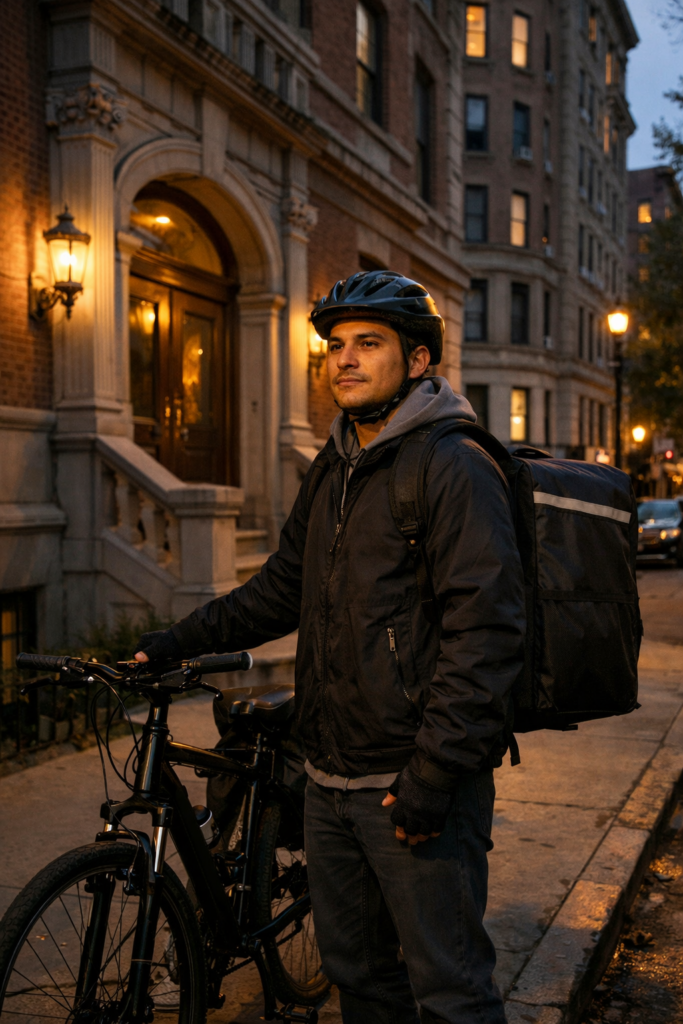
If you live on the Upper West Side, you likely live in one of several common building types:
An elevator building with a doorman or lobby staff
An elevator building without staff
A walk-up
A brownstone or smaller building with stairs
A building where the door can be tricky to access
All of these factors change the effort required for delivery.
A practical tipping baseline for delivery
A strong baseline tip for delivery in NYC is about $5 minimum, even for smaller orders. That’s because the delivery person’s time is valuable even if your meal was inexpensive.
From there, adjust for:
Distance
Order size
Stairs
Weather
Difficulty accessing the building
A typical delivery tip on the Upper West Side often falls in the $6 to $10 range.
Walk-up buildings and stairs
If you live in a walk-up and the delivery person climbs multiple flights, tipping higher is fair. The more stairs, the more effort. It’s that simple.
A good approach:
A small order to a walk-up: $6 to $8
A larger order to a walk-up: $8 to $12
If the weather is bad, increase it. Rain, snow, or icy sidewalks add difficulty and risk.
Elevator buildings and doormen
If you have a doorman or front desk, delivery might be easier if the food is left at the lobby. But many seniors prefer delivery to the apartment door, especially if mobility is a factor. If the delivery person comes to your door, it’s more work and deserves a fair tip.
If the building is easy to access, an elevator building tip might be:
$5 to $7 for smaller orders
$7 to $10 for larger orders
If access is difficult, door codes are confusing, or the elevator requires special entry, tipping higher is considerate.
Cash tip vs app tip
People often ask whether cash is better. Cash can be appreciated because it’s immediate and clear. But app tipping is also normal and acceptable. The most important thing is that the delivery person actually receives the tip. App systems vary, but generally, a tip entered as a tip is intended for the delivery person.
If you have concerns about an app, tipping in cash is a straightforward solution.
Fees that look like tips but aren’t
This is important: many delivery platforms include fees such as “delivery fee” or “service fee.” These are not always tips. They often go to the company or to operating costs. The delivery person may not receive those fees as a tip.
So if you see a delivery fee, do not assume you “already tipped.” If you want the delivery person to be compensated, add a tip separately.
Common Tipping Mistakes Seniors Make
Seniors are not “bad tippers.” In many cases, seniors are some of the most thoughtful tippers because they value routine, relationships, and fairness. The mistakes that happen are usually caused by modern confusion, not by stinginess.
Here are the most common mistakes and how to fix them.
Mistake: Tipping less because you ate early
Eating at five o’clock does not reduce the work. The server still served you. Tip as you normally would for full service. If you receive especially calm, attentive service because the room is quiet, that’s a reason to tip normally or slightly higher, not lower.
Mistake: Tipping on the discounted total without thinking
If you got a senior discount or early bird deal, the server’s effort did not shrink. A good approach is to tip on the pre-discount amount, or at least tip at the higher end of the range to keep your tip fair.
Mistake: Feeling forced by tip screens
Tip screens are not rules. They are prompts. Decide whether the situation is full service, counter service, hybrid service, takeout, or delivery. Tip accordingly. You do not owe a 25% tip for handing a cashier your card for a muffin. You can tip a dollar if you want, or nothing if the service was minimal.
Mistake: Not tipping on delivery because “there was a fee”
Fees are not tips. If you want to tip the delivery person, add a tip.
Mistake: Skipping tips because prices are high
Restaurant prices in NYC have risen. Many people feel sticker shock. But staff wages have not risen in the same way. If you choose to dine out, tipping fairly is part of the cost of dining out. If you’re cutting back, it’s better to dine out less often and tip correctly when you do.
How to Tip Confidently on a Fixed Income
This section matters because it’s real life. Many seniors want to tip well but also need to protect a budget. The solution is not guilt. The solution is a plan.
Use a simple default rule
If you want one rule you can use almost everywhere:
Full table service: aim for 20% pre-tax.
Delivery: aim for $5 to $10 depending on stairs and difficulty.
Takeout pickup: $1 to $5 depending on order size.
Counter service: optional, usually $1 or 5–10% when help was meaningful.
When you have a default, you stop negotiating with yourself at the table.
Budgeting without feeling deprived
If tipping feels heavy, adjust the dining choices, not the tip. Here are practical ways seniors on the Upper West Side often do this:
Choose diners and neighborhood restaurants with simpler menus
Go earlier when specials exist
Skip alcohol and dessert sometimes
Split an entrée if portions are large
Dine out fewer times per week, but tip well when you go
This approach keeps your relationship with local places strong and keeps your habits sustainable.
Keep cash available for simple tipping
A small amount of cash can reduce stress. Even if you pay the check by card, leaving cash for the tip can feel cleaner, especially in diners and casual spots. It also avoids confusion with screens and receipts.
You do not need large bills. Small bills make it easy.
Frequently Asked Questions
Should seniors tip differently in NYC?
No. Tipping is based on the service model and the work done, not your age. Seniors may have different budgets, but the etiquette standard stays the same.
Is it rude to tip less because you ate early?
Yes, it can be. Early dining does not reduce the server’s work. It can feel dismissive if someone assumes early diners should tip less. A fair tip is appreciated at any hour.
Do you tip on senior discounts?
The most respectful approach is to tip based on what the meal would have cost without the discount, or to tip at the higher end of the normal range on the discounted amount.
Do diners expect the same tip as upscale restaurants?
For full table service, yes. Diners still involve real service work. The setting is casual, but the expectation of tipping for table service is the same.
Is cash better than card tipping?
Cash is often appreciated and avoids system confusion, but card tips are also normal. The best method is the one that keeps you consistent and comfortable.
Do I tip if I only ordered coffee?
If you sat at a table and a server kept your coffee coming, yes, tip something. Even a modest tip is a respectful acknowledgment of service. If you ordered coffee at a counter and left, tipping is optional.
Should I tip at deli counters?
If it’s pure counter service and your order is simple, tipping is optional. If staff is helpful, packs a large order, or handles special requests, a small tip is polite.
How much should I tip delivery to a walk-up?
Walk-ups involve extra effort. A common range is $6 to $12 depending on flights, order size, and weather.
What if service was polite but slow?
If the server was kind and attentive, slow service is often a kitchen or staffing issue. Tip fairly. If the server truly ignored you, you can adjust downward.
Is it okay to tip less if prices are already high?
Tipping is part of the cost of dining out in NYC. If prices feel too high, consider eating out less often, choosing simpler meals, or using takeout. Try not to reduce the tip for full service.
What if the restaurant adds an automatic gratuity?
If an automatic gratuity is clearly added, you generally do not need to tip extra unless you want to. If you do add extra, even a small amount is a kind gesture for great service.
What about tipping when I use a gift card?
You still tip based on the meal total, not on how you paid. Gift cards cover the food, not the service.
A Few Quick Scenarios to Make Tipping Feel Easy
Sometimes the best way to feel confident is to picture the moment.
You go to a diner at five. You get a booth. The server brings menus, refills coffee, checks on you once or twice, and brings the bill. You tip about 20%.
You pick up a takeout order from a neighborhood place. The staff member hands you a bag with neatly packed containers, utensils, and sauces. You tip a couple of dollars or about 5–10% depending on size.
You order delivery to an elevator building. The delivery person calls, comes up, and hands you the bag at your door. You tip at least $5, usually closer to $7–$10.
You order delivery to a walk-up in the rain. The delivery person climbs stairs with your food. You tip higher because the effort is higher.
These scenarios cover most of Upper West Side routine dining.

Conclusion: The Calm, Confident Way to Tip on the Upper West Side
The Upper West Side is a neighborhood where routines matter. Early dinners matter. Familiar places matter. And good service relationships matter.
Tipping etiquette in NYC restaurants can feel complicated because the world has added layers: screens, fees, apps, and confusing prompts. But the core remains simple. If someone serves you at the table, tipping is expected and fair. If someone delivers to your home, tipping is expected and should reflect the effort. If you’re at a counter, tipping is optional and should match the help you received.
The goal is not to tip perfectly every time. The goal is to tip confidently, respectfully, and consistently. That’s what makes you a good neighborhood customer, and it’s what keeps the places you enjoy running smoothly.
If you ever feel unsure, return to the simplest question: was this full service, partial service, counter service, takeout, or delivery? Once you answer that, the right tip range becomes obvious.
And the best part is this: when you tip with calm confidence, you can enjoy your early dinner the way it was meant to be enjoyed. The Upper West Side is at its best when life feels steady. Your tipping can feel steady too.