
Traveling with grandkids is one of those life experiences that feels big in the best way. You get the laughter in the hallway, the “Can we go to the pool again?” excitement, and the sweet little moments that happen when everyone is out of their usual routine.
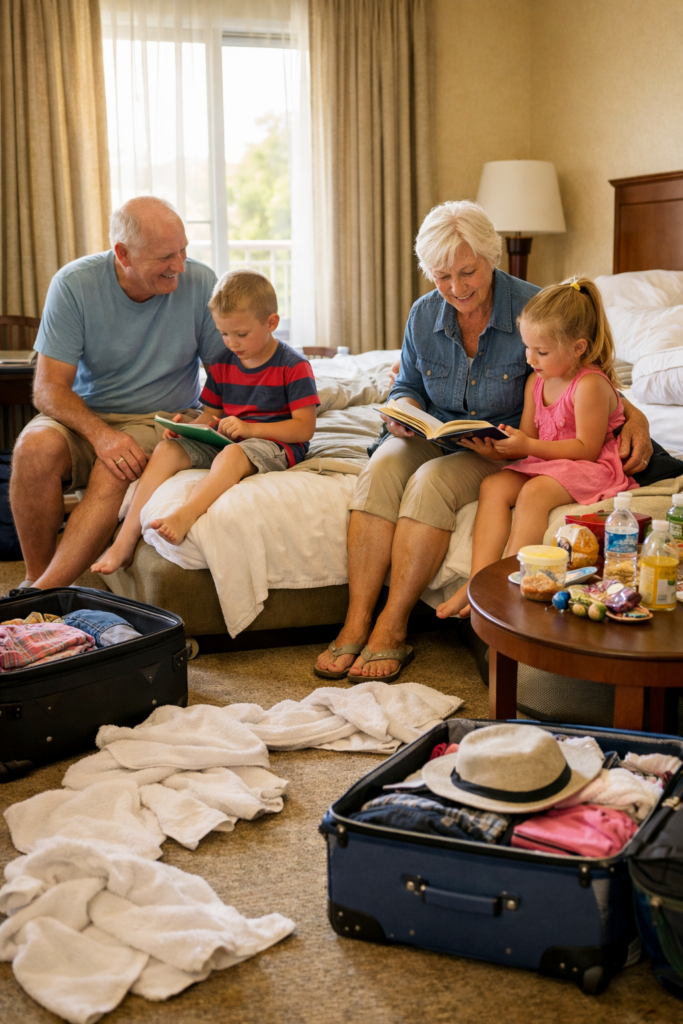
You also get… towels. So many towels.
You get crumbs that appear like magic. You get tiny socks in strange places. You get a room that can go from “we just arrived” to “how did this happen?” in one afternoon.
And then the thought hits: Do we tip more when traveling with kids?
If so, how much? When? For what?
If you’ve ever felt that little swirl of guilt or uncertainty, you’re not alone. Tipping in hotels already has a lot of unwritten rules. Add grandkids to the mix, and it can feel like you’re supposed to know a secret handbook.
There’s no secret handbook. There are just practical, kind guidelines.
This article will help you tip with confidence, keep it fair, and stop second-guessing yourself—especially when your family trip includes extra messes, extra towels, and the occasional room service moment that ends with pancakes on the carpet.
Why Traveling With Grandkids Changes Hotel Tipping Norms
Most adults can keep a hotel room reasonably steady. Not perfect, but stable. You reuse a towel. You throw wrappers away. You don’t smear applesauce on a light switch.
Kids travel differently.
Even the sweetest, most respectful grandchild still adds extra work. It’s not a moral failure. It’s just reality. Children are learning, growing, moving, spilling, forgetting, and living at full speed. That shows up in the room.
Kids create more work, even when they’re well-behaved
“Messy” doesn’t always mean “wild.” A child can be polite and still leave behind:
- Extra trash from snacks and juice boxes
- Wet towels from pool time
- Crumbs in places you didn’t know crumbs could go
- Smudges on mirrors and windows
- Sticker residue, marker dots, or toothpaste streaks
- More laundry demand if there’s an accident or spill
The biggest difference is volume. More people in the room means more everything: more towels, more sheets, more cups, more trash, more footsteps, more time.
Housekeeping is often underpaid and time-pressed
Housekeepers do physically demanding work on a tight schedule. Many have to flip room after room quickly. A “normal” room might be manageable in a set time window, but a family room—especially after a pool day—can easily require extra minutes and extra effort.
Tipping is one of the few ways guests can directly say, “I see the work you did, and I appreciate it.”
Grandparents feel a special responsibility
When you travel with grandkids, you’re not just handling your own comfort. You’re modeling behavior. You’re caring for the group. You might be paying for the room. You might feel like you’re representing your family.
That can turn tipping into an emotional thing instead of a simple thing.
It doesn’t have to be emotional.
A good tipping approach is not about guilt. It’s about fairness, clarity, and the kind of respect you’d want someone to show you if you had a physically demanding job and a tight schedule.
How Hotel Housekeeping Actually Works Behind the Scenes
Understanding housekeeping makes tipping easier. When you know what happens behind the door, your decisions feel less like guessing and more like common sense.
What housekeepers are expected to clean versus what becomes “extra”
A standard room reset usually includes:
- Making the bed
- Replacing used towels
- Emptying trash
- Wiping surfaces
- Basic bathroom cleaning
- Vacuuming or light floor cleaning
- Restocking basic items like toilet paper and soap
When a room becomes “extra,” it usually means:
- More trash than normal
- Food messes that require scrubbing
- Sticky spills that need special attention
- Excess towels that need sorting and hauling
- Sand or dirt that takes longer to vacuum
- Stains that require treatment
- Wet floors that need extra drying time
Kids can create “extra” quickly without meaning to. A single melted popsicle can change the cleaning workload. A bathtub full of wet swimsuits can turn the bathroom floor into a slip hazard. A pile of towels can mean multiple trips to the cart.
Why time per room matters
Most housekeeping teams have a set number of rooms to turn over. That schedule doesn’t pause because a family had a fun day. If a room takes longer, the housekeeper either has to speed up somewhere else or work harder to stay on time.
That’s why tipping for extra mess is less about “paying for damage” and more about acknowledging labor.
Why daily tips are often better than one big tip
Hotels often rotate cleaning staff. The person who cleans your room on Monday might not be the same person on Thursday.
If you tip only at the end, the person who did the hardest day might not be the person who receives your gratitude.
Daily tipping is simpler, more fair, and more likely to reach the right hands.
How Much to Tip Hotel Housekeeping When Traveling With Grandkids
There’s no single number that fits every trip, but there is a reliable way to think about it.
A good tipping approach depends on:
- How many people are in the room
- How messy the day was
- Whether housekeeping is coming daily
- The type of room (suite vs standard)
- Whether you’re requesting extra items
A solid baseline when it’s just adults
Many travelers use a baseline like:
- A few dollars per night in a standard hotel room
- More for larger rooms or higher-end hotels
That baseline is useful because it gives you a starting point.
A simple, practical baseline with grandkids
When grandkids are in the room, especially if you’re using the room heavily, a strong rule of thumb is:
- Tip a little more than you would as adults
- Increase it on high-mess days
Think in ranges, not exact numbers. Your goal is not “the perfect tip.” Your goal is “a fair and kind tip.”
Here’s a practical way to decide:
- Light mess, one grandchild, short stay: tip modestly but consistently
- Regular family mess, multiple kids, daily cleaning: tip more than your adult baseline
- High-mess days (pool, beach, food spills): bump it up for that day
What counts as a “high-mess” day?
These are the classic ones:
- Pool days with wet towels and wet floors
- Beach days with sand everywhere
- Theme park days with snacks and tired kids
- Any day with spills, accidents, or extra laundry
- Any day you request lots of extra supplies
If your room looks like you hosted a tiny festival in there, that’s a high-mess day.
Daily tipping versus end-of-stay tipping
If you can do daily, do daily. It’s cleaner, simpler, and fairer.
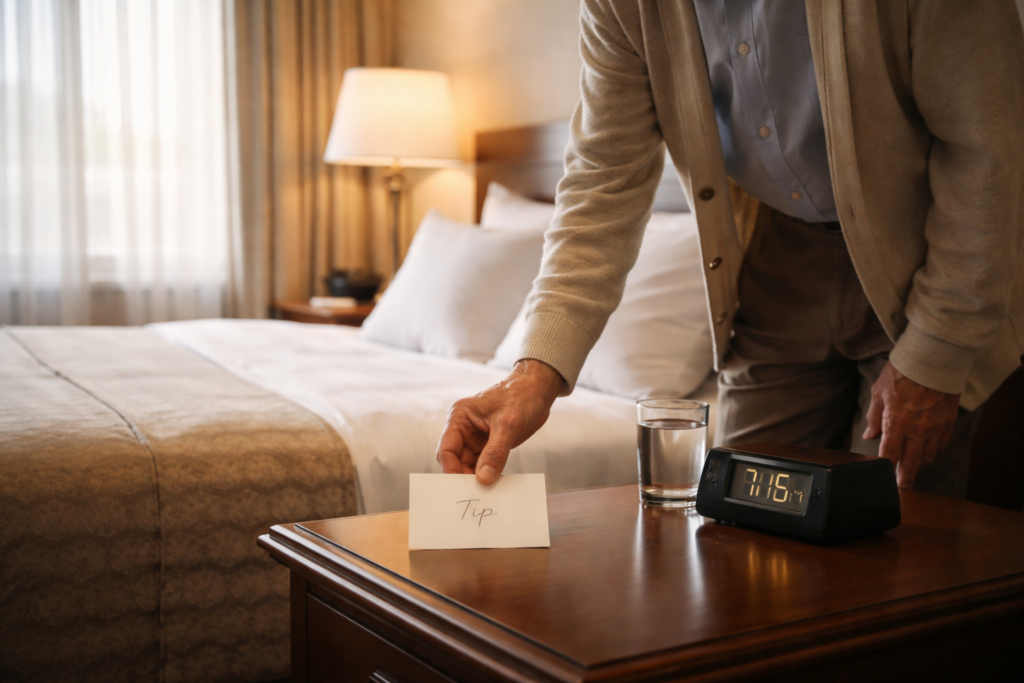
If you can’t do daily, consider leaving tips in a visible way with a short note so it’s clear it’s meant for housekeeping.
The “kind but not excessive” mindset
A lot of grandparents overthink tipping because they don’t want to look rude or feel cheap.
But kindness doesn’t require you to overspend. It requires you to be thoughtful and consistent.
A fair tip isn’t about proving something. It’s about acknowledging the extra workload you know your family created.
How to Leave the Tip So It Actually Reaches Housekeeping
This matters more than many people realize.
Cash is still the most reliable option
Many housekeeping teams do not have a clean digital tipping system. If you want your tip to actually reach the person cleaning, cash is usually best.
Make it clear it’s for housekeeping
You can place cash:
- On a desk or nightstand
- Near a small note that says “Housekeeping, thank you!”
- In a labeled envelope if you have one
A lot of travelers worry about leaving cash “out.” In many hotels, this is common and understood. The key is clarity.
Consider a short thank-you note
A note is not a replacement for a tip, but it adds warmth. It makes the tip feel personal instead of transactional.
It also helps avoid confusion if cash is left in the room.
A simple message like:
“Thank you for taking care of us this week.”
That’s enough.
Extra Towels, Bedding, and Supplies: Should You Tip?
This is one of the biggest questions for family travel because kids cause legitimate towel needs.
The good news is that requesting extra towels isn’t automatically a tipping event. Hotels expect families to need more.
But the tipping question depends on how the request is handled.
When extra towels are reasonable
Extra towels make sense when:
- Kids are swimming
- You’re staying multiple days
- There are more people than the standard towel count
- Someone has long hair and needs more towels
- There’s an accident or spill
If you’re requesting extra towels because you’re traveling with kids, that’s normal.
When extra requests become “extra work”
It becomes extra work when:
- You request towels multiple times per day
- You request large quantities repeatedly
- You request towels late at night
- You request towels plus other items plus special setups
One request is normal. Multiple requests can become a workload.
Who are you tipping for extra towels?
Sometimes towels come from:
- Housekeeping
- A runner
- Front desk staff who coordinate delivery
If someone brings towels directly to your door, that’s a service moment. A small tip is a kind gesture—especially if it’s late or you requested a lot.
A practical approach that keeps it simple
- If you make a normal request, and housekeeping handles it during cleaning, tip through housekeeping as usual
- If someone makes a special trip to your room with items, consider a small tip as a thank-you
- If you made several requests over the stay, consider increasing housekeeping tips overall
This avoids turning every small request into a stressful tipping math problem.
Room Service Tipping When Traveling With Kids
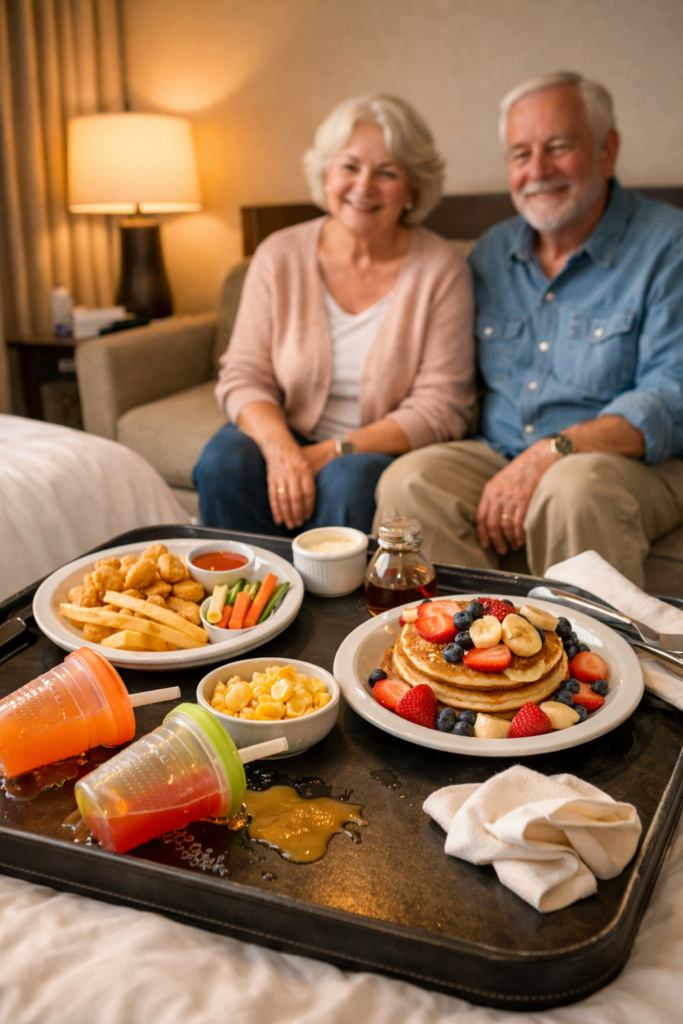
Room service is one of those things that feels like a treat on a family trip. It can also feel like the fastest way to create a mess.
The main room service tipping question is:
Did the hotel already include a service charge or gratuity?
Step one: check the bill carefully
Room service charges can include:
- A delivery fee
- A service charge
- A built-in gratuity
Sometimes these are clearly labeled. Sometimes they’re vague.
If gratuity is already included, you’re not obligated to add more—though you can if you want.
If gratuity is not included, tipping is generally expected.
Extra considerations with kids
When you travel with grandkids, room service can involve:
- More food items
- More drink spills
- More trash and packaging
- A tray that looks like a tornado visited
If you leave a heavy mess, consider tipping a little extra—not because you “have to,” but because you know someone is handling the aftermath.
One small habit that helps everyone
If you can, do this before the tray is collected:
- Gather trash
- Put leftover food neatly on the tray
- Wipe up obvious spills if possible
- Keep the room from looking chaotic
You don’t need to deep clean. You’re just making it easier for the staff.
That small step often matters as much as the tip.
Public Areas: Pools, Breakfast, and Common Spaces
A lot of family travel mess doesn’t happen in the room. It happens in shared spaces.
Tipping is not always expected in these areas, but manners matter.
Pools
Common pool-related family issues:
- Piles of wet towels
- Snack wrappers left behind
- Water tracked everywhere
Even if tipping isn’t part of pool etiquette at your hotel, respect is. The best “tip” in pool areas is to leave it tidy.
Breakfast areas
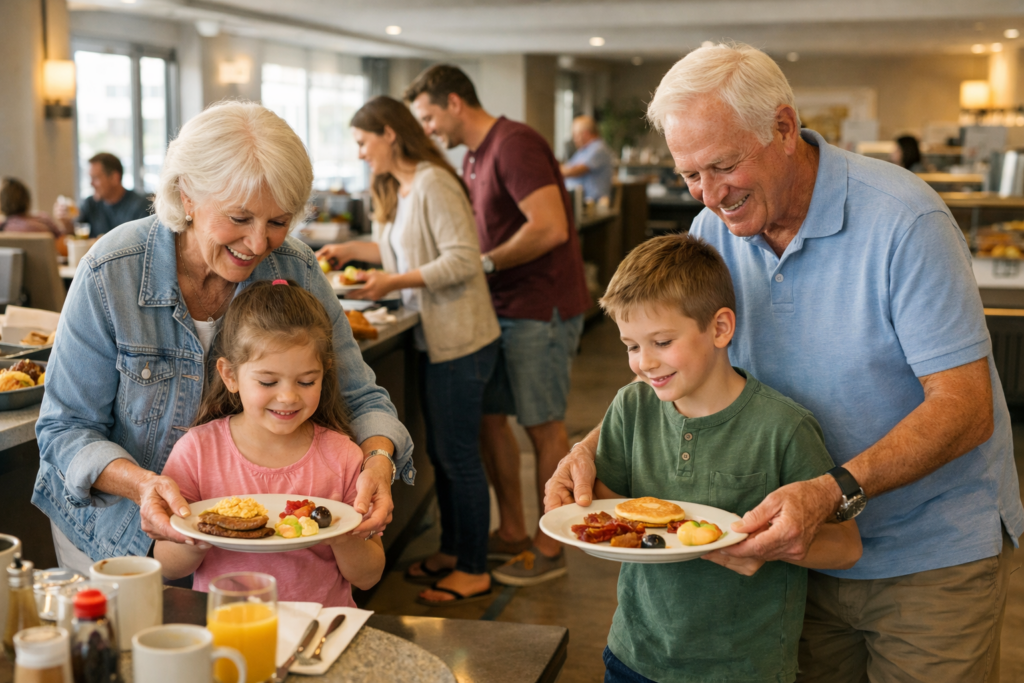
Buffet breakfasts are wonderful for grandkids and sometimes a little chaotic.
Here’s what helps:
- Stack plates if there’s a clear place to do it
- Gather trash
- Wipe obvious spills if you can
- Teach kids to say thank you
Many hotels have staff constantly clearing tables. Your goal is to not leave your table as a disaster zone.
International Travel: Tipping Rules Change
If your family travel includes international destinations, tipping can shift dramatically.
In some places, tipping is minimal or not expected. In others, service charges are already included.
The most important thing is to avoid assuming your home rules apply everywhere.
A simple approach:
- Look at what the hotel expects locally
- Ask the front desk in a polite way if you’re unsure
- Follow the local norm rather than overcompensating out of anxiety
When you travel internationally with grandkids, it’s especially easy to feel pressure because you want to be respectful. Respect is good. But respect doesn’t always mean tipping the same way you would at home.
Teaching Grandkids Good Travel Manners Through Tipping
This is one of the hidden gifts of traveling with grandkids: you get to shape how they treat people.
You don’t need to make tipping a lecture. You can make it a simple values moment.
Explain it in a way kids understand
Kids don’t need a speech about wage structures. They can understand:
- “Someone works hard to clean our room.”
- “We’re thankful, so we leave something to say thank you.”
- “We try to leave the room nice so their job is easier.”
Give kids a role
If the grandkids are old enough, they can:
- Throw away trash before leaving the room
- Put towels in one pile
- Help gather stray toys
- Leave a short note like “Thank you!”
It turns travel etiquette into something positive instead of something tense.
The best lesson is the tone you use
If you tip with calm confidence, kids learn that gratitude is normal.
If you tip while stressed and guilty, kids learn that money and manners are anxiety.
You want the first one.
Common Mistakes Grandparents Make (and How to Avoid Them)
Even very thoughtful people make the same mistakes because hotel tipping is confusing.
Tipping only at checkout
This is common, but it can miss the person who did the work. Daily is usually better.
Assuming every fee is a tip
Not all service charges go directly to staff. Some are administrative. Always read the bill and labels carefully.
Feeling embarrassed to ask
If you’re unsure, it’s okay to ask the front desk how their tipping works. You’re not being difficult. You’re being respectful.
Over-tipping out of guilt
Kindness is great. Panic tipping is not necessary.
You can be fair without being extreme.
Quick Reference Tipping Guide for Traveling With Grandkids
Use this as a practical “no overthinking” guide.
Housekeeping (room cleaning)
- Tip daily when possible
- Tip more on high-mess days
- Increase if the room is large or heavily used
Extra towel delivery or special item runs
- If someone makes a dedicated trip to your door, a small thank-you tip is a nice gesture
- If towels are simply restocked during normal cleaning, it’s covered by housekeeping tipping
Room service
- First check whether gratuity is included
- Tip if it isn’t included
- Consider a little extra if the cleanup is unusually heavy
Bell staff (if you use them)
- Tip per bag if they handle luggage and escort you
Front desk
- Tipping is not usually expected for routine help
- For exceptional help over multiple interactions, gratitude can be shown in many ways, including a note or a kind verbal thank-you
How to Travel With Confidence, Not Guilt
Here’s the truth: most hotel staff do not expect perfect guests. They expect human beings.
Traveling with grandkids is loud, joyful, busy, sometimes messy, and deeply meaningful. You don’t need to apologize for taking up space in the world.
You do want to be fair. You do want to be kind. You do want to treat workers with respect.
When you tip thoughtfully and keep your room reasonably tidy, you’re already doing more than many guests.
Tipping doesn’t have to be a moral test. It can be a simple habit of gratitude.
Leave the room in decent shape. Tip in a way that reflects the extra work. Teach your grandkids to say thank you. Enjoy your trip.
The memories are the point.
FAQ: Traveling With Grandkids and Hotel Tipping
Do I need to tip more if my grandkids make a mess?
If the room requires extra cleaning—more trash, food spills, extra towels—tipping more is a fair and kind choice.
Should I tip housekeeping every day or at the end?
Every day is usually better because housekeeping staff can rotate. Daily tips are more likely to reach the right person.
How much should I tip for extra towels?
If towels are restocked during normal cleaning, it’s part of housekeeping tipping. If someone makes a special trip to deliver items, a small thank-you tip is a nice gesture.
What if I don’t carry cash?
Plan ahead by getting small bills before your trip. If that’s not possible, consider leaving a larger tip when you can, along with a note.
Is tipping expected at all-inclusive resorts?
Often there are service charges built in, but extra tipping may still be appreciated in some places. Check what’s included and follow local norms.
Do hotel service charges go to staff?
Not always. Some service charges are administrative. If you want to be sure the staff gets it, cash tips are usually the most direct.
Should I tip if the kids spill food?
If it’s a small spill you clean up, your normal housekeeping tip is fine. If it becomes a bigger cleanup, it’s considerate to increase that day’s tip.
Is tipping different when traveling internationally?
Yes. In some places tipping is minimal or not expected. Always check local customs rather than assuming US norms.
Can I leave a thank-you note instead of cash?
A note is lovely, but it usually shouldn’t replace a tip. The best combo is a small tip plus a short note.
How do I teach kids about tipping without making it awkward?
Keep it simple. Explain that someone works hard to help us, so we show appreciation. Give kids a small role like tidying or writing “thank you.”
What if I forget to tip one day?
It happens. You can add a little extra the next day, or leave a larger tip with a note at the end.