You’re out to dinner on vacation. Everyone’s relaxed. The food is good. You pay the bill, add a generous tip, and leave feeling like you did the right thing.
Then someone in your group says, “Wait… didn’t they already add something?”
You look again and see it: “18% service charge” or “gratuity included.”
Suddenly that warm, polite moment turns into an annoying question: Did we tip twice?
If you’ve ever felt that little jolt of uncertainty at the bottom of a receipt, you’re not alone. Service charges, auto-gratuity, suggested tips on a payment screen, “fees,” “surcharges,” and “hospitality charges” have made bills harder to read—especially when you’re traveling, dining with family, or managing a group.
This guide is built for seniors and family travelers who want to feel confident, avoid awkward moments, and keep spending under control. You’ll learn how to spot what’s already included, what isn’t, and how to tip correctly—without overpaying or feeling embarrassed.
The goal is simple: be kind, be fair, and never tip twice by accident.
Service Charge vs Tip: The Simple Difference
Let’s make this easy.
A tip is money you choose to add.
A service charge is money the business adds.
That’s the heart of it.
What a tip is
A tip is a voluntary amount you decide to give based on service. It’s a “thank you,” and it’s flexible. You can tip more for great service, tip less for poor service, or choose not to tip in situations where it doesn’t apply.
Typical tip situations:
- Sit-down restaurants
- Bars
- Haircuts and salon services
- Taxis and rideshares
- Tour guides (often)
What a service charge is
A service charge is an amount added to your bill by the business. It can be a percentage or a flat fee. It might be called:
- Service charge
- Service fee
- Hospitality charge
- Surcharge
- Administrative fee
- Gratuity (sometimes)
- Auto-gratuity (commonly)
The key detail: a service charge is not automatically the same thing as a tip, even if it looks like one.
Sometimes it functions like a tip. Sometimes it does not. Sometimes it goes partly to staff. Sometimes it goes to the business. Sometimes it replaces tipping; sometimes it doesn’t.
That’s why people get caught.
What Is Auto-Gratuity?
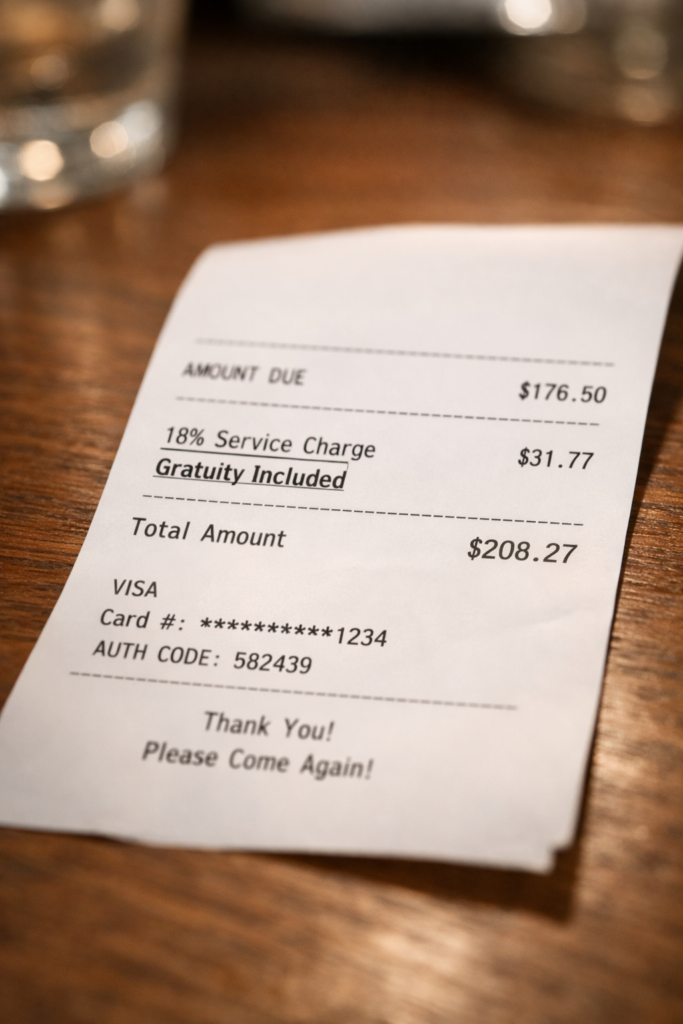
Auto-gratuity is a tip that gets added automatically. It’s usually shown as a percentage, often in the range many people already tip.
Common auto-gratuity percentages:
- 18%
- 20%
- 22%
Auto-gratuity is especially common for:
- Large groups (often 6+ people)
- Busy tourist areas
- Some restaurants that choose to add it to every bill
- Special events, banquets, or private dining
Auto-gratuity is meant to reduce confusion for staff and protect them from getting stiffed, especially when groups split checks, people forget, or someone thinks “the other person tipped.”
The problem is not the idea. The problem is how it shows up.
A receipt can include:
- Auto-gratuity already added
…and still show: - A tip line
…and still show: - Suggested tip amounts
So you see three different “tip-looking” things and wonder which one is real.
“Is Gratuity Included?” How to Tell at a Glance
When you’re tired, traveling, or chatting with family, you want a fast method.
Here’s the easiest approach: scan the bill like you’re looking for a hidden fee.
Where to look first
Check the bottom portion of the receipt, especially:
- Just above the final total
- Near the subtotal section
- In small print below the payment area
- Near the tip suggestions
Also check:
- The menu footer (small print)
- A sign at the host stand
- A notice on the table
- The payment tablet screen
Words that strongly suggest it’s already included
If you see any of these, slow down and verify:
- “Gratuity included”
- “Automatic gratuity”
- “Auto-gratuity”
- “A gratuity of __% has been added”
- “Service charge __%”
Words that mean “this might not be a tip”
These phrases often mean the money may not go directly to your server:
- “Service fee”
- “Administrative fee”
- “Kitchen fee”
- “Hospitality fee”
- “Operations fee”
- “Employee benefits charge”
- “Wellness charge”
These can be real business policies, but they are not always the same as a tip. The bill might even say something like “this is not a gratuity.”
The biggest modern trap: the “suggested tip” math
Many receipts and payment screens calculate suggested tips using the wrong base:
- They calculate on the total after fees
instead of: - The subtotal before fees
If an 18% service charge is added, then the screen suggests 20% on the new total, you can accidentally add a tip on top of an already-added charge.
It’s not always intentional. Sometimes it’s just how the software works. But the result is the same: you pay more than you meant to.
A simple confidence check
Ask yourself:
- Is there already a line that adds money as a percent?
- Does the receipt mention gratuity or service charge?
- Is the suggested tip section still present?
If the answer is yes, you’re in the danger zone for double tipping.
Should You Tip on a Service Charge?

This is the question everyone really wants answered.
The honest answer: it depends on what the service charge is doing.
The helpful answer: most of the time, you should not add a full additional tip if a clear gratuity/auto-gratuity is already added.
Here’s how to decide quickly.
Situations where an extra tip is usually not needed
If the receipt clearly says something like:
- “Gratuity included”
- “Auto-gratuity applied”
- “Service charge is distributed to service staff”
In those cases, tipping again at full percentage usually means you’re tipping twice.
Many people still add a little extra if service was outstanding. That can be kind, but it should be a choice—not an accident.
Situations where a small extra tip can make sense
Sometimes the receipt or menu explains that:
- the service charge helps cover benefits or wages
- it is not fully paid out as tips
- it is an operations fee
If you suspect the staff is not receiving the service charge the way a tip normally works, and service was good, a small additional tip can be reasonable.
A practical approach:
- Add a smaller extra amount if you want, rather than another full percentage
- Consider giving it in cash if you want it to go to a specific person
- Keep it simple so you feel good about it
Situations where you should pause and ask
If the bill uses vague language and you’re not sure:
- “service fee”
- “hospitality charge”
- “admin fee”
- “surcharge”
That’s your cue to ask one calm question before paying.
Why Double Tipping Happens So Often (Especially When Traveling)
When you travel, your brain is doing a lot at once:
- reading an unfamiliar menu
- managing timing
- keeping up with family
- dealing with noise and distractions
- making sure everyone is happy
That’s exactly when confusing bills win.
Here are the most common travel scenarios where people tip twice.
Restaurants in tourist areas
Tourist restaurants often use auto-gratuity to protect staff when visitors aren’t sure about tipping customs. That can be helpful. But it also means you must read the receipt carefully.
Common pattern:
- auto-gratuity already added
- tip line still present
- payment tablet asks for tip again
Hotels and resorts
Hotels can have layers of charges:
- resort or destination fees
- service charges on certain services
- room service fees
- spa service charges
Sometimes the tip for certain services is already built in. Sometimes it’s not. A hotel bill can be the perfect place for quiet double tipping.
Cruises
Cruises are a prime “tipping confusion” zone because they often add:
- daily gratuities per person
and then: - specialty dining tips or service charges
and then: - bar gratuities
and then: - excursion tipping norms
It is very easy to think you still need to tip again everywhere, even when many gratuities are already included.
Tours, shuttles, and transfers
Tour operators sometimes bundle service charges into the booking cost. Other times it’s expected separately. Payment screens at the end can push suggested tip amounts even when you paid a service fee earlier.
Counter service with a tip screen
Even in places where tipping never used to be part of the experience, a tablet can now ask for 20%, 25%, 30%. That doesn’t mean you must tip. It’s just a prompt.
When you’re traveling, you may feel extra pressure to be polite. That’s when people click quickly and overpay.
Why This Hits Seniors and Families Hardest

Older travelers and family groups tend to be generous. That’s a good quality. But it can also make you an easy target for accidental overspending.
Here’s why it happens more often for seniors and families:
Politeness pressure
Many seniors grew up with a strong “do the right thing” mindset. If there’s even a chance you under-tipped, it can feel uncomfortable.
So the brain says: “Better to add more.”
Group distraction
When you’re paying for a family meal, your attention is split:
- “Did everyone get what they ordered?”
- “Did we cover the grandkids?”
- “Did we split the appetizers?”
- “Who’s using what card?”
That’s the perfect moment to miss a small line that says “service charge included.”
Desire to avoid awkwardness
No one wants to ask questions at the table, especially with younger family watching. But the truth is: a calm question about the receipt is normal now. You’re not being difficult. You’re being smart.
Higher total bills
Family travel meals and group activities often cost more. A mistake on a $40 bill stings a little. A mistake on a $240 bill stings a lot.
That’s money that could have gone to another experience, another excursion, or an extra night’s treat for the family.
How to Ask Without Feeling Awkward
You don’t need a speech. You don’t need to sound suspicious. You just need one polite sentence.
Good options that feel natural:
- “Quick question—does the service charge replace the tip?”
- “Just confirming: is gratuity already included?”
- “Is this service charge for the staff, or is tipping still separate?”
Most staff will answer clearly. They get asked all the time now.
If you want the smoothest delivery, say it like you’re asking for help reading the receipt, not accusing anyone of hiding fees. Tone matters more than words.
If the staff says, “Yes, it’s included,” you can relax and pay with confidence.
If they say, “That fee isn’t a tip,” you can decide what you want to do—without guessing.
The Receipt Trap: When the Tip Screen Still Asks for a Tip
This is where people lose money.
A payment tablet may show:
- “Add a tip”
- big buttons with 20%, 25%, 30%
- a small “custom” option
Even if gratuity was already included.
Why? Because many systems show a tip prompt by default. The business may not have customized it perfectly, or they may want to leave room for extra tipping.
That doesn’t mean you must add more.
Here’s what to do:
- Look back at the printed receipt or itemized screen
- Find any service charge or gratuity line
- Decide whether you want to add extra
If gratuity is already included and you’re happy with it, it’s perfectly fine to choose:
- “No tip”
- “Custom” and enter $0
- Or skip the extra tip line if possible
This is a money-confidence moment. You’re not being rude. You’re paying what was asked.
Real-World Examples You Can Copy in Your Head
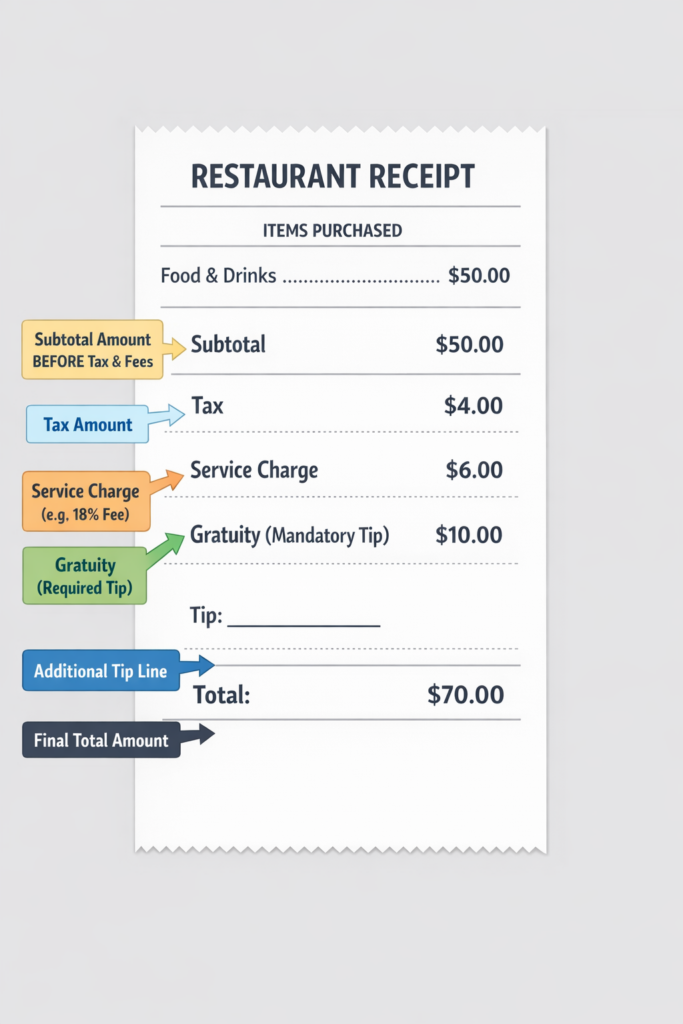
Examples make this stick. Here are realistic scenarios and what to do.
Restaurant bill with auto-gratuity
You’re dining with family, party of eight. The receipt shows:
- Subtotal
- Tax
- “20% gratuity”
- Total
- Tip line still printed
What this usually means:
- The tip has already been added.
What to do:
- If service was normal or good, you can sign and leave without adding another full tip.
- If service was excellent and you want to add something, add a small extra amount on the tip line, not another full percentage.
A simple mental approach:
- Think of the auto-gratuity as “the tip.”
- Anything extra is a bonus you choose.
Restaurant bill with “service charge” but unclear wording
You see:
- “Service charge 18%”
but no line that says where it goes.
What this might mean:
- It could be the tip.
- It could be a business fee.
- It could be shared across staff.
- It could be partially retained.
What to do:
- Ask one question: “Does the service charge replace the tip?”
Then decide:
- If yes, you’re done.
- If no, tip as you normally would, but consider tipping based on subtotal rather than total including fees.
Tip suggestions calculated after fees
You see:
- Subtotal: $100
- Service charge: $18
- Tax: $10
- Total: $128
Then suggested tips: - 20%: $25.60
- 25%: $32.00
Those tip suggestions are likely calculated from the total, not the subtotal. If you add that tip, you could be tipping on top of fees and tax.
What to do:
- If gratuity is already included, consider no extra tip or a small extra.
- If gratuity is not included, tip based on the subtotal (in this example, 20% of $100 is $20).
Hotel room service
You order room service and the receipt shows:
- “Service charge”
- “Delivery charge”
- Tip line
Room service commonly includes a service charge. Sometimes that replaces tipping. Sometimes the staff receives part of it. Sometimes people add extra.
What to do:
- If the service charge is clearly described as gratuity, no need to tip again unless you want to.
- If it’s vague, a small additional tip is a reasonable choice if you want to be generous, especially if someone delivered to your room.
Cruise gratuities
Your cruise account includes daily gratuities for each passenger. At the bar, your drink receipt also includes an added gratuity. At dinner, specialty dining might add another service charge.
What to do:
- Treat each setting separately.
- If gratuity is already added on a bar receipt, there is no need to add another full tip unless you choose.
- If you’re unsure, ask once on the ship. Staff are used to the question.
A Senior-Friendly “Don’t Get Burned” Checklist
When you’re ready to pay, run this quick checklist:
- Scan for a line that includes a percentage added automatically
- Look for the words “gratuity,” “auto-gratuity,” “service charge,” or “fee”
- If there’s already a percent-based add-on, pause before adding a new tip
- If the payment screen asks for a tip, don’t assume it means you should
- If wording is unclear, ask one calm question
- If you choose to tip extra, make it intentional and modest
This is not about being stingy. It’s about paying the right amount and staying in control.
What to Do When Service Was Bad and Auto-Gratuity Was Added
This can feel uncomfortable: you had poor service, but the tip was added automatically.
Here’s the calm truth:
- Auto-gratuity is a policy, like a posted price.
- In many places it is treated as a charge, not a voluntary tip.
What you can do:
- Speak to a manager politely and explain the issue
- Ask if the gratuity can be adjusted given the situation
- Keep your tone calm and factual
- Focus on the experience, not the person
Sometimes they will adjust it. Sometimes they won’t. But asking politely is reasonable, especially if something was clearly wrong.
If you don’t want confrontation on vacation, you can also choose a simpler option:
- Pay it, note it mentally, and skip returning to that business
Your peace matters too.
Special Situations That Confuse People
A few scenarios come up a lot for travelers and older readers.
All-inclusive resorts
“All-inclusive” can mean many different things. Some include gratuities. Some don’t. Some include gratuities for certain staff but not others.
What to do:
- Ask at check-in: “Are gratuities included in the package?”
- If you plan to tip, consider small cash tips for staff who help you directly
Banquets, weddings, and group events
Event contracts often include:
- service charge
- gratuity
- staffing fee
- admin fee
Some of those go to staff. Some don’t.
What to do:
- Ask the organizer or venue: “Is staff gratuity included, or is tipping separate?”
- If you’re a guest, you usually don’t need to tip unless there’s a special reason
Spas
Many spas add an automatic gratuity. Then the payment screen asks for more.
What to do:
- Check for “gratuity included” on the invoice
- If included, you can decline the extra tip prompt without guilt
Takeout and counter service
Tip screens show up everywhere now. That doesn’t mean the expectation is the same as sit-down dining.
A reasonable approach:
- Tip for genuinely extra service, complicated orders, or places you love
- Feel no pressure to tip heavily for a basic pickup order
The Confidence Rule: Never Tip Twice Again

Here’s the rule you can carry anywhere, even when you’re tired and traveling:
If money is already added automatically, don’t add another full tip until you understand what that charge is.
That’s it.
You can still be generous. You can still reward great service. You can still hand someone a few dollars because they went above and beyond.
But you do it on purpose, not by accident.
This rule protects your budget and your dignity. It keeps you from that nagging feeling later when you wonder if you got it wrong.
A Calm, Practical Way to Be Generous Without Overpaying
Some people want to avoid double tipping, but still want to feel kind. That’s a great goal.
Here are simple ways to do that intentionally:
- If auto-gratuity is already included, leave a small extra cash amount when service was excellent
- Tip individuals who provided personal help (a bag carried, a thoughtful check-in, a special accommodation)
- Write a kind note on the receipt if someone made your day easier
- Thank staff clearly and warmly—kind words matter
Generosity isn’t only a number. It’s a choice made with awareness.
FAQ
What is the difference between a service charge and a tip?
A tip is voluntary and chosen by you. A service charge is added by the business. Some service charges function like tips, but not all do.
Is gratuity included when there is a service charge?
Sometimes yes, sometimes no. Look for wording that says “gratuity included” or ask if the service charge replaces the tip.
Should I tip if there is an 18% service charge?
If the 18% is clearly presented as gratuity or auto-gratuity, an additional full tip usually means double tipping. If it’s unclear, ask what the charge is for.
Does a service charge always go to the server?
Not always. Some places share it across staff or use it for operations. The bill or menu sometimes explains where it goes.
What is auto-gratuity at restaurants?
It’s a tip added automatically, often for large groups or in certain locations. It’s typically 18–22%.
Why do restaurants still ask for a tip after adding auto-gratuity?
Often it’s because payment systems show a default tip screen or the receipt format includes a tip line automatically. It can also leave room for extra tipping.
Should I tip on top of auto-gratuity for great service?
You can, but it should be a choice. Many people add a small extra amount rather than another full percentage.
How do I politely ask if gratuity is included?
Try: “Just confirming, does the service charge replace the tip?” It’s simple and normal to ask.
How does tipping work on cruises with daily gratuities?
Many cruises add daily gratuities automatically, and some receipts (like bars) may include additional gratuity too. Check each receipt and avoid tipping twice unless you mean to.
Do hotels include gratuity in resort fees?
Resort fees usually cover amenities, not tips. Some hotel services (like room service or spas) may add a service charge. Always check the itemized receipt.
What should I do if I already tipped twice?
If you notice immediately, politely ask if the second tip can be adjusted. If it’s later, consider it a learning moment and use the checklist next time.
Final Takeaway
You don’t need to become an expert in billing language to protect yourself. You just need one habit: scan for auto-added charges before adding a tip.
That habit gives you money confidence. It keeps family travel smoother. It removes that end-of-meal uncertainty. And it lets you be generous on your terms.
If you’d like, I can also create a one-page print-friendly cheat sheet version of this article for seniors to keep in a wallet or travel folder.