
Airports can feel like a different world, especially when you’re a senior traveler trying to do everything “the right way.” LaGuardia can be busy, loud, and fast-moving. Add bags, mobility needs, and time pressure, and tipping becomes one more thing to worry about.
Here’s the good news: airport tipping is not mysterious once you make it service-based.
A simple rule handles almost everything:
If they did real, hands-on help that saved you effort, time, or stress → tip.
If they only gave directions or did their normal job behind a counter → usually no tip.
This guide is built to remove the guesswork for seniors flying from LaGuardia. You’ll get a clear tipping table, the “who’s who” of airport helpers, and practical tips for common situations like curbside check-in, skycaps, and wheelchair assistance.
The One-Page Rule: “If They Do X → Tip Y”
Use this as your quick answer. It’s designed for real-life airport moments, not perfect etiquette debates.
Quick tipping table for LGA (senior-friendly)
| If they do this… | Typical tip | Notes for seniors |
|---|---|---|
| Skycap checks bags curbside (simple drop-off) | $2–$3 per bag | More if bags are heavy or you have several |
| Skycap handles everything (bags + paperwork + problem-solving) | $5–$10 total | Tip toward the higher end if they truly “managed the moment” |
| Skycap helps you from car to airline counter with bags | $5–$10 total | Think “portering,” not just tagging |
| Wheelchair push for a short distance (curb to desk, or desk to nearby area) | $3–$5 | More if they’re careful, patient, and helpful |
| Wheelchair escort through a full sequence (check-in to security to gate) | $5–$10 | Add more if it’s slow, crowded, or they handle stops smoothly |
| Wheelchair help for a long trip with extra stops (bathroom break, food stop, gate changes) | $10–$20 | Only if they truly provided extended assistance |
| Help at baggage claim (finding bags, lifting, walking you out) | $5–$10 | Especially if they lift or carry |
| Someone only points or answers a quick question | $0 | A warm thank-you is enough |
| Airline counter agent checks you in | $0 | They’re doing their standard role |
| TSA agents or security staff | $0 | Tips are not expected |
| Gate agent help with seats/boarding | $0 | Not a tipping role |
The “stress test” question:
If you imagine doing the exact same moment without them, would it have been physically hard, risky, or stressful? If yes, tipping makes sense.
Understanding Who Helps Seniors at LGA
At LaGuardia, you may interact with several different types of helpers in the same trip. Some are clearly tip-based. Others are not. The confusion often comes from the fact that they can all wear uniforms, look official, and move with authority.
Skycaps
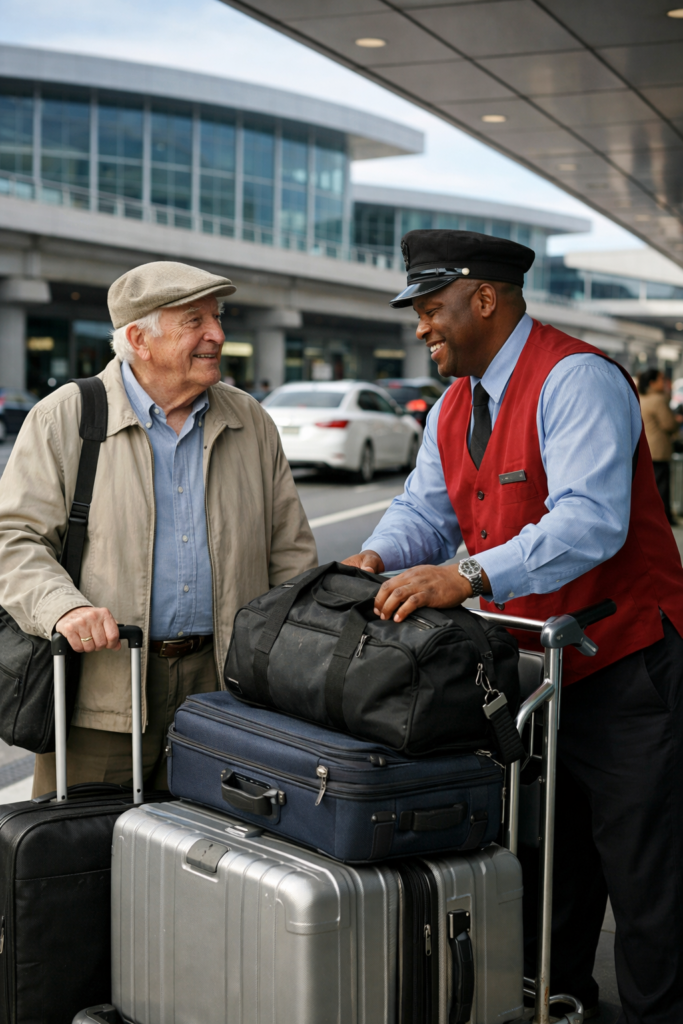
Skycaps are the classic “airport helpers” most people associate with tips. They usually work near curbside areas or near check-in zones. Their main work is handling luggage and sometimes helping with check-in processes.
Typical skycap help includes:
- Taking bags from you (or your car)
- Tagging and checking bags
- Printing boarding passes (sometimes)
- Giving basic guidance on where to go next
A skycap tip is common because it’s hands-on help. It’s similar to a porter or bellhop role.
Wheelchair attendants
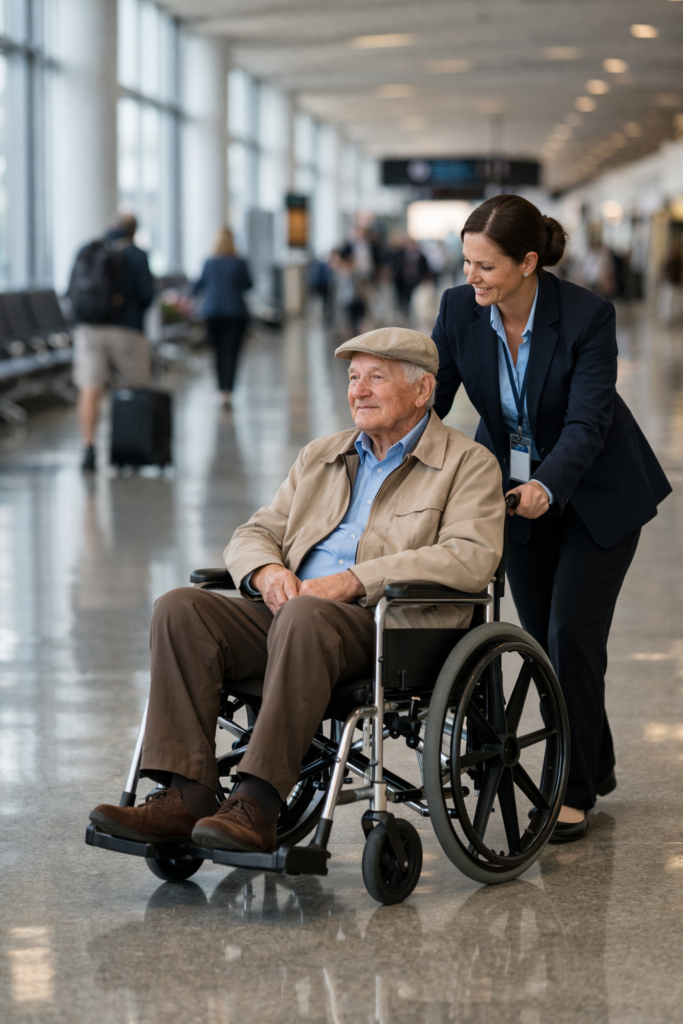
Wheelchair attendants help passengers who requested mobility assistance. They may push the chair, guide you through the terminal, and sometimes help you navigate busy areas.
Wheelchair assistance can be:
- Short, simple transfers
- Full assistance from check-in through security to the gate
- Help during connections
- Help at arrival to baggage claim and the exit
Tipping is common because this is personal, physical assistance. But it is still voluntary. You’re not “required” to tip.
Airline employees
Airline employees at desks and gates are doing standard duties. Even if they are extremely helpful, tipping is not typical.
Examples:
- Check-in counter agent
- Gate agent
- Customer service desk agent (airline desk)
A sincere thank-you matters. If you want to show appreciation beyond that, a compliment to their supervisor or airline support channel is often more meaningful than cash.
Security and TSA
Security staff and TSA are not tip roles. It can also create discomfort to offer tips in security contexts. Keep it simple and respectful.
Skycap Tipping at LaGuardia: What Seniors Should Know
If you only learn one airport tipping rule, let it be this:
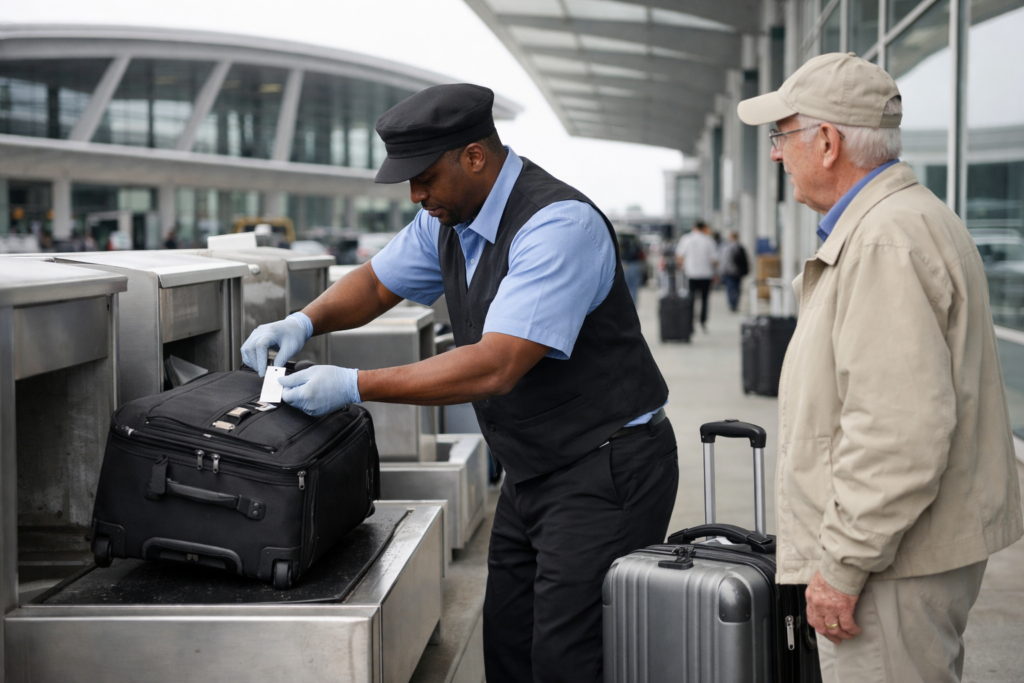
Skycaps are tipped for handling luggage and saving you effort.
The more bags, weight, complexity, and time involved, the more you consider tipping.
What skycaps actually do (and why it matters)
Some seniors assume skycaps “just stand there.” In reality, when it’s busy, their job can be physically demanding and time-sensitive.
A skycap may:
- Lift and move multiple bags quickly
- Deal with bag tags and fragile items
- Handle luggage carts in crowded curb areas
- Help you keep your place and calm when traffic is hectic
- Reduce your physical strain and fall risk
For seniors, the value is often not just the luggage. It’s also the stability, pacing, and confidence they bring to a chaotic area.
Typical skycap tip ranges that feel fair
A simple way to decide:
- Per bag is best for straightforward curbside bag checking
- Flat tip is best if the skycap did more than “scan and tag”
Practical ranges:
- A couple of bags, simple check-in: $2–$3 per bag
- Several bags or heavier luggage: $3–$5 per bag
- A skycap who truly “handles the whole situation”: $5–$10 total
- A skycap who helps you significantly beyond normal (big family load, medical gear, extra problem-solving): $10–$20 total if it was genuinely substantial
When seniors should tip more
Tip more when the help is clearly more than the basic task:
- You have heavy luggage that would be risky to lift
- You move slowly and they patiently pace with you
- They help you reorganize bags, manage tags, or solve a snag
- They keep you safe in a crowded curbside area
- They treat you with real respect and care, not rushing or scolding
This is not about “buying kindness.” It’s about recognizing true assistance.
When a skycap tip is optional or not necessary
If the “help” is minimal, a tip is not mandatory.
- They point you to a sign
- They answer one question without handling luggage
- They don’t actually touch bags or provide service
A warm thank-you can be the right choice. Seniors should never feel forced.
A senior-friendly way to hand the tip
Many seniors feel awkward about tipping in public. Here’s a simple method:
- Keep small bills in an easy-to-reach pocket or small wallet section
- Make eye contact, smile, and say: “Thank you for your help today.”
- Hand it directly and calmly
- No extra explanation needed
You’re not negotiating. You’re closing the moment with respect.
Wheelchair Assistance Tipping at LGA
Wheelchair assistance can be the most emotionally loaded tipping situation because it’s personal. You might feel grateful, vulnerable, or unsure.
Here’s the clean rule:
If the wheelchair attendant safely moved you and reduced your stress, tipping is common.
If you can’t tip, you can still be polite, grateful, and firm without shame.
What wheelchair help may include
Wheelchair help varies widely. Two “wheelchair assists” can look completely different.
It can include:
- Meeting you at curb or check-in
- Getting you to the airline desk
- Helping you navigate lines and crowded corridors
- Guiding you to security
- Waiting near security while you proceed
- Taking you to the gate
- Helping at arrival, including baggage claim
Sometimes it includes stops:
- Restroom breaks
- Food or water stop
- Gate changes
- Time spent waiting with you
The more time and care involved, the more tipping becomes reasonable.
Practical tip ranges for wheelchair assistance
Use distance, time, and complexity as your guide.
Typical ranges:
- Short push, simple handoff: $3–$5
- Full escort to gate, with patience and steady pacing: $5–$10
- Longer escort with extra stops, gate change, extended waiting, or heavy crowd navigation: $10–$20 if the help truly went above and beyond
If you’re a senior who needs slow pacing and the attendant is gentle, attentive, and careful, that is real service.
When to tip in the wheelchair process
Many seniors ask, “When do I give it?”
The simplest answer:
- Tip at the end of the assistance you received
- If it’s split between different attendants, tip the one who helped you the most in that segment
Common moments:
- When they leave you safely at the gate
- When they hand you off to another helper
- When you reach baggage claim or the pickup area
What if you can’t tip?
This happens. Seniors may be on a fixed income. You may also simply not carry cash.
Here’s what you can do that still feels dignified:
- Offer a sincere thank-you and a kind word
- Be direct without apologizing excessively: “Thank you so much. I don’t carry cash, but I truly appreciate your help.”
- If they pressure you, you are allowed to repeat yourself once and end the conversation
No one should shame you into tipping. Assistance is not supposed to feel like a hostage situation.
Handling pressure or awkwardness
Most attendants are respectful. But sometimes seniors feel pressured.
Use a simple script:
- “Thank you. That’s all I need today.”
- “I appreciate your help.”
- “No, thank you.”
Keep your tone calm. You do not need to argue or justify.
Curbside Check-In at LGA: Tip or No Tip?
Curbside check-in can be wonderful for seniors. It reduces walking, reduces time inside crowded spaces, and can help you avoid long lines.
But curbside also creates confusion because it feels informal. People wonder if tipping is expected.
Use this rule:
If curbside staff took your bags and checked them in → tip.
If you only got directions or minimal interaction → tipping is optional.
What “curbside check-in” usually means
Curbside check-in is when you check bags (and sometimes get boarding passes) outside the terminal, near the curb. It can be operated by staff associated with the airline or by contracted helpers. The practical tipping logic is the same: if they handled luggage and made your trip easier, tipping is common.
Curbside check-in tipping ranges
Simple, senior-friendly ranges:
- One to two bags, simple process: $2–$3 per bag
- Several bags or heavy items: $3–$5 per bag
- If they also provide extra assistance (patience, re-tagging, solving an issue): add a few dollars
When seniors should skip curbside tipping
Skip the tip if:
- No bags were handled
- The interaction was only verbal
- The service didn’t actually reduce your effort
The key is: tipping is about the work, not the location.
Cash vs Card: The Senior Strategy for Not Feeling Stuck
The easiest way to avoid tipping stress is a simple cash plan.
Why cash still matters at airports
Even in a world of cards and phones, many airport help roles still operate in a cash-friendly way. Some helpers may not have a card reader. Others may not be allowed to process payments.
For seniors, cash keeps the moment simple.
The “small bills” plan
A practical approach:
- Carry a small amount, often around $20–$40
- Break it into small bills, such as fives and ones
- Keep it somewhere easy to reach, not deep in a bag
This prevents the awkward moment of fumbling or opening your wallet widely in a crowded area.
What if you only have larger bills?
If you only have a large bill and don’t want change drama:
- Tip what feels comfortable
- If it would create strain, skip tipping and give a sincere thank-you
- You are not required to over-tip because of your bill size
What if you prefer not to carry cash?
If you avoid cash for safety or simplicity, that’s valid. You can still:
- Use sincere appreciation
- Plan to ask a companion to carry small bills
- Use service choices that reduce the need for tipping interactions
What You Never Have to Tip For at LGA
Seniors often over-tip because they don’t want conflict. This section is your permission slip to relax.
TSA and security staff
Do not tip. It’s not expected and can create discomfort.
Airline counter agents and gate agents
They are doing their professional role. A thank-you matters. Tipping is not typical.
Someone who only points or gives quick directions
A tip is not required for verbal guidance. If you want to be kind, a warm “Thank you, I appreciate you” is perfect.
Standard announcements and routine help
If it’s a normal part of their job and not personal assistance, tipping usually isn’t part of the culture.
Senior Scenarios: Exactly What to Do in Real Moments
This is where most seniors get the most value: real situations, simple choices, no shame.
Scenario: You arrive with two medium bags and a cane
You find curbside help. They take your bags, tag them, and check them in. They are calm and patient.
A fair tip:
- $2–$3 per bag
- If they were especially helpful and you felt safer, consider $5 total
Scenario: You’re traveling alone with three heavy bags and feel unsteady
A skycap takes the bags from your car, manages the cart, checks them in, and makes the process feel safe.
A fair tip:
- $10 total is reasonable
- If it was genuinely heavy and complex, $10–$15 can make sense
Scenario: Wheelchair assistance from check-in through security to gate
The attendant meets you, moves at your pace, helps you navigate crowds, and gets you to the gate calmly.
A fair tip:
- $5–$10
- Add more if it included extra waiting time, long distances, or extra stops
Scenario: Wheelchair assistance but it felt rushed and careless
They push too fast, don’t communicate, and leave you feeling stressed.
A fair tip:
- You can tip nothing
- Or a small token amount if you prefer to avoid conflict, but you don’t owe it
Seniors are allowed to protect their dignity and boundaries.
Scenario: You asked a staff member where the restroom is
They point and tell you which direction to go.
A fair tip:
- No tip
- A friendly thank-you is enough
How to Tip Without Feeling Awkward or Exposed
Many seniors don’t mind tipping, but they hate the social moment.
Here’s how to make it easy.
Use a “close the moment” phrase
Short, warm, and final:
- “Thank you for your help today.”
- “I really appreciate you.”
- “You made this much easier for me.”
Hand the cash. Smile. Move on.
Don’t over-explain
Over-explaining creates awkwardness. You do not need to justify your amount.
If you’re worried about safety
Senior-friendly safety choices:
- Keep small bills in a secure pocket
- Avoid pulling out a full wallet in a crowded curb area
- If you feel uncomfortable, tip inside the terminal after moving away from the busiest flow
When Seniors Travel With Family: Who Should Handle Tipping?
If you travel with a spouse, adult child, or friend, you can reduce stress by deciding in advance who does tipping.
A simple family plan:
- One person carries small bills
- That person handles tips
- The senior focuses on balance, breathing, and moving safely
This avoids confusion, rushed decisions, and awkward “Do we tip?” debates at the curb.
How Much Is “Too Much” or “Too Little”? A Senior-Friendly Reality Check
Many seniors worry about being judged. Let’s make this real.
The truth about airport tipping
Airport tips tend to be small, practical, and tied to effort. Most helpers don’t expect luxury tips from seniors. They expect something that matches the task.
If you tip within these ranges, you’re fine
- Skycap bag handling: $2–$5 per bag, depending on weight and complexity
- Wheelchair assistance: $3–$20, depending on length, stops, and care
If someone tries to make you feel small for a normal tip, that’s not etiquette. That’s pressure.
Your budget matters
Seniors on fixed incomes should never feel obligated to tip beyond what’s comfortable. A tip is gratitude, not a fee.
A Calm Senior Checklist for LGA Travel Day
This section reduces stress more than any tipping rule.
Before you leave home
- Pack small bills if you plan to tip
- Keep them easy to reach
- Wear shoes with grip and stability
- Bring a water bottle if allowed, or plan to buy water after security
- Keep medications and essentials in your personal bag
When you arrive at LGA
- Move slowly, and let faster people pass
- If you feel unsteady, ask for help early
- Use assistance tools without embarrassment
- Protect your energy; airports drain people
During check-in and assistance
- Confirm where you’re being taken
- If you need a restroom stop, say it early
- If you feel rushed, speak up: “Please slow down. I’m not steady.”
Seniors deserve safe pacing. Always.
The “No-Regrets” Approach: How to Decide Fast
If you’re standing there wondering what to do, use this quick decision tool.
Ask yourself:
- Did they physically handle bags or equipment?
- Did they escort me, protect my pace, or reduce fall risk?
- Did they spend meaningful time helping me?
- Did they make a stressful moment calmer?
If yes, tipping makes sense.
If not, a thank-you is enough.
Common Mistakes Seniors Make (And How to Avoid Them)
Tipping the wrong roles
Many seniors tip airline counter staff or security roles out of kindness. It’s not required. Save your tipping energy for the people doing hands-on assistance.
Over-tipping due to guilt
Guilt is a bad tip advisor. Use the table. Tip what feels fair. End the moment with confidence.
Carrying no small bills, then feeling trapped
If you prefer to tip, small bills remove pressure. If you don’t have them, it’s okay to tip nothing.
Letting someone rush you
If you’re being pushed too fast in a wheelchair or hurried through a crowd, speak up. Your safety is more important than social comfort.
FAQ: Seniors + LGA Tipping Questions (Clear Answers)
How much should seniors tip a skycap at LaGuardia?
A common range is $2–$3 per bag for basic curbside bag checking. If the skycap truly handles a bigger situation, $5–$10 total is often reasonable.
Do wheelchair attendants expect tips at LGA?
Tips are common, but not mandatory. For a short assist, $3–$5 is typical. For a full escort to the gate, $5–$10 is common. Longer, more complex help can reach $10–$20 if it truly took time and care.
Is tipping required at LaGuardia Airport?
No. Airport tipping is voluntary. It’s a social norm for hands-on assistance roles, not a rule.
What if I can’t afford to tip?
You can still be polite and grateful. A sincere thank-you is acceptable. Seniors should not feel pressured to tip beyond their means.
Do airline employees accept tips?
Most airline desk and gate roles are not tip roles. If they help you, a warm thank-you is the standard response.
Should I tip per bag or per service?
Per bag works well for straightforward skycap baggage handling. A flat tip works better when someone does broader help, like solving problems, guiding you, or managing several steps.
Is curbside check-in free?
Curbside check-in may not have a separate fee for the service itself, but tipping is common when someone handles your bags and checks them in. Think of the tip as appreciation for the physical assistance.
Can I tip with a credit card?
Sometimes, but often not. Many helpers rely on cash tips. The easiest senior strategy is carrying a few small bills.
What if the service was poor or made me feel unsafe?
You can tip less or not tip. Seniors should never feel obligated to reward rushed, careless, or disrespectful service.
Is tipping different if I’m traveling internationally?
The tipping logic at the airport is generally the same. The biggest factor is the service given, not the destination.
What if more than one person helps me?
If your help is split between different people, you can tip the person who provided the real assistance for that segment. If the help was brief and shared, a smaller tip for each is fine.
A Simple, Senior-Friendly Closing Thought

LaGuardia can be intense, but you don’t have to carry airport tipping stress on your shoulders.
Remember the clean rule: Tip for hands-on help that truly supports you.
Use the table. Keep small bills if you want to tip. And if you can’t tip, you’re still allowed to travel with dignity and confidence.
You’re not “supposed to guess.” You’re supposed to get where you’re going safely.