A realistic guide for students, low-income workers, and travelers on a budget
[author]If you’ve ever stared at a receipt, your bank app open in one hand, your stomach tight with guilt, you’re not alone.
You want to be kind.
You want to do the right thing.
But you’re also counting every dollar, euro, or coin just to get through the week.
Most tipping guides assume you’re financially comfortable. They talk about percentages, etiquette, and “standard rules” as if everyone has spare money at the end of the month. But that’s not real life for millions of people.
This guide is different.
This is for:
- Students living on loans or part-time work
- Low-income workers juggling rent, food, and transport
- Travelers stretching every cent
- Anyone who cares about people but doesn’t have much money
We’ll talk honestly about minimum respectful tips, when a heartfelt thank-you matters more than cash, who to prioritize when you can’t tip everyone, and when it’s okay to tip nothing without shame.
No judgment. No math stress. Just real guidance for real life.
Why Tipping Feels So Stressful When You’re Broke
Tipping isn’t just about money.
It’s about morality, shame, and social pressure.
When you’re broke, tipping can feel like a test you’re doomed to fail.
You know someone is serving you.
You know tipping matters.
You also know your bank balance is close to zero.
That tension creates stress that people with comfortable finances rarely feel.
The hidden pressure of tipping culture
Tipping culture often sends the message that:
- Good people tip well
- Bad people tip poorly
- If you can’t tip, you shouldn’t be there
That message hurts when you’re struggling.
It makes everyday moments—coffee, food, a ride home—feel emotionally loaded. Instead of enjoying the service, you’re calculating guilt in your head.
Percentage rules make it worse
Most guides say things like:
- “Always tip 20%”
- “Never tip less than X%”
- “If you can’t afford the tip, don’t go”
Those rules assume disposable income.
For someone on a tight budget, percentages are brutal. A small luxury suddenly feels irresponsible. A $30 meal doesn’t feel like $30—it feels like $36 you don’t have.
Shame keeps people silent
Because money struggles are rarely discussed openly, people feel alone. They don’t ask questions. They don’t admit they’re broke.
So instead of clarity, they carry guilt.
This guide exists to replace that guilt with understanding.
Being Broke Is Not the Same as Being Cheap
One of the most important things to understand is this:
Being broke is not the same as being cheap.
Cheapness is about attitude.
Being broke is about reality.
Cheap behavior looks like:
- Having money but refusing to acknowledge service
- Acting entitled
- Treating workers as invisible
Being broke looks like:
- Wanting to tip but having limits
- Making careful choices
- Still treating people with respect
Service workers can often feel the difference.
They notice tone.
They notice eye contact.
They notice whether someone sees them as human.
A small tip with kindness feels very different from no tip with entitlement.
This distinction matters, because it removes a lot of unnecessary self-blame. You are not a bad person for having financial limits.
The “Respectful Minimum” Rule (Forget Percentages)
When money is tight, percentages stop being helpful.
That’s where the idea of a respectful minimum comes in.
What is a respectful minimum?
A respectful minimum is:
- A small, intentional amount
- Given with awareness and gratitude
- Meant to acknowledge effort, not prove generosity
It’s not about being perfect.
It’s about being human.
Why flat amounts work better than percentages
Percentages punish small budgets.
Tipping 20% on a $5 coffee feels very different than tipping 20% on a $60 dinner, even though the math says they’re equal in effort.
Flat amounts are simpler:
- Less mental math
- Less shame
- More consistency
They also match how many service workers actually experience tips in real life.
Minimum Tips That Still Show Respect (When You’re Broke)
This section is the heart of the guide. These are realistic minimums, not ideal-world expectations.
They are not obligations. They are tools.
Coffee Shops & Counter Service
Let’s be honest: this is where people feel awkward tipping, especially when they’re broke.
Here’s the truth:
Tips at coffee shops are appreciated, not required.
Respectful options:
- $0 — completely okay
- $0.25–$0.50 — a kind gesture
- $1 — generous on a tight budget
If you’re paying cash, dropping coins is fine. If you’re paying by card, skipping the tip screen doesn’t make you rude.
When tipping matters a bit more:
- Complicated orders
- Custom requests
- You’re there daily
Even then, politeness matters more than money.
Bars & Drinks
Bars feel stressful because tipping is visible.
People worry about being judged for what they leave.
Budget-friendly guidelines:
- $1 per beer if you can
- $1 total if you’re broke
- $0 is acceptable if that’s all you can manage
If you’re ordering multiple drinks but truly short on cash, tipping once is fine.
A simple “Thanks, I appreciate it” goes a long way.
Sit-Down Restaurants
This is where guilt hits hardest.
Servers often rely on tips. That reality is important—but it doesn’t erase your financial limits.
Honest guidance:
- If you truly can’t tip at all, consider takeout instead
- If you do eat in and money is tight:
- $3–$5 total is better than nothing
- Even on a larger bill
A small tip acknowledges effort without destroying your budget.
Silence and avoidance feel worse than a small tip with kindness.
Food Delivery (Apps & Couriers)
This one deserves special care.
Delivery drivers often:
- Pay for gas
- Use their own vehicles
- Depend heavily on tips
Minimum reality:
- $3 is a respectful minimum if you order delivery
- If you can’t afford that, pickup is often the kinder choice
This isn’t about guilt—it’s about understanding how the system works.
If delivery is your only option, tip what you can and be polite. Drivers understand reality more than you think.
Taxis & Rideshare
Rides are short, and money can be tight.
Budget rules:
- Rounding up is fine
- $1–$2 is kind
- $0 is okay if you truly can’t
Conversation, respect, and a thank-you still matter.
Hotels (Housekeeping & Bellhops)
For budget travelers, hotel tipping can be confusing.
Simple guidance:
- Housekeeping: $1 per night if possible
- Short stays: $0 is okay
- Bellhops: $1–$2 per bag, or none
No one expects luxury tips from budget travelers.

When a Thank-You Truly Matters More Than Money
This part is important.
Money matters—but kindness is felt immediately.
What service workers notice most:
- Eye contact
- Tone of voice
- Patience
- Respect
A rushed, silent interaction feels cold even with a tip.
A warm, grateful interaction feels human even with a small one.
Simple actions that help:
- Saying “Thank you, I really appreciate it”
- Using someone’s name if you see it
- Leaving a kind review later
- Being patient when things go wrong
You don’t need to explain your finances.
You don’t need to apologize for being broke.
Kindness doesn’t require justification.
Who to Prioritize When You Can’t Tip Everyone
When money is limited, trying to tip everyone leads to guilt and stress.
It’s okay to prioritize.
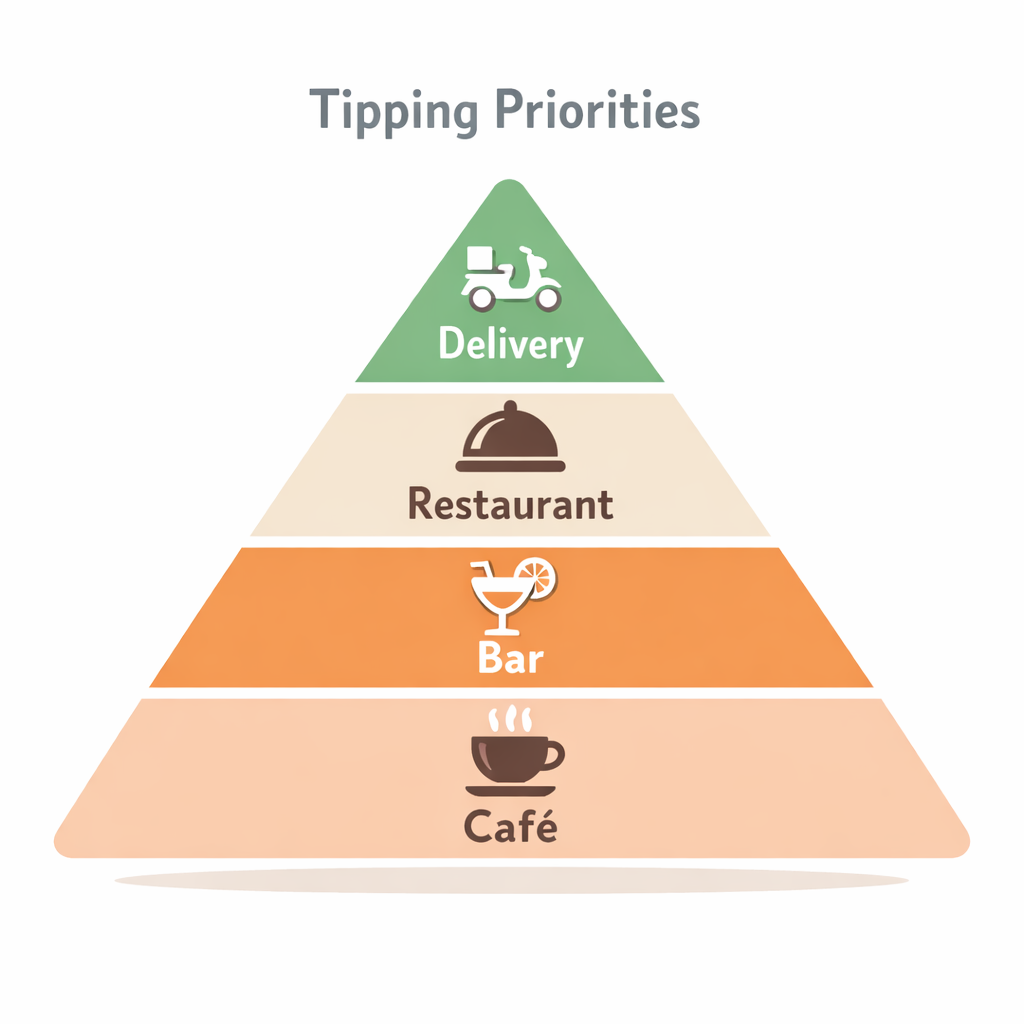
A practical priority order:
- Delivery drivers
- Sit-down restaurant servers
- Bartenders
- Haircuts & personal services
- Coffee shops & counter service
This isn’t about ranking people’s worth.
It’s about understanding who relies most on tips to survive.
Choosing intentionally reduces guilt.
Is It Ever Okay to Tip $0?
Yes.
And saying that clearly matters.
When $0 is okay:
- Counter service
- Minimal interaction
- When money is genuinely gone
- When tipping would harm essentials like food or rent
Tipping is not a moral requirement. It’s a social practice shaped by flawed systems.
What matters when tipping $0:
- Don’t act entitled
- Don’t rush or ignore
- Say thank you
Respect costs nothing.

How to Be Kind Without Spending More Money
There are ways to reduce stress without increasing cost.
Smart strategies:
- Choose cheaper items so tipping feels possible
- Tip once instead of many small places
- Carry small bills when you can
- Tip later if you return somewhere
Planning helps remove guilt from the moment.
If You’re Feeling Ashamed About Tipping, Read This
This section matters most.
You are not failing at kindness because you’re broke.
You are navigating a system that often ignores poverty while relying on it.
You are allowed to:
- Eat out sometimes
- Travel on a budget
- Use services
- Take up space
Kindness is not a luxury item reserved for the wealthy.
You are doing your best. That counts.

Final Thoughts: Kindness Isn’t About How Much You Have
Tipping culture is complicated.
Money is stressful.
Life is hard enough already.
This guide isn’t about rules. It’s about permission.
Permission to:
- Tip small
- Tip selectively
- Tip later
- Sometimes not tip at all
And still be kind.
Respect, gratitude, and awareness matter more than perfect numbers.
You don’t have to be rich to be decent.