
You’re standing at the end of a tour. People are smiling. The guide is thanking everyone for coming. The bus driver is closing the luggage bay. And you’re thinking the same thing most travelers think in that moment:
“How much am I supposed to tip… and who exactly am I tipping?”
If you’ve ever felt awkward, rushed, or uncertain at the end of a bus tour, a city walk, a museum visit, or a day trip excursion, you’re not alone. Tipping on tours has its own set of unwritten rules. It’s not like a restaurant where you already know the percentage. Tours can involve multiple workers. The expectations change by country. And for senior travelers, there’s often an extra layer: mobility assistance, pacing needs, weather issues, and the simple desire to be kind without feeling pressured.
Here’s the good news: tour tipping gets easy when you use one simple per-person rule, then adjust only when there’s a clear reason to do so.
This guide gives you that rule, plus practical amounts for common tour types, how to handle drivers versus guides, when to tip more (like when someone helps you navigate steps or delays), and when it’s okay to tip less or not at all. No guilt. No confusion. Just clear, senior-friendly guidance you can use anywhere.

The Simple Rule for Tipping Tour Guides (Per Person)
If you want one rule you can remember without pulling out your phone, this is it:
Tip per person based on the length and effort of the tour, then add a little more when you receive extra help or special attention.
That might sound obvious, but it solves the biggest problem: most people overthink tours because they try to convert everything into percentages. With tour tipping, a clean per-person approach is usually more natural and more fair.
Here’s a straightforward baseline that works well for many tours, especially in the United States and other places where tipping is common:
For a short tour (about one to two hours), a small per-person tip is normal.
For a half-day tour (around three to five hours), tip a bit more.
For a full-day trip (six to ten hours), increase the amount again.
For multi-day tours, tip daily or at the end of each day if the tour structure supports it.
What matters most is that you’re tipping the human effort: the guide’s preparation, storytelling, pacing, and group care. Unlike a restaurant tip, you’re not “tipping the bill.” You’re acknowledging service.
Why per-person tipping matters, especially for seniors
Per-person tipping prevents two common mistakes.
It keeps you from accidentally under-tipping on a large group tour where a guide is working hard for dozens of people all day.
It also keeps you from feeling like you “have to” tip a huge amount just because the tour cost was expensive. A pricey tour might include transportation, attraction tickets, permits, or meals. The guide’s personal labor doesn’t always scale with the price.
Per-person tipping is also easier if you travel as a couple. You can simply think, “What feels fair per person?” and then multiply by two.
And if you’re on a fixed income, this method helps you budget in advance. You can set aside a small “tour tip envelope” for the day and enjoy the experience without worrying at the end.
Tour Guides vs Tour Bus Drivers: Who Gets Tipped?
Tours often involve two key roles: the guide and the driver. Sometimes they’re the same person, but often they aren’t.
Understanding who does what makes tipping feel less awkward and more respectful.
What a tour guide does
A good guide does much more than speak into a microphone.
They shape the day’s pace so you’re not constantly rushed.
They manage time so the group arrives when attractions are open and ready.
They watch for safety issues, especially in crowded areas or unfamiliar neighborhoods.
They adjust the plan when things go wrong, like traffic, weather, closures, or late arrivals.
They tell stories, give context, and connect dots so what you’re seeing actually means something.
For seniors, great guides also do something extra important: they make the tour feel comfortable. They choose sensible stopping points, explain where bathrooms are, warn about uneven ground, and keep the group together without making anyone feel singled out.
What a bus or coach driver does
Drivers often have responsibilities that are easy to overlook because they’re quiet. But on bus tours and day trips, a driver can be the difference between a calm day and a stressful one.
They navigate traffic and difficult roads.
They manage tight schedules and safe drop-off points.
They handle luggage, strollers, walkers, or mobility devices.
They assist passengers getting on and off safely, especially when steps are steep.
They keep the ride smooth, which matters a lot if you have back, hip, or balance concerns.
Many senior travelers tip drivers because their work is physical, safety-focused, and often underappreciated.
Should you tip both?
If your tour has a separate guide and driver, tipping both is often expected in places where tipping is part of service culture.
If the driver is also the guide, you tip one person, and you can tip slightly more because they’re doing both jobs.
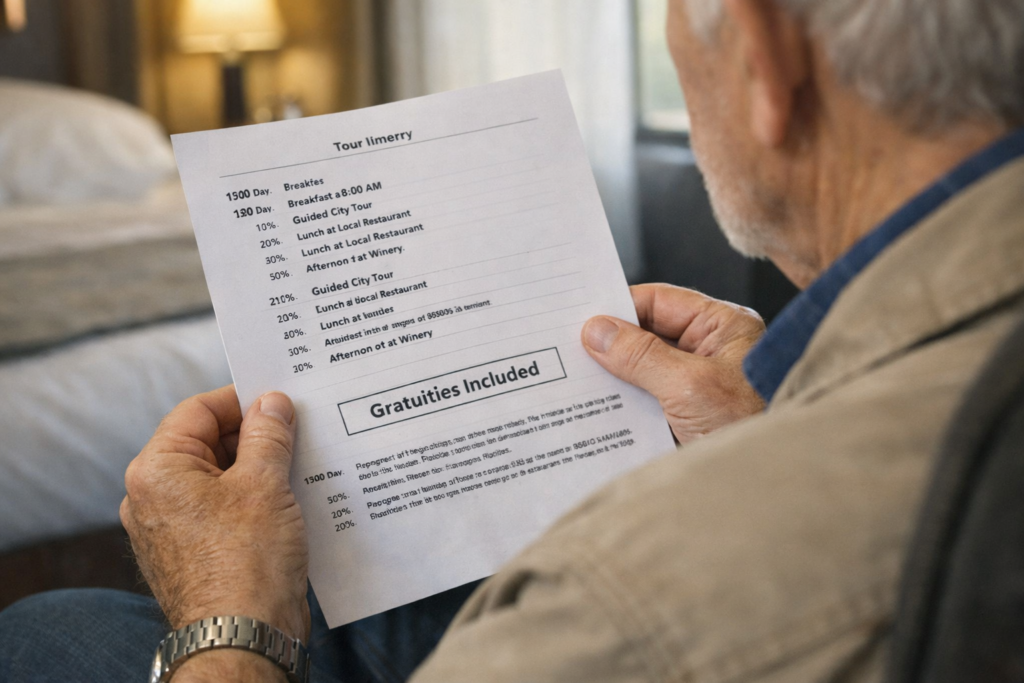
If the company says “gratuities included,” you don’t need to tip unless you truly want to give an extra thank-you.
If tips are pooled, the guide may mention it at the end. In that case, you can still hand your tip to the guide, and they’ll distribute it properly.
When in doubt, it’s okay to politely ask at the end: “Do tips go to you directly, or are they shared with the driver too?” A professional guide won’t be offended.
How Much to Tip on Common Types of Tours
Now let’s make this practical. Below are common tour types senior travelers book often, along with sensible tipping ranges and real-world examples.
The goal is not perfection. The goal is confidence.
Bus tours: city loops, scenic routes, and hop-on hop-off tours
Bus tours can vary a lot. Some are quick sightseeing loops with recorded audio. Others involve a live guide, multiple stops, and a lot of coordination.
A helpful way to decide is to ask one question: is there a live guide providing service, or is it mostly transportation?
If it’s mostly transportation with minimal service, tipping is smaller.
If there’s a live guide plus a driver handling the bus, tipping is usually split.
If the guide is doing the full commentary, managing stops, and helping the group, tipping tends to be stronger.
For a short city loop, a modest per-person tip is typical.
For a longer scenic tour with multiple stops, tip more.
If the driver handles luggage or gives special assistance, tip the driver separately.
Example: You take a two-hour city bus tour that is mostly sightseeing with a guide giving live commentary. You and your spouse can tip the guide an amount that feels like “a thank-you,” then add a smaller amount for the driver if the driver actively helped passengers or handled luggage.
Example: You take a full-day coach tour to a famous site outside the city. It includes long driving, a tight schedule, a guide managing the group, and a driver loading bags. In this scenario, many travelers tip both, with the guide usually receiving more than the driver.
Walking tours: historic districts, food walks, and museum areas
Walking tours can be wonderful for seniors because they are often slower paced and more personal. But they also vary in intensity. Some are gentle strolls with frequent stops. Others involve hills, stairs, or long distances.
Tipping on walking tours depends heavily on how the tour is priced.
If the tour is a paid ticket, tipping is usually a modest per-person amount.
If the tour is “free” or “pay what you want,” tipping is often the primary way the guide gets paid. In that case, tipping is not just polite—it’s the business model. People often tip more on these tours because they received real value without a set price.
For seniors, there’s another factor: if the guide adjusted pacing for you, chose accessible routes, or helped you navigate tricky ground, that’s a good reason to tip more.
Example: You join a paid two-hour historical walk. The guide is excellent, gives bathroom tips, keeps the group comfortable, and answers questions kindly. A modest per-person tip feels right.
Example: You join a “free” city walk. The guide is fantastic and the tour ends at a central plaza. In that situation, you can treat your tip as the price of admission. If you felt you got real value, tip accordingly.
Day trips and excursions: the “all-day” tours seniors love
Day trips are one of the most common travel bookings for seniors because they reduce stress. Someone else plans it. Someone else drives. You just enjoy the experience.
Because day trips often last six to ten hours, the guide’s work is more intense. They’re managing timing, headcounts, safety, meal stops, and the emotional energy of a group for an entire day.
If there’s a separate driver, that’s another layer of labor.
For a full-day tour, a higher per-person tip is common than on a short walk or quick bus loop.
Day trips also tend to involve more “extra” moments that deserve appreciation, like helping you find a seat with shade, allowing extra time at a stop, or navigating a sudden closure.
Example: You take a day tour to a coastal town with two attractions and a lunch stop. The guide keeps everything smooth, helps guests with mobility needs, and the driver handles bags. This is the kind of tour where tipping both feels normal, especially if the day was comfortable and well-run.
Multi-day tours: the “travel with a group” experience
Multi-day tours can include everything from a three-day regional trip to a two-week escorted vacation.
Tipping on these tours can be confusing because it often involves several staff members: the tour director, local guides, and drivers.
Many companies provide guidance, sometimes even envelopes or suggested ranges. If they do, it’s okay to follow it.
If there’s a main tour director who stays with you every day, people often tip that person daily or at the end, depending on the tour’s norms.
Local guides, who may join for one city or one attraction, are typically tipped at the end of their portion.
Drivers, especially on long coach tours, often receive tips because their work is continuous and physically demanding.
For seniors, multi-day tour tipping is also about consistency. Instead of making one big emotional decision at the end, it can help to tip along the way, or set aside a daily amount in an envelope.
If you’re traveling internationally, remember that tipping norms may change by country. A tour company’s suggested amounts are often designed for that region.
When You Should Tip More Than Average
This is where your hook becomes real: seniors often receive services on tours that are simply not part of the standard experience, and it’s fair to recognize that.
You never need to tip out of fear. But tipping more can be a beautiful and practical way to say, “I noticed the effort.”
Mobility and accessibility assistance
If someone helps you in a way that protects your dignity and comfort, it’s worth acknowledging.
Helping you safely board the bus when steps are steep
Offering you a seat near the front
Waiting while you move at a comfortable pace
Helping manage a walker, cane, or wheelchair
Choosing routes with fewer stairs
Making sure you have time for restrooms
These are not “little things” when you’re traveling. They can be the difference between enjoying the day and feeling overwhelmed.
If a guide or driver gave you that kind of support, tipping more is one of the simplest ways to express appreciation without making a big scene.
Bad weather and difficult conditions
Tours don’t stop just because the weather is miserable.
If your guide kept the group calm in heavy rain, adjusted the plan, found shelter, or maintained good spirits in extreme heat or wind, that’s real labor. It takes energy to lead people when everyone is uncomfortable.
Many travelers tip more when a guide turns a tough day into a good story.
Extra stops and personal attention
Sometimes a guide goes beyond the script.
They stop for a scenic photo spot.
They help you find a specific landmark.
They answer extra questions in detail.
They give you suggestions for a restaurant that works well for your dietary needs.
They help you feel included if you’re traveling alone.
These are meaningful additions. If you received them, tipping more is reasonable.
When It’s Okay to Tip Less (or Not at All)
This is important: a good tipping guide should never turn into pressure.
You’re allowed to tip less if service was truly poor. You’re also allowed to skip tipping if gratuities are included and you don’t want to add extra.
The key is to be fair and clear with yourself.
What actually counts as poor service?
Not every minor inconvenience should reduce a tip. Tours involve traffic, crowds, and unpredictable weather.
But these issues can justify tipping less:
The guide is rude, dismissive, or insulting
Safety is ignored (reckless driving, unsafe instructions, poor crowd control)
Accessibility needs are mocked or brushed off
The guide provides minimal effort and seems disengaged the entire time
The tour is drastically different from what was promised, and it’s clearly not due to unavoidable circumstances
If you feel uncomfortable tipping normally, you can tip less without guilt.
When gratuities are included
Some tours, especially cruise excursions and premium packages, include tips automatically. You’ll often see language like:
“Gratuities included”
“Service charges included”
“Tipping is included in the price”
If that’s the case, you have no obligation to add more. If the service was exceptional, you can still give a small extra tip, but it becomes optional.
When tipping is not the local custom
In some places, tipping is minimal or not expected the way it is in the U.S. A local guide may appreciate a small tip, but they may not expect it as a “must.”
If you’re unsure, a good approach is to follow the tour company’s guidance, watch what other travelers do, or ask discreetly.
If tipping feels culturally awkward, you can also express gratitude in other ways: a warm thank-you, a positive review, or mentioning the guide by name to the company.
Tipping Tour Guides in the U.S. vs Internationally
Many seniors travel both domestically and abroad, so let’s address the biggest difference: tipping culture.
United States
In the U.S., tipping tour guides is common and often expected. Most guides rely on tips as part of their income, especially on group tours.
If you’re touring in major U.S. cities, national parks, or popular tourist regions, tipping is part of the normal rhythm. People often bring small bills and tip at the end.
Europe
Europe varies.
In some places, tipping is modest and more about rounding up.
In others, tipping is appreciated but not assumed.
In tourist-heavy areas, guides may be used to Americans tipping more than locals.
The best approach is not to overthink it. If you had a good experience, a modest per-person tip is usually received warmly.
If you want to be especially respectful, use the “small but sincere” method: a modest tip plus a direct thank-you.
Cruises and package tours
Cruises often add automatic service charges. Shore excursions may include gratuities, or they may not.
Package tours sometimes give you a tipping guideline sheet. If so, follow it. These companies often design the numbers to match local expectations and avoid awkward moments.
If everything feels unclear, ask a simple question at the start of the trip: “Do we tip daily, or at the end, and who receives tips?” That one question can save a lot of stress later.

Cash or Card? How to Tip the Right Way
The “how” matters almost as much as the “how much.”
Cash: still the simplest option
Cash is the easiest way to tip because it’s immediate, private, and clear. Many guides prefer it.
For senior travel, the best strategy is to carry small bills on tour days. That way you’re not stuck trying to break a large bill at the end of a walk.
If you’re on a bus tour, tipping can happen as you exit. On a walking tour, it usually happens near the end when the guide is saying goodbye.
If you prefer discretion, you can fold the bills or place them in an envelope and hand it over quietly.
Card or digital tipping
Some tours now support card tips, QR codes, or digital tipping platforms.
These can be convenient, but there’s one concern: sometimes digital tips go through the company first, and you may not know how quickly the guide receives them.
If you’re using digital tips, it’s still fine. Just do it confidently, and don’t feel like cash is required if you truly don’t have it.
A practical compromise for seniors is to keep a small amount of cash for tips, then use card for the tour ticket itself.
Senior-Specific Tipping Advice: Comfort, Budget, and Confidence
Senior travelers often want to do the right thing, but they also want to travel without anxiety.
This section is about making tipping feel calm and manageable.
Budgeting tips that prevent stress
If you’re traveling for several days and doing multiple tours, tips can add up. The easiest solution is planning.
Before your trip, look at the tours you booked and set aside a rough daily tip budget.
If you’re traveling as a couple, plan the amount for two people.
If you’re on a fixed income, choose a comfortable baseline and stick to it. Consistency matters more than occasional splurges that cause worry.
You can even keep tips in labeled envelopes: “City Tour,” “Day Trip,” “Museum Walk.” That small step removes end-of-tour stress.
The “no-pressure” mindset
Tipping is not supposed to feel like a test.
If you tip in a way that reflects your gratitude and your budget, you’re doing it right.
A guide would rather receive a modest tip with a warm thank-you than receive a larger tip from someone who felt pressured or resentful.
Traveling as a couple or group
If you’re traveling with others, tipping can get awkward because no one wants to bring it up.
A simple method is to decide together in advance. If you’re comfortable, you can say: “Let’s each do a per-person tip at the end,” or “We can combine and tip together.”
If someone else insists on handling tips, it’s okay to ask what they plan to do, especially if you want to contribute.
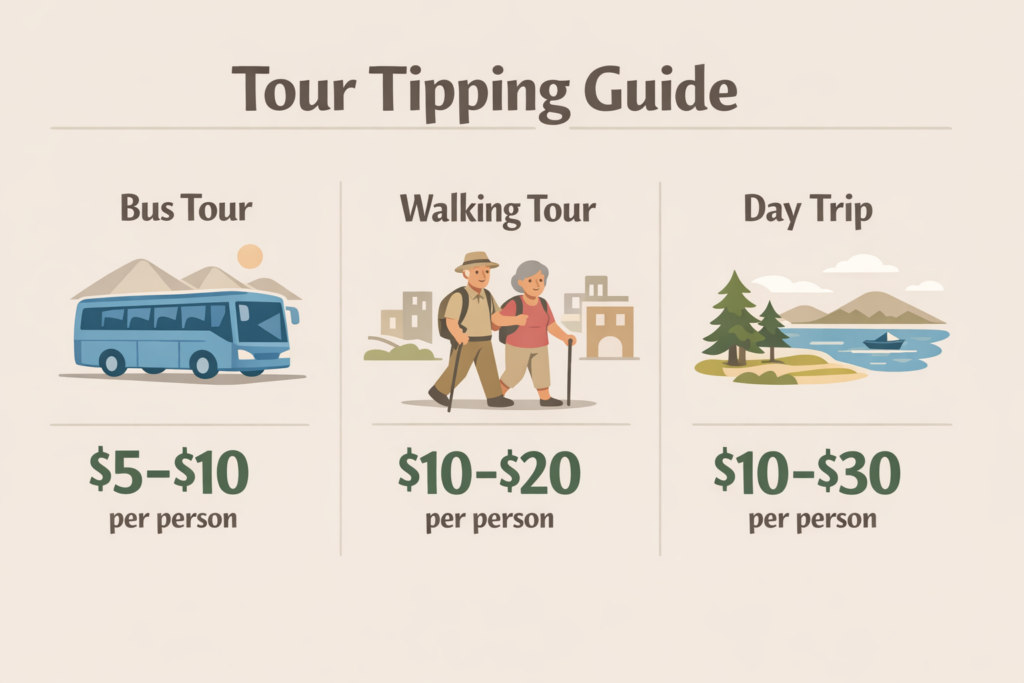
Quick Reference: Tour Guide and Driver Tipping at a Glance
When you’re tired at the end of a tour, you don’t want a long explanation. You want a simple mental map.
Short tours usually get smaller per-person tips.
Half-day tours get a moderate per-person tip.
Full-day tours get a higher per-person tip.
If there’s a driver separate from the guide, the driver often receives a smaller tip than the guide, especially if the guide is doing most of the customer-facing work.
If the driver handled luggage, helped with boarding, or provided accessibility help, tipping the driver becomes more important.
If gratuities are included, tips become optional unless the service truly stood out.
If service was poor in a meaningful way, you can tip less.
A Few Real-Life Scenarios (So You Know Exactly What to Do)
Let’s bring this to life with situations senior travelers commonly face.
You’re on a city bus tour for two hours and the guide provides live commentary, but the driver does not handle luggage and there are no special needs. You tip the guide modestly per person. If you want to acknowledge the driver, you can tip a small amount, but many travelers focus on the guide here.
You’re on a full-day bus tour with a guide and a driver. The driver helps you safely board and handles bags. The guide keeps a comfortable pace and helps with restroom planning. You tip both, with the guide receiving more. You also feel good about tipping a little extra because you received real assistance.
You’re on a “free” walking tour and the guide is excellent. You treat your tip as the main payment. You tip per person in a way that reflects how much value you received, then say thank you warmly.
You’re on a tour abroad where tipping is not strongly expected. You give a modest tip or round up, then express appreciation. If you’re unsure, you follow the company’s guidance.
You’re on a tour where gratuities are included, but the guide went out of their way for your comfort. You give a small extra thank-you tip because it feels deserved, not because you’re required.
What If You’re Not Sure? Use This Simple “Fairness Check”
If you’re still unsure in the moment, ask yourself:
Did this person make my day easier, safer, or more enjoyable?
Did they help me personally in a way that mattered?
Did they handle a difficult situation calmly?
If the answer is yes, tipping at your comfortable level is a good choice.
If the answer is no and service felt careless or disrespectful, tipping less is reasonable.
And if gratuities were included and everything was simply fine, you can skip extra tipping without guilt.
Conclusion: Tip With Confidence, Not Stress
Tour tipping should never steal joy from travel. It should be a small, kind finishing touch that says, “Thank you for taking care of us today.”
When you use a simple per-person rule, you remove most of the awkwardness. From there, you only adjust when something clearly deserves it—mobility help, extra stops, tough weather, or exceptional care.
That’s the senior travel sweet spot: practical, fair, calm, and confident.
If you want to make your next tour day even easier, pack a few small bills before you leave your hotel, decide your per-person tip range early, and enjoy the experience knowing you’ll handle the ending gracefully.
FAQ: Tour Guide Tipping Questions Seniors Ask Most
How much should I tip a tour guide per day?
For full-day tours, many travelers tip more than they would on a short tour, especially if the guide managed logistics all day and kept things comfortable. A per-person approach is easiest, and you can increase the tip if you received extra help.
Do I tip the bus driver separately?
If the driver is separate from the guide, tipping the driver is often appreciated, especially if they handled luggage, helped with boarding, or contributed to comfort and safety.
Is tipping expected on free walking tours?
Usually yes. “Free” walking tours often rely on tips as the guide’s main pay. If you enjoyed the tour, tipping is part of the system.
Should I tip more if I need extra help?
If a guide or driver provided meaningful mobility or comfort assistance, tipping more is a kind way to recognize effort without making it awkward.
What if I’m on a fixed income?
Set a comfortable per-person range before the trip. Consistency matters. A modest tip paired with sincere gratitude is still respectful.
Is tipping expected on international tours?
It depends on the country. In many tourist areas, tipping is appreciated, but not always required. If the company provides guidance, it’s usually safest to follow it.
Do tour companies share tips with guides?
Sometimes. Some tours pool tips between guides and drivers. If you’re unsure, you can ask politely at the end.
Should I tip at the beginning or end?
Most people tip at the end, once they’ve experienced the service. On multi-day tours, some people tip daily or at the end of each day.
What if service was only average?
If service was fine but not special, a baseline tip is reasonable in places where tipping is expected. If gratuities are included, you can skip extra tipping.
Can I tip in my local currency abroad?
It’s usually better to tip in the local currency, especially outside major tourist areas. If you only have your home currency, some guides will accept it, but local currency is simpler.
Is it rude not to tip a tour guide?
In the U.S. and some tour settings, not tipping can feel unusual if service was good and tips are not included. But if gratuities are included or the local culture doesn’t expect tipping, it’s not necessarily rude.
Are tips taxed or tracked?
This varies by country and company. As a traveler, your job is simply to tip fairly and respectfully, not to worry about the guide’s internal payroll details.
If you’d like, I can also provide the exact image prompts and the best placements inside this finished article, so you can drop them into your CMS in minutes.