Hotel tipping can feel strangely stressful. You’re trying to be polite. You don’t want to offend anyone. You don’t want to look clueless. And you definitely don’t want to feel pressured into spending money you didn’t plan for.
If you’re a senior traveler, there’s an extra layer to it. Many older travelers grew up with different norms. Some were taught that tipping was rare and only for special service. Others learned simple rules that made sense at the time, then discovered that modern travel has turned “simple” into “complicated.”
Here’s the good news: hotel tipping does not have to be awkward. You don’t need to guess. You don’t need to over-tip out of fear. And you don’t need to memorize a long list of rules.
A strong approach is easy to remember:
Tip the people who directly help you.
Tip in a way that reaches the right person.
Tip amounts that feel respectful and reasonable.
And do it with confidence.
This guide is written to help you do exactly that—especially for housekeeping, bellhops (porters), and concierge services—so you can relax and enjoy your stay.
Why Hotel Tipping Feels So Unclear (Especially for Seniors)
Hotel tipping used to feel more straightforward because hotels used to work differently.
In the past, many hotels had a smaller staff and more visible service roles. You might see the same housekeeper in the hallway. You might have a bellhop who stayed with you from the front door all the way to your room. And the concierge desk felt like an obvious place where you could hand someone a tip if they pulled off something impressive.
Today, hotel operations are often more complex, even in ordinary, mid-range hotels. Housekeeping may be done by a rotating team. Rooms may be serviced at different times and sometimes not daily by default. Staff may belong to separate departments or even outside contractors in some properties. And tips you leave “at checkout” might never reach the people you intended to thank.
Seniors also face a few common tipping stress points:
The fear of “doing it wrong.”
Nobody wants to feel embarrassed. When you’re traveling, you’re already navigating unfamiliar places, schedules, and rules. Tipping can feel like one more test you didn’t study for.
The fear of being judged.
Some travelers worry they’ll be seen as cheap. Others worry they’ll be seen as naïve. That anxiety can push people into tipping more than they want to, just to avoid discomfort.
The fear of being taken advantage of.
If you’ve seen pushy tip screens in everyday life, you might worry hotels are heading in that direction too. Most hotel tipping is still traditional and optional, but the fear is understandable.
The fear of running out of small bills.
Even when you want to tip, it’s easy to arrive without singles or fives. Then the whole thing becomes a scramble.
And then there’s the big one: many seniors travel on a fixed income. That means your money plan matters. Tipping should never become a source of financial strain.
A good hotel tipping strategy respects both sides. It respects the work hotel staff do. And it respects your budget, comfort, and dignity.
The Golden Rule: What Tipping Is — and What It Is Not
In hotels, tipping is a social custom. It is not a legal requirement. It is not an “extra fee” you owe. And it is not a test of your character.
The purpose of tipping is simple: to show appreciation for hands-on help or services that make your stay easier, cleaner, safer, or more comfortable.
Tipping is not:
A requirement for basic, standard treatment
A bribe to get what you already paid for
A way to “prove” you’re a good person
A situation where bigger is always better
A respectful tip is one that matches the service and feels appropriate for your circumstances.
If you’re a generous tipper, great. If you’re modest with tipping, that can also be completely appropriate—especially if you’re consistent, polite, and you tip the roles that typically receive tips.
One more important point: in most hotels, the staff who benefit most from tips are often the ones doing physically demanding work behind the scenes. Housekeeping is a good example. A small daily tip can mean more than people realize, because it acknowledges work that is essential but often unseen.
Housekeeping: How Much to Tip Per Night (And Why Daily Matters)
Housekeeping is the most common area where travelers feel uncertain. Many people wonder whether they should tip at all. Others tip only at checkout, then worry it didn’t reach the right person. And seniors often want to do “the proper thing” but don’t want to throw money around.
Let’s make it clear and practical.
A Simple Range for Housekeeping Tips
A reasonable, widely accepted approach for many U.S. hotels is:
A standard hotel: about $2–$5 per night
A nicer or more service-heavy hotel: about $5–$10 per night
Minimal service or limited housekeeping schedules: tip on serviced days
These are ranges, not strict rules. You can adjust based on:
How many people are in the room
How much work you create (more towels, more trash, food containers, etc.)
Whether you asked for extra items
Whether you stayed multiple nights
Whether the cleaning was clearly thorough and careful
If you’re staying in a suite or a larger room, tipping on the higher end is reasonable. If you’re traveling alone and keeping things very tidy, a smaller daily tip can still be respectful.
Why Daily Tipping Works Better Than One Lump Tip
Many travelers grew up tipping at checkout. That used to work better when the same person serviced a room throughout the stay. But today, that’s less reliable.
Daily tipping is better because:
The person who cleaned today is the person who benefits today
Housekeeping staff often rotate rooms and shifts
You don’t have to remember at checkout, when you’re rushed
You don’t have to carry a larger amount of cash for a single moment
Think of it like this: daily tipping is the most “accurate” way to say thank you.
If you prefer to tip at checkout, you still can. But daily tipping increases the chance your tip reaches the person who did the work.
How to Leave the Tip So It’s Clear
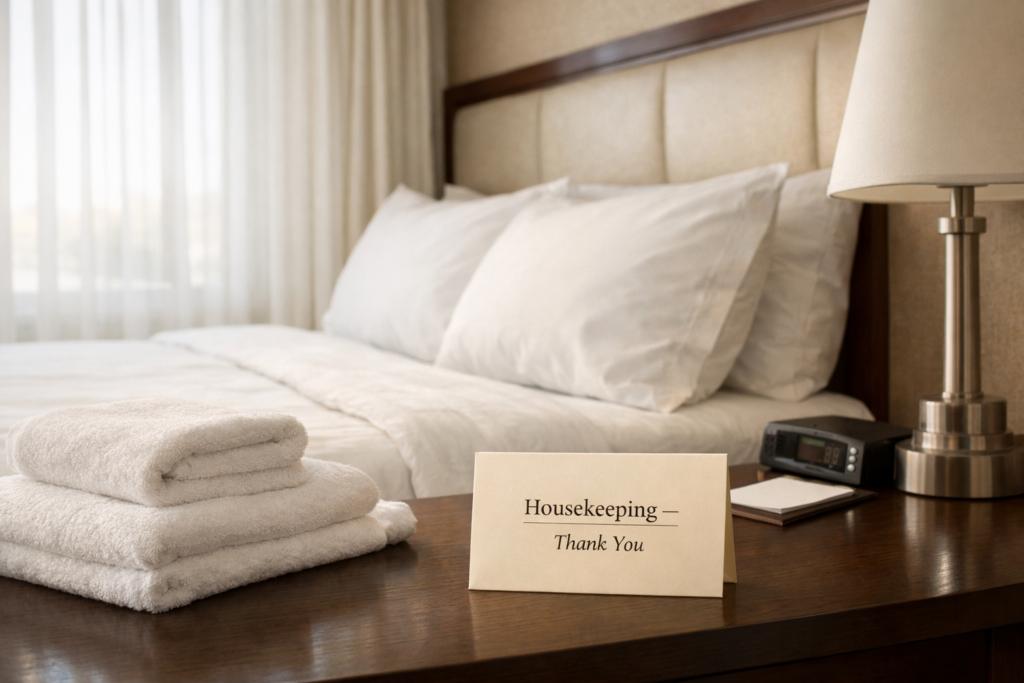
Housekeeping tips should be left in a place that makes the intention obvious.
Good options:
On the desk or nightstand, in plain view
In an envelope labeled “Housekeeping”
With a short note that says “Thank you”
Avoid leaving it on the bed under covers or hidden in a drawer. You don’t want your tip to look like forgotten cash or something that could be mistaken for a personal item.
If you use an envelope, even better. It removes doubt. It also feels more dignified and intentional, which many seniors prefer.
What If Housekeeping Doesn’t Come Daily?
Many hotels now offer “on request” or reduced cleaning schedules. If your room is not cleaned every day, tipping daily may not make sense.
Instead:
Tip on the day your room is serviced
Tip when you request extra towels or special help
Tip at checkout only if you know the room was cleaned repeatedly by staff during your stay
If the room isn’t serviced at all during a short stay, there may be nothing to tip for. That’s okay. You can still leave the room neat and say thank you to any staff you interact with.
Special Situations Where a Bit More Makes Sense
Some situations create extra work. You don’t need to feel guilty about it, but acknowledging it is kind.
Consider tipping a bit more when:
You request lots of extra towels, bedding, or pillows
You need accessibility-related arrangements (like furniture moved for mobility)
You have medical equipment that takes up space and requires extra care around it
You’re dealing with spills or unusual messes
You stay with grandchildren or a larger family group in one room
This isn’t about shame. It’s about recognizing effort.
A Few Real-Life Examples
A simple 3-night stay, one or two guests, tidy room
A daily $3–$5 tip is a calm, respectful approach.
A 5-night stay in a nicer hotel, daily cleaning, more towels used
A daily $5–$8 tip fits many travelers’ comfort zone.
A week-long stay, housekeeping comes every other day
Tip on each cleaning day, perhaps $5–$10 depending on room size and needs.
A night or two, no housekeeping during the stay
No tip is necessary for housekeeping, unless you requested something that required staff effort.
A Small Habit That Makes Tipping Easier
Before you leave home or arrive at your hotel, make sure you have:
A few $1 bills
A few $5 bills
A few envelopes or small note paper
If you arrive without cash, you can often get change at the front desk, but it’s easier when you’re prepared.
Bellhops and Porters: Per Bag or Per Trip?
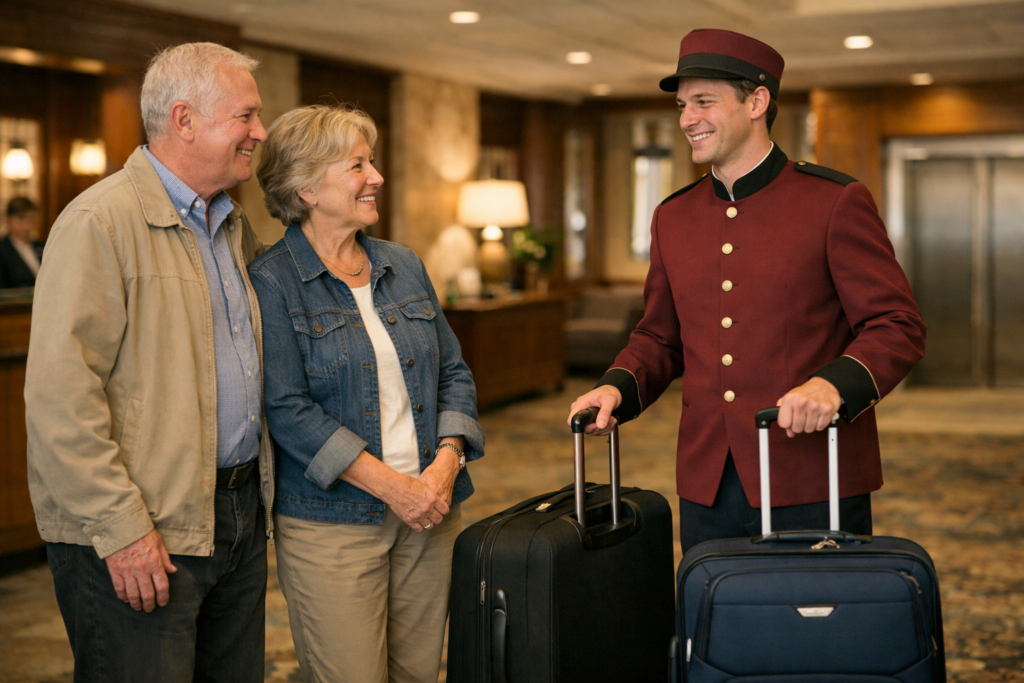
If you grew up in a time when bellhops were more common, you might remember tipping as automatic. Today, many hotels don’t even offer bell service unless you ask or you’re staying in a full-service property.
So what’s expected now?
A simple rule works well:
Tip based on the help you received, usually per bag.
A Simple Range for Bellhop Tips
A common approach is:
About $1–$2 per bag
Or a flat tip of about $5–$10 for a small amount of luggage
If you have heavy bags, many bags, or special items, tipping toward the higher end is kind.
Also, many senior travelers have unique luggage considerations:
A walker or mobility device
A medical bag
A cooler bag for medications
A delicate item like a musical instrument
A bag that’s heavier than it looks
If someone carries or manages those items carefully, it’s reasonable to tip a bit more. Not because you “must,” but because the help is more meaningful and often more physically demanding.
When a Flat Tip Is Better Than Counting Bags
Counting per bag is easy when you have two suitcases. It gets weird when you have a suitcase, a garment bag, a backpack, a medical tote, and a shopping bag.
In that case, a flat tip avoids awkward math.
Examples:
Someone brings your luggage to the room, explains where things are, and offers extra help
A flat $5–$10 is often comfortable and reasonable.
Someone makes multiple trips due to luggage volume or accessibility needs
A bit more may be appropriate.
What If You Carry Your Own Bags?
If you don’t use bell service, you don’t need to tip for it. Simple as that.
Many seniors prefer to keep control of their belongings. Others travel light. Some just don’t want anyone in their space. That’s all fine.
If a staff member holds the door or points you in the right direction, a friendly thank-you is enough.
What If You Decline Help and Someone Insists?
Occasionally a staff member may offer help in a way that feels pushy. You’re allowed to say no. You can simply say:
“No thank you, I’ve got it.”
If the person does not provide service, there’s nothing to tip for.
If they do end up helping you, and you accept it, a modest tip avoids awkwardness and closes the interaction politely.
A Senior-Friendly Tip Approach
If you want one easy rule you can remember without stress, use this:
If they take your bags to your room, tip $5–$10.
If they handle multiple bags or heavy items, tip a little more.
If you don’t use the service, no tip needed.
It’s calm, consistent, and it works in most situations.
Concierge Services: When Tipping Is Appropriate (And When It’s Not)
Concierge tipping is where many travelers feel the most confused. Some people tip every time they ask a question. Others never tip. Many seniors worry that they’ll either look rude or look out of touch.
Here’s the simplest way to think about it:
Basic information usually does not require a tip.
Special effort, time, or access is where tipping becomes appropriate.
When a Tip Is Not Expected
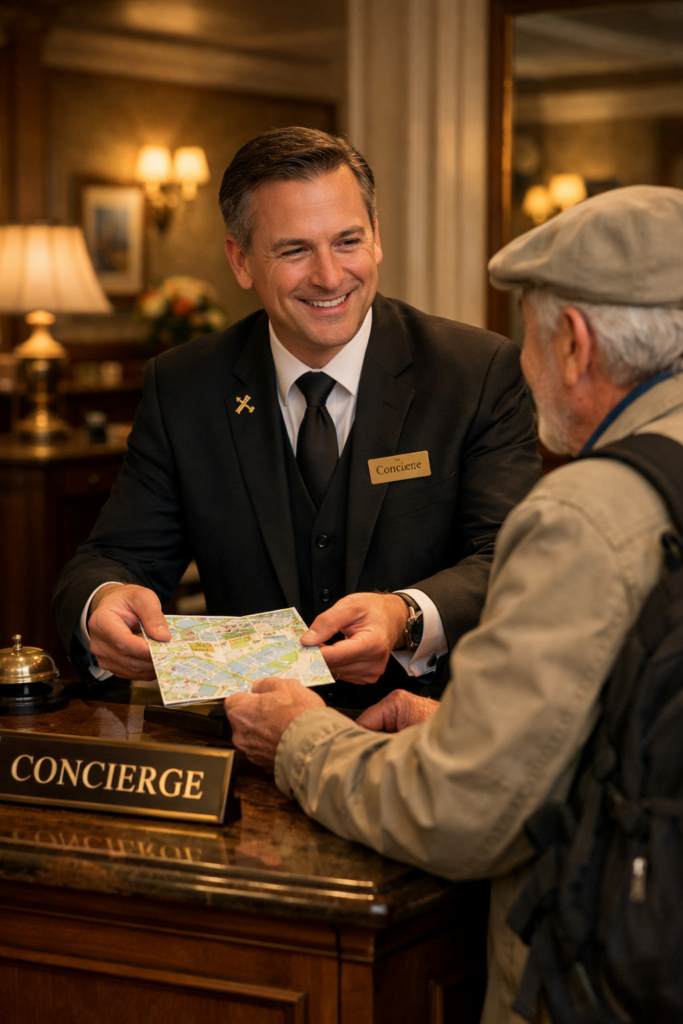
A concierge often provides help that is part of their role. You do not need to tip for normal, quick support such as:
Giving you a restaurant list
Telling you museum hours
Pointing you toward the elevator
Recommending a local attraction
Printing basic directions
Answering quick questions
In these situations, a sincere thank-you is perfect.
If you want to show appreciation, you can also mention their name to a manager or leave a positive note. Many concierges value recognition.
When Tipping Makes Sense
Tipping becomes more appropriate when the concierge provides something that feels like a “favor” or an effort beyond the basics.
Examples:
Getting you a reservation at a popular restaurant during peak times
Arranging transportation with special requirements
Helping you secure sold-out tickets or hard-to-get access
Coordinating a complex schedule (multiple stops, special needs, timing constraints)
Handling a situation that saves you significant time or stress
In those cases, a reasonable approach might look like:
For a straightforward reservation that takes effort: around $5–$10
For something complex or difficult: around $10–$20 (or more if you feel it truly deserved it)
You don’t need to overdo it. Most concierges notice gratitude and professionalism. A tip is a bonus, not a pass/fail moment.
Tip Timing Matters
If you’re asking for help and you know it will take effort, you can tip after they succeed, not before. That keeps it simple and fair.
If the concierge goes above and beyond and solves a real problem—like finding an accessible tour last-minute or helping you recover a lost item—that is exactly the kind of moment where a tip feels appropriate and appreciated.
How to Tip Without Awkwardness
The easiest way is direct and simple:
Hand them the cash as you thank them.
Keep it brief.
Don’t over-explain.
A good script is:
“Thank you so much for your help. I really appreciate it.”
That’s it. No speech needed.
If you feel awkward, remember: hotel staff are used to tipping norms. A polite handoff is normal.
Front Desk Staff: Do You Tip Them?
In most hotels, front desk staff are not typically tipped for routine check-in, check-out, or basic questions.
So if you want a clear rule:
Most of the time, no tip is expected at the front desk.
However, there are exceptions where a tip can feel appropriate—especially when someone provides unusual help, solves a difficult situation, or makes your stay significantly better.
Examples of situations where some travelers choose to tip:
A staff member spends a long time helping you fix a booking problem
They find a solution during a busy period when the hotel is full
They handle a major issue with care and speed (noise problems, room changes, accessibility needs)
They arrange something personal and thoughtful that goes well beyond basic duties
In those cases, a modest tip might be appreciated. But it’s still optional, and some hotels have policies about accepting tips.
A powerful alternative is a written compliment. If you mention a staff member by name in a compliment to management, that can carry real weight. It’s also a good option if you don’t have cash or you’re unsure of hotel rules.
The Printable Hotel Tipping Checklist for Seniors
You don’t need a complicated system. You need something you can remember and use without stress.
Here’s a simple checklist you can follow from start to finish.
At Check-In
If someone carries your bags to the room, tip them at the end of the help.
If nobody handles bags, no tip needed.
During the Stay
Housekeeping: tip daily if the room is cleaned daily.
If cleaning is not daily, tip on the cleaning days or when you request extra items.
Concierge: tip for special effort, not for basic questions.
At Checkout
If you tipped housekeeping daily, you’re done.
If you didn’t tip daily and housekeeping was consistently servicing your room, you may leave a final tip, but daily is still better.
If someone helps with bags on departure, tip them.
That’s the whole system.
If you want to make it even easier, keep a small envelope in your travel bag with singles and fives. Then you never have to scramble.
What If You’re on a Fixed Income?
This part matters. It deserves a clear and respectful message.
If you’re on a fixed income, your budget is not a moral failure. It’s reality. Hotel tipping should not create financial strain, and it should not take away from your ability to travel with comfort and security.
Here’s a healthy way to think about it:
Small, consistent tips are perfectly acceptable.
A sincere thank-you matters.
You do not need to tip everyone.
You can prioritize the roles where tipping is most customary.
If you’re deciding where your money makes the most impact, consider this priority order:
Housekeeping, because it’s hard physical work and often underappreciated
Bellhops/porters, because the service is direct and physical
Concierge, only when they provide special effort
If you can’t tip as much as you’d like, tip what you can without stress. Many seniors find that a modest daily housekeeping tip feels manageable, and it’s often the most meaningful.
And if you truly cannot tip, focus on what you can control:
Keep the room tidy
Treat staff with kindness
Say thank you directly
Leave a positive comment or compliment with names
These actions matter more than people think.
Common Hotel Tipping Myths (Debunked)
Tipping myths spread because people repeat them, not because they’re true. Let’s clear up the ones that cause the most anxiety.
Myth: “If I don’t tip big, my service will suffer.”
In most hotels, staff do not track your tipping habits in a way that affects basic service. Professional hospitality is still expected. Tipping can influence how warmly someone responds in the moment, but it should not determine whether you receive basic service you paid for.
Myth: “Seniors are expected to tip more.”
There is no special tipping rule for seniors. Expectations are based on service roles and local culture, not age.
Myth: “Hotels track tips and label guests.”
This is largely exaggerated. Some staff may remember individual guests from personal interaction, but hotels aren’t running a tipping scoreboard. Your best “reputation” is being respectful.
Myth: “No cash means no appreciation.”
Cash is traditional, but kindness, thanks, compliments, and respectful behavior are meaningful too. If you don’t have cash, you haven’t failed.
Myth: “I should tip the front desk every time I ask something.”
No. Routine front desk tasks are not usually tipped. Save your tips for the roles where tipping is more common and directly tied to hands-on service.
How to Tip with Confidence (Without Feeling Awkward)
Sometimes the hardest part is not the amount. It’s the feeling.
Many seniors feel uncomfortable handing over cash. It can feel like making a judgment. Or it can feel like charity. Or it can feel transactional.
A helpful mental shift is this:
A tip is not charity.
A tip is a thank-you in the local language of hospitality.
If you’d rather avoid the “cash in hand” moment, housekeeping tips are the easiest because you can leave them with a note. Bellhop tips are usually quick and natural at the end of the help. Concierge tips are easiest when you hand them over after the request is successfully handled.
If you want short, simple phrases that feel natural:
“Thank you, I really appreciate your help.”
“You made that easy for me—thank you.”
“That was very kind of you. Thank you so much.”
No explanation needed. No apology needed. No awkward smile needed. Just calm gratitude.
Practical Senior Scenarios and What to Do
A guide becomes truly helpful when you can picture real situations. Here are common senior travel moments and how to handle tipping without stress.
You’re Staying Three Nights and Housekeeping Cleans Daily
Leave a tip each morning after the room is cleaned or before you leave for the day.
Use a note or envelope if you like.
A modest daily tip is fine. You don’t need a large checkout tip.
You’re Staying Five Nights but Housekeeping Only Comes Every Other Day
Tip on the days your room is cleaned.
If you request extra items in between, a small tip when they deliver can be a kind gesture, but it is still optional.
You Use a Walker and Need the Room Adjusted
If staff help move furniture or accommodate your mobility needs, that’s extra effort.
A small tip can be appropriate, but more importantly, a clear thank-you goes a long way.
You Ask the Concierge for Dinner Reservations
If it’s a simple booking and they do it quickly, a tip may not be needed.
If it’s hard to get, or they coordinate special requests and timing, tipping becomes more appropriate.
You Don’t Use Any Extra Services
If you check in, sleep, and leave with no special help, you may not need to tip anyone at all.
That is not rude. That is simply how the system works.
Confidence Is the Real Courtesy
The best hotel tipping style is not the biggest tip. It’s not the most complicated system. It’s not the person who looks like they “know the rules.”
It’s the traveler who is calm, kind, and consistent.
A respectful hotel tipping approach for seniors is simple:
Housekeeping: tip per night or per cleaning day, ideally daily when possible
Bellhops: tip when they carry bags or provide direct help
Concierge: tip when they do special work, not for basic questions
Front desk: usually no tip needed, but gratitude and compliments matter
If you take anything from this guide, let it be this:
You do not need to overthink tipping.
You do not need to overpay out of fear.
You can show appreciation in a way that fits your budget and your values.
Travel should feel freeing, not stressful. And once you have a plan for tipping, you can stop thinking about it and start enjoying your trip.
FAQ
How much should seniors tip hotel housekeeping per night?
Many travelers tip around $2–$5 per night in standard hotels, and more in higher-end properties. Daily tipping is often preferred when housekeeping service is daily.
Should I tip housekeeping daily or at checkout?
Daily tipping is usually better because housekeeping staff may rotate. A tip at checkout might not reach the person who cleaned your room.
Is tipping required at hotels in the US?
No. Tipping is customary for certain services, but it is not legally required. Tip what feels reasonable.
How much do you tip a bellhop per bag?
A common approach is around $1–$2 per bag, or a flat $5–$10 for a small amount of luggage.
Do you tip concierge for restaurant reservations?
Not always. Basic reservations may not require a tip. If the concierge puts in special effort or secures something difficult, a tip becomes more appropriate.
Should seniors tip more than younger travelers?
No. Expectations are based on service roles, not age. Tip what is comfortable and fair.
What if I can’t afford to tip much?
Small, consistent tips are fine. Prioritize housekeeping and direct help. Kindness, thanks, and keeping the room tidy also matter.
Is tipping expected at extended-stay hotels?
It depends on how often housekeeping services your room. Tip on cleaning days or when staff provide direct help.
Should I tip front desk staff?
Usually no for routine service. Some travelers tip for exceptional help, but written compliments are also a strong option.
Can I leave tips with a note instead of cash?
A note is great, but cash is the part that functions as a tip. A note plus cash is ideal for housekeeping.
Is it rude not to tip if service was minimal?
Not necessarily. If you didn’t receive direct service, there may be nothing to tip for. Courtesy and respect still matter.