Living on a fixed income changes how you think about money. Every dollar has a job. Groceries, utilities, rent, medication, transportation — they are all predictable, and they all matter. What often feels unpredictable is tipping. A meal out, a delivery, a haircut, a taxi ride. Suddenly you are expected to make a decision on the spot, sometimes in public, sometimes under pressure, often with a glowing screen suggesting amounts that feel uncomfortable.
For many seniors and retirees, tipping creates a quiet kind of stress. You want to be fair. You want to be kind. You don’t want to look cheap or ungrateful. At the same time, you cannot afford to treat tipping as an afterthought. When your income is fixed, even small surprises add up.
The good news is that tipping does not need to involve anxiety, mental math, or guilt. It does not require percentages, calculators, or guessing what other people might expect. It simply needs a system — one that respects your budget while still allowing you to show appreciation.
This guide introduces a calm, practical approach to tipping on a fixed income: a simple monthly tip budget. It works whether you live on Social Security, a pension, retirement savings, or a combination of all three. It removes pressure from individual moments and replaces it with clarity, intention, and peace of mind.
Once you understand the system, tipping stops feeling like a test you can fail and starts feeling like a choice you control.
Why tipping feels harder on a fixed income
When income is flexible, tipping feels flexible. If one week is more expensive than expected, the difference can often be absorbed later. On a fixed income, there is no “later.” The amount coming in is known, and the amount going out must match it.
Tipping becomes stressful because it sits in an uncomfortable middle space. It is not strictly optional, yet it is not a fixed bill. It changes depending on where you go, what you order, and how payment is presented. One day it is a sit-down restaurant. Another day it is a delivery driver in the rain. The expectations feel inconsistent, and the rules feel unclear.
Many retirees also feel a strong social pressure around tipping. Tip screens now suggest percentages that would have been considered generous only a few years ago. Some ask for twenty-five or thirty percent with a single tap. Even if no one is watching, it can feel awkward to choose a smaller amount.
There is also an emotional layer. Seniors often grew up valuing politeness, gratitude, and fairness. The idea of leaving too little can feel disrespectful, even when money is tight. At the same time, overspending on tips can create regret later, especially when looking at a monthly budget.
Percentages add another challenge. They require mental math, and they scale with prices, not service. A simple lunch and a more expensive dinner might involve the same amount of work for the server, yet the tip changes significantly. For someone trying to keep spending predictable, this feels arbitrary and stressful.
All of these factors combine to make tipping feel heavier than it needs to be. The problem is not generosity. The problem is the lack of a clear boundary.

The idea that changes everything: a monthly tip budget
A monthly tip budget turns tipping from a moment-by-moment decision into a planned category, just like groceries or transportation. Instead of asking yourself how much to tip every time, you decide once per month how much you are comfortable spending on tips overall.
This amount becomes your guide. It is not about being cheap or rigid. It is about protecting your financial stability while still allowing space for kindness.
When tipping comes from a monthly budget, each individual decision becomes easier. You are no longer reacting emotionally or socially. You are simply allocating from a pool you already chose with a clear head.
This approach works especially well for seniors because it aligns with how fixed incomes are received. Social Security and pensions arrive monthly. Bills are paid monthly. A tip budget fits naturally into that rhythm.
It also removes math anxiety. There are no percentages to calculate, no awkward moments at the table, no pressure to decide quickly. You already know what you can afford, and you tip accordingly.
Most importantly, it replaces guilt with confidence. You are not tipping randomly. You are tipping intentionally.
Choosing a tip budget that feels safe and realistic
There is no universal “correct” tip budget. The right amount is the one that fits your life without causing stress. For some people, that might be a modest amount. For others, it might be more generous. What matters is that it does not interfere with essentials.
A helpful way to think about a tip budget is to treat it as discretionary kindness money. It should come after housing, food, utilities, healthcare, and transportation are fully covered. If money feels tight in a given month, the tip budget should shrink without guilt.
Many retirees find that a monthly range between twenty-five and sixty dollars feels manageable. Others who eat out more often or use more services may feel comfortable with a higher amount. Some months may be lower. Some months may be higher. There is no requirement to be consistent across your lifetime, only within your comfort zone.
The most important rule is that tipping should never come from money meant for essentials. If tipping creates anxiety about paying bills later, the amount is too high.
Once you choose your number, write it down. Treat it as a real category, not a vague intention. This simple act gives the budget weight and makes it easier to follow.
Keeping track without technology or stress
Tracking a tip budget does not require apps, spreadsheets, or smartphones. Simple methods often work best.
Some people prefer cash. Setting aside a small envelope at the beginning of the month makes the limit visible. When the envelope is empty, tipping pauses or becomes smaller until the next month. This method feels tangible and reassuring.
Others prefer using a debit card and simply keeping a note on paper of how much has been tipped so far. A small notebook or calendar works well. Each tip is written down, and the remaining amount is easy to see.
What matters is not precision down to the cent, but awareness. The goal is to avoid surprises, not to audit yourself.
At the start of each new month, the budget resets. If money was left over, it can roll forward or simply stay unused. If the budget was fully spent, that is not a failure. It is information that helps guide the next month.
Flat tips instead of percentages
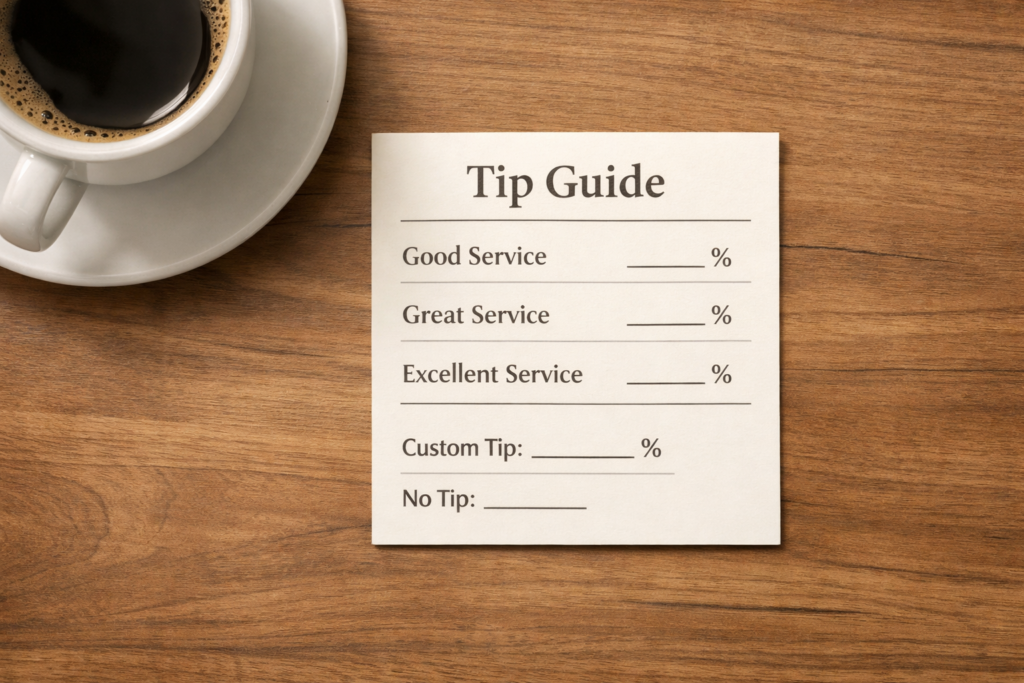
One of the simplest ways to reduce tipping stress is to stop using percentages entirely. Flat tips provide predictability and fairness without math.
In sit-down restaurants, a modest flat amount per person often works well. For a simple meal, a few dollars per person is reasonable and respectful. For longer meals or more attentive service, a slightly higher flat amount feels appropriate.
Delivery services can follow a similar logic. A base amount that you are comfortable with, adjusted slightly for distance or weather, is enough. The driver benefits from consistency, and you benefit from clarity.
Coffee shops and counter service often involve minimal interaction. A small dollar tip, or none at all for quick take-out, is acceptable. The pressure created by tip jars and screens does not change that.
Haircuts and personal services usually happen less frequently, making them easier to plan for within a monthly budget. A flat amount that reflects how often you visit is more important than the price of the service itself.
Taxis and rideshares can be handled by rounding up to a comfortable amount. This feels natural and avoids calculations.
Flat tips remove the emotional roller coaster. You know what you will give before you arrive. There is no last-minute decision to regret.
Deciding who to prioritize when money is tight
Even with a budget, there may be months when tipping needs to be selective. This does not make you unkind. It makes you realistic.
Service workers whose income depends heavily on tips are usually the highest priority. Restaurant servers, delivery drivers, and personal care providers fall into this category. A consistent modest tip matters more than an occasional large one.
Other situations involve less dependence on tips. Counter service, retail, and self-service environments often include tip prompts even when tipping is not expected. Choosing not to tip in these situations is reasonable, especially on a fixed income.
It is also important to remember that businesses are responsible for wages. Customers are not required to make up for systemic issues. Your responsibility is to act within your means.
Prioritization allows your limited tip budget to do the most good without stretching you thin.

When kindness matters more than cash
Tipping is one form of appreciation, but it is not the only one. A genuine thank-you, eye contact, and respectful behavior leave a strong impression.
Service workers consistently report that polite customers stand out. Using someone’s name, expressing appreciation, and treating them with patience can matter as much as a few extra dollars.
Positive words also extend beyond the moment. Leaving a kind comment, praising good service to a manager, or simply acknowledging effort can have lasting impact.
For seniors on a fixed income, combining modest tips with sincere gratitude creates a balanced form of generosity that feels authentic.
Navigating tip screens with confidence
Modern payment systems often present tipping options in ways that feel aggressive or uncomfortable. Large buttons, high percentages, and limited choices can create pressure.
It is important to remember that these screens are suggestions, not rules. Choosing a custom amount or skipping a tip does not require explanation. No one is entitled to your financial details.
If a screen feels overwhelming, taking a breath before responding helps. You are not being timed. You are allowed to choose what fits your budget.
Confidence grows with repetition. The first few times may feel awkward, but the discomfort fades quickly when you remember that you have a plan.
Common mistakes to avoid on a fixed income
One common mistake is tipping emotionally. Feeling rushed, embarrassed, or overly grateful can lead to tips that exceed your comfort level. Planning prevents this.
Another mistake is using credit cards for tips without tracking them. This can create the illusion that tipping is free, only to cause regret when statements arrive.
Comparing yourself to younger diners or higher-income households is also unhelpful. Their circumstances are different. Your generosity should reflect your reality, not someone else’s.
Finally, punishing yourself for a “mistake” tip is unnecessary. One generous moment does not define your habits. Learn from it and move forward.
Why planned tipping often feels more generous
There is a quiet confidence in tipping that comes from planning. When you know your limits, your actions feel intentional rather than hesitant.
Service workers notice this. A modest but consistent tip given calmly often feels more respectful than a larger tip given with discomfort or apology.
Planned tipping also protects your peace of mind. You leave interactions feeling satisfied rather than worried. Over time, this changes your relationship with money in a positive way.
Generosity is not about impressing strangers. It is about acting in alignment with your values.

A calmer way forward
Tipping on a fixed income does not require sacrifice, stress, or shame. It requires boundaries.
A monthly tip budget gives you control. Flat tips give you clarity. Prioritization gives you balance. Kindness fills the rest.
When tipping becomes part of your plan instead of a surprise, it stops feeling like a burden. It becomes what it was always meant to be — a simple gesture of appreciation that fits comfortably within your life.
If you take one thing from this guide, let it be this: generosity is measured by intention, not by numbers on a screen.