
Getting your ears pierced feels simple on the surface.
You pick the placement, choose the jewelry, sit down, take a breath, and a few moments later it is done.
But once the appointment ends and the payment screen appears, a very normal question shows up right behind it:
Do you tip an ear piercer?
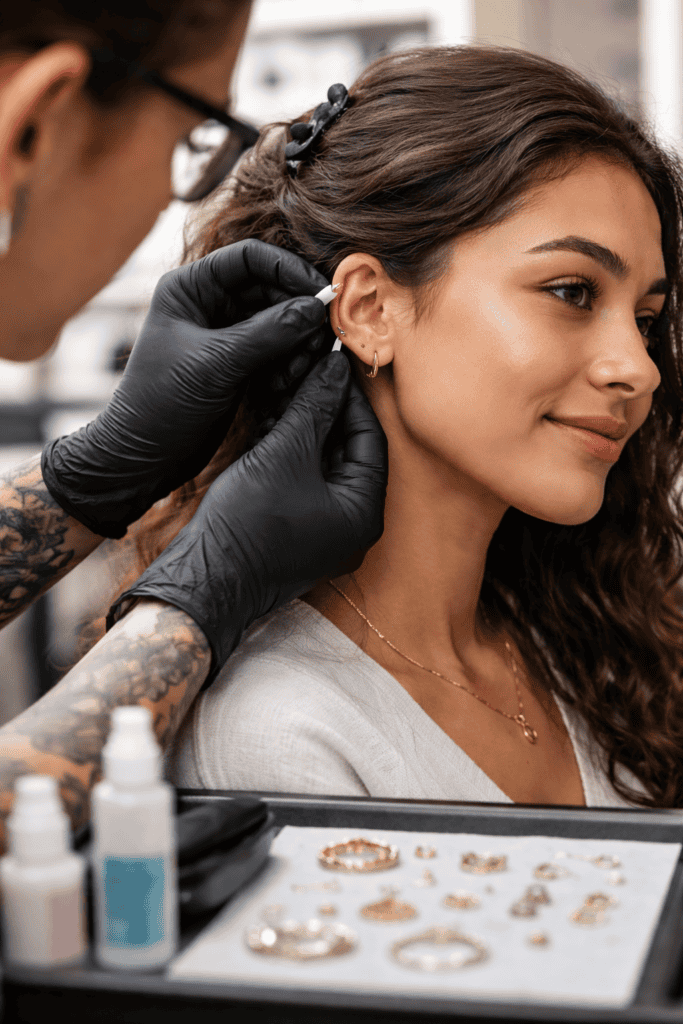
In most cases, yes, tipping an ear piercer is common in the United States, but it is still optional rather than mandatory. There is no universal legal or industry rule that says you must tip. At the same time, many piercing professionals and studio etiquette guides describe tips as appreciated, especially when the piercer provided careful placement, clear aftercare instructions, quality jewelry guidance, and a calm, professional experience.
That balance matters.
An ear piercing is not quite like buying a retail product.
It is also not exactly like restaurant service.
It sits in its own category.
A piercer is handling sterile tools, assessing anatomy, helping with jewelry selection, creating a wound on purpose, and then giving you aftercare guidance that can affect healing for weeks or months. The Association of Professional Piercers says piercing breaks the protective barrier of the skin and carries real health risks, including infection and bloodborne disease exposure if proper standards are not followed.
So the short answer is this:
Tipping an ear piercer is usually a thoughtful and normal gesture when the service is good.
But it is not an absolute requirement.
The short answer: yes, usually — but it is optional
If you want one simple rule to follow, use this:
Tip an ear piercer if the experience was good and you can comfortably do so.
Do not panic if you cannot.
That is close to how many professional piercers describe it themselves. Piercer Lynn Loheide’s public FAQ says tips are “never expected, always appreciated,” and notes that some clients tip by percentage, some tip a flat rate, and some do not tip at all. Another studio etiquette guide from Body AltAR says tipping is not mandatory, but is often appreciated when you are happy with the service.
That is the best starting point because it avoids two bad assumptions.
The first is thinking a tip is required no matter what.
The second is thinking a piercer is just selling jewelry and therefore tipping makes no sense.
Neither view really captures what the appointment is.
Why ear piercing feels different from a normal retail purchase
When people hesitate about tipping an ear piercer, it is often because the bill usually includes both service and jewelry.
That can make the whole thing feel a little confusing.
But a professional piercing appointment is more than a product sale.
The Association of Professional Piercers makes that clear in its public guidance. APP materials emphasize safety, proper studio practices, suitable jewelry, and informed aftercare. The group also notes that training and regulation are inconsistent across places, which is why choosing a qualified piercer matters so much.
A good ear piercer is not just making a hole.
They are checking whether your anatomy suits the placement.
They are helping you avoid unsafe jewelry.
They are setting up sterile equipment.
They are reducing the risk of infection.
They are making judgment calls that affect healing, comfort, symmetry, and long-term results.
That is why many people treat piercing more like a personal service than a basic transaction. Studio etiquette guidance aimed at clients often frames tipping as a thank-you for specialized skill and personal attention, not just for the few seconds it takes to pass the needle through.
Why many people choose to tip piercers
There is a practical reason tipping is common in piercing studios.
A good appointment often includes a lot of work that you do not fully see.
The actual piercing may take only a moment.
The real service starts before that.
A reputable piercer usually spends time on consultation, consent, sanitation, placement marking, jewelry fit, and aftercare. APP guidance stresses that proper care, appropriate jewelry, and informed instruction are central to a safer result, not optional extras.
That hidden labor is part of why people tip.
Not because there is a hard rule.
Because the appointment is hands-on, skilled, personal, and safety-sensitive.
And when a piercer makes someone feel calm during something that can be painful or nerve-racking, that often feels worth recognizing too.
This is especially true for first-time ear piercings, cartilage work, or appointments for children and nervous clients.
So how much do you tip an ear piercer?
There is no official nationwide percentage.
That is the honest answer.
Still, a practical tipping range that comes up often in piercing etiquette discussions is about 15% to 20% of the piercing service, with many people using a flat-dollar amount for simpler ear piercings like single or double lobes. Public-facing studio and piercer guidance describes a mix of percentage tips and flat tips as normal, while also stressing that gratuity is optional.
That means a few simple approaches all make sense:
If you had a straightforward lobe piercing and the service was smooth, a modest flat tip can be perfectly reasonable.
If the appointment involved multiple piercings, detailed styling help, extra patience, or a lot of consultation, a percentage tip may feel more natural.
If the service was excellent, tipping more is also fine.
If the experience was poor, tipping less or not tipping is within your rights.
The key is not to overcomplicate it.
This is not one of those situations where everyone is silently judging whether you hit an exact number.
Should you tip on the jewelry price or just the piercing fee?
This is one of the biggest gray areas.
And it comes up often because ear piercing bills can vary a lot depending on jewelry.
High-quality jewelry can significantly raise the final total.
APP guidance repeatedly emphasizes that proper jewelry matters, especially for fresh piercings, because unsuitable materials can create real problems for new clients.
Because of that, many clients prefer to tip based on the piercing service rather than the full jewelry total, especially if they chose expensive gold or premium pieces.
Others tip on the full total because the piercer also spent time helping select and install the jewelry.
Both approaches exist.
And because there is no universal rule, neither one is inherently wrong.
A sensible middle-ground is to ask yourself what part of the bill feels like service.
If the jewelry choice was simple and the bill jumped mainly because of the metal or design, tipping on the service portion is a fair approach.
If the piercer spent a lot of time curating placements and walking you through jewelry options, tipping on more of the total can also make sense.
When you should definitely consider tipping more
Some ear piercing appointments clearly involve more care than others.
That is where tipping more often feels most natural.
For example, you may want to be more generous if the piercer:
Spent extra time calming nerves.
Helped style multiple ear placements thoughtfully.
Worked carefully around difficult anatomy.
Explained aftercare in a way that made you feel confident.
Fixed a bad previous piercing plan.
Stayed patient during a child’s appointment.
Fit you with better jewelry than the cheap standard options many mall-style piercing places use.
This matters because a safe piercing is not only about technique.
It is also about decision-making.
The APP’s public materials are full of reminders that jewelry quality, studio practices, and aftercare can seriously affect outcomes.
When someone brings real expertise to the appointment, many people feel a tip is warranted.
When it is okay not to tip
Not tipping is not automatically rude.
That is important to say clearly.
Professional piercer Lynn Loheide explicitly says tips are appreciated but not expected, and that some clients are not able to tip at all.
So if your budget is already stretched by the piercing fee and jewelry, it is okay to stop there.
It is also okay not to tip if the experience was poor.
Maybe the piercer was dismissive.
Maybe the consultation felt rushed.
Maybe the studio was not reassuring.
Maybe the staff pushed jewelry without explaining anything.
A tip is a thank-you.
It is not a penalty for being honest about bad service.
There is another case where people often hesitate: a free jewelry change, short check-up, or quick help at a piercing studio.
In those situations, a tip can be a kind gesture, but it is still optional.
Sometimes a sincere thank-you or a great review is enough.
Why safety matters more than the tip itself
If you are spending time wondering about tipping an ear piercer, it is worth spending even more time on one bigger question:
Was the piercer reputable in the first place?
That matters more than gratuity.
The Association of Professional Piercers says safety is in your hands because you cannot assume consistent training or regulation everywhere. Its public resources encourage people to research studios, understand aftercare, and use qualified professionals. APP also offers a member locator so clients can search for APP members by location.
That matters because bad ear piercings are not just cosmetic annoyances.
Medical sources note that ear piercings can become infected, and cartilage infections can be especially serious. Cleveland Clinic says infected piercings may become red, swollen, sore, warm, itchy, or tender and may ooze pus. UK health guidance on ear-piercing-related perichondritis warns that cartilage infections can become severe and may even lead to permanent deformity if not treated properly.
So while tipping is useful etiquette, safe piercing is the much bigger priority.
A good piercer usually earns the tip before the needle even comes out
One of the easiest ways to judge whether tipping feels right is to look at the full experience.
Did the piercer explain the process?
Did they wash up and handle equipment professionally?
Did they talk you through placement?
Did they explain what jewelry was best for a fresh piercing?
Did they give clear healing instructions?
APP aftercare guidance says fresh piercings should be cleaned with sterile saline, handled only with clean hands, and not twisted or rotated unnecessarily. Mayo Clinic also advises leaving jewelry in place during healing and avoiding irritation from touching or friction.
If someone gave that level of care, the appointment probably felt like more than a transaction.
And that is exactly the kind of experience many people choose to tip for.
What if the piercer owns the studio?
People ask this a lot.
Some assume that if the piercer owns the studio, tipping is unnecessary because they already control the pricing.
In practice, tipping can still happen.
There is no universal etiquette law saying owners should or should not be tipped in piercing.
Since many piercers publicly frame tips as appreciated but optional, the safer view is this: ownership does not forbid tipping, but it does make tipping feel even more discretionary.
So if the owner-piercer gave excellent service, tipping is still a reasonable gesture.
If you do not tip, that is also less likely to be seen as a breach of etiquette than in a heavily tip-dependent industry.
Better alternatives if you do not want to tip cash
Cash is common, but it is not the only way to show appreciation.
Some clients leave glowing reviews.
Some refer friends.
Some bring a thank-you card or a small gift.
Some return for future jewelry upgrades and follow-up appointments.
Lynn Loheide’s FAQ even notes that some clients bring creative gifts or thank-you items instead of money.
That matters because piercing is often relationship-based.
If you find a piercer you trust, that relationship can last for years.
A thoughtful review and repeat business can matter a lot.
The bottom line on ear piercing etiquette
The cleanest answer is this:
Yes, it is normal to tip an ear piercer.
No, it is not mandatory.
And in real life, the right choice usually depends on the quality of the appointment, the complexity of the service, and your budget.
A professional ear piercing involves more than a quick puncture. APP resources make clear that proper piercing requires attention to hygiene, jewelry quality, anatomy, and aftercare. Piercers themselves often describe tips as appreciated but not expected. Medical sources also show why choosing a skilled professional matters, since poor technique or poor aftercare can lead to infection and more serious complications, especially with cartilage piercings.
So if the service was good, tipping is a solid and courteous move.
If the service was exceptional, tipping more makes sense.
If the appointment was disappointing or money is tight, not tipping is acceptable.
That is the real etiquette.
It is not about pressure.
It is about appreciation.
Final verdict: do you tip an ear piercer?
Usually, yes.
But only if you want to.
In the U.S., tipping an ear piercer is widely treated as a polite thank-you for skilled, personal service, especially when the appointment includes careful placement, high-quality jewelry guidance, strong hygiene practices, and clear aftercare. At the same time, professional piercers themselves often say tips are appreciated rather than expected, which means you are not breaking a rule if you skip it.
A practical approach is simple.
If the appointment felt professional, reassuring, and well done, tip what feels fair.
If not, pay the bill and move on.
And above all, choose a piercer based on safety and skill first.
That will matter much longer than the gratuity.
Sources
- Association of Professional Piercers – Picking Your Piercer
- Association of Professional Piercers – Find a Piercer
- Association of Professional Piercers – Suggested Aftercare for Body Piercings
- Association of Professional Piercers – Aftercare for Minors
- Association of Professional Piercers – Piercing FAQ
- Association of Professional Piercers – Body Jewelry Verification Program FAQ
- Lynn Loheide – FAQ
- Body AltAR – Piercing Studio Etiquette
- iPrickU – Tipping Your Body Piercer
- Cleveland Clinic – Infected Ear Piercing
- Mayo Clinic – Piercings: How to Prevent Complications
- UK Government – Information for Ear and Cosmetic Piercing Businesses