
Yes, you can tip an appliance delivery person.
But in most cases, you do not have to.
That is the clearest answer.
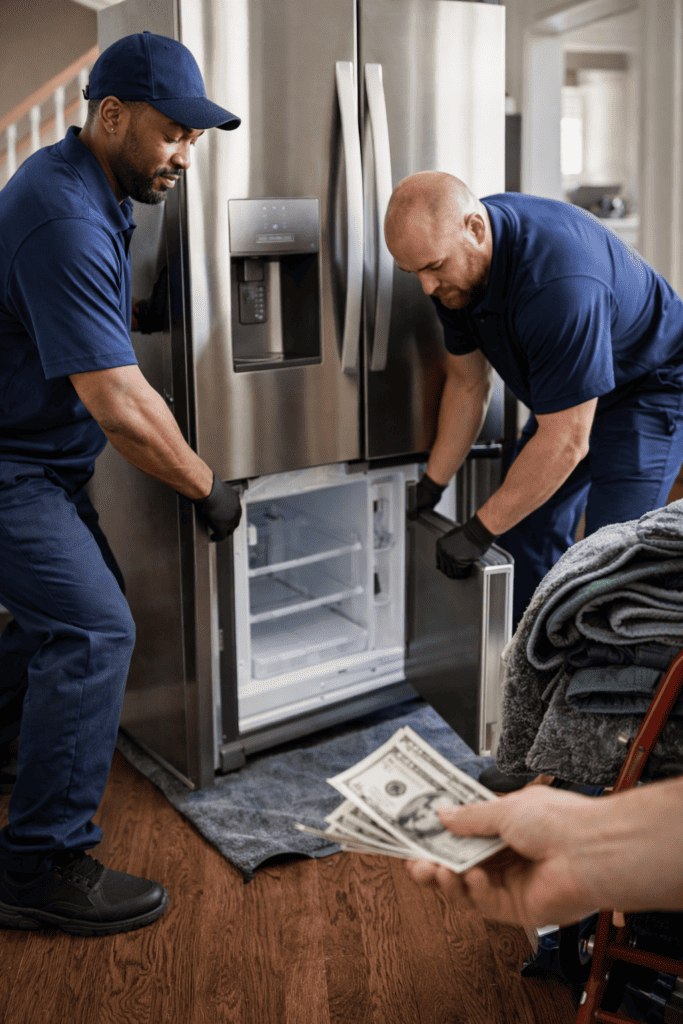
The most reliable guidance points to tipping as optional, not required, for appliance delivery. Consumer Reports says that even when delivery fees are substantial, a small tip of $5 to $10 per person can be a way to acknowledge the physical effort of a delivery team, while Mr. Appliance says tipping is appreciated but not required and suggests $10 to $20 per person for exceptional service.
That means appliance delivery is not treated the same way as a sit-down restaurant meal.
It is closer to a skilled home-service visit.
You already paid for the delivery.
You are not expected to add a mandatory gratuity on top.
But if the crew handled a difficult job well, a tip is a normal and generous way to say thank you.
The quick answer
If you want the simplest rule, use this:
For a routine appliance delivery, no tip is necessary.
For a difficult or unusually helpful delivery, tipping is a nice gesture.
A practical range from current etiquette-style guidance is about $5 to $10 per person for solid service and roughly $10 to $20 per person when the crew went above and beyond. Consumer Reports and Mr. Appliance both land in that general zone, and Oprah Daily also suggests $10 to $20 for appliance deliveries when tipping is allowed and the service was favorable.
That is the basic answer that fits most households.
Why this question feels confusing
Appliance delivery sits in an awkward middle ground.
It is clearly a service.
But it is also usually a paid service with its own delivery fee, installation fee, haul-away fee, or all three.
That makes people wonder whether the extra money is already covered.
Retailers themselves reinforce that feeling because many of them spell out the included services in detail. Lowe’s has a dedicated appliance delivery and haul-away page describing delivery options and additional service choices by appliance type, while Costco’s appliance delivery guidance says professional delivery and connection to existing compatible utilities may be included in the price.
That is why people hesitate.
They know the crew is doing real physical work.
But they also know they may already be paying a visible service charge.
So the real question is not whether appliance delivery is valuable.
It is whether that value is already fully priced in, or whether extra effort should still be rewarded personally.
Most guidance lands in the middle: the service is paid for, but a tip is still welcome for strong service.
Appliance delivery fees and tipping are not the same thing
This is the most useful distinction to keep in mind.
A delivery fee pays for the delivery service itself.
A tip is a voluntary thank-you for the people doing the work.
That difference matters because many appliance purchases involve structured service packages. Costco says professional delivery and hookup to existing compatible utilities may be included in the appliance price, and Lowe’s similarly presents delivery, haul-away, and other service options as formal parts of the purchase.
So if you already paid for delivery and installation, you should not feel as though you are morally required to tip on top of that.
You have already paid for the core service.
A gratuity is only about whether the crew’s actual work made you want to add something extra.
So, do you tip an appliance delivery person?
Usually, only if you want to.
That is the most honest version.
Consumer Reports does not frame appliance-delivery tipping as mandatory.
It frames it as a “small tip” for the physical effort involved.
Mr. Appliance says the same thing even more directly: tipping is appreciated but not required. Oprah Daily also says there is “much debate,” and advises first checking company policy, then considering a tip if the service was favorable or the crew went above and beyond.
So if the crew simply brought in a dishwasher, set it where it belonged, and left without any real complications, no tip is perfectly acceptable.
If they maneuvered a refrigerator through a narrow hallway, protected your floors, removed the old unit, installed the new one cleanly, and solved problems without fuss, tipping starts to make much more sense.
When tipping makes the most sense
A tip feels most justified when the delivery was clearly harder than average.
That might mean stairs.
It might mean tight corners.
It might mean a very heavy washer, dryer, or refrigerator.
It might mean awkward condo access, difficult parking, or a full haul-away job.
Consumer Reports specifically ties tipping to the physical effort of the delivery team. Oprah Daily says a tip is appreciated when the crew had to go above and beyond, such as carrying a heavy appliance down a flight of stairs. Mr. Appliance says delivery difficulty and professionalism should help guide the decision.
That is a good way to think about it.
Tip for effort.
Tip for care.
Tip for problem-solving.
Not simply because an appliance showed up at your door.
Installation changes the picture
Installation often makes the service more demanding.
A basic curbside or room-of-choice drop-off is one thing.
A full install is another.
Costco’s appliance guidance notes that professional delivery and connection to existing compatible utilities may be included, depending on the appliance and location. Best Buy’s appliance service page says delivery teams or installers are required to install an anti-tip bracket for new ranges at no additional charge, and that refusing anti-tip installation turns the service into drop-off only.
That means some crews are doing more than carrying boxes.
They may be positioning appliances, leveling them, connecting utilities where eligible, removing packaging, or hauling away old units.
When that work is done carefully and smoothly, many homeowners feel a tip is warranted even though the underlying service was already purchased. Consumer Reports and Mr. Appliance both support that kind of “tip for strong service, not because it is mandatory” approach.
How much should you tip?
A flat amount usually works better than a percentage.
That is because appliance orders can be expensive.
A percentage of the total bill can get large very fast, especially when the price reflects the product itself rather than only the labor.
The cleaner approach is to use a per-person amount.
Consumer Reports says $5 to $10 per person is a reasonable small tip for delivery teams. Mr. Appliance suggests $10 to $20 per person for exceptional service, and Oprah Daily says delivery workers themselves often view $10 to $20 per person as suitable when tipping is permitted and the job was done well.
So in practice, many people think like this:
For ordinary good service, something at the lower end.
For harder or more careful work, something at the higher end.
That keeps the tip proportional without turning it into a math problem.
Should you tip each person or one total amount?
If there are two delivery workers, a per-person tip is usually the clearest way to handle it.
That matches how Consumer Reports and Mr. Appliance describe tipping, both using a per person framing.
That way, each crew member is acknowledged directly.
It also avoids confusion over whether one person did more of the carrying, setup, or haul-away work.
If you prefer handing over one total amount, that can still work.
But the common etiquette language is per person, not one pooled figure.
What if the company does not allow tips?
Then do not push it.
This point matters because company policy can vary.
Oprah Daily explicitly says to check company policy first and gives Best Buy as an example of a retailer where tipping may not be allowed. There is also a Best Buy partner policy document stating that employees must not solicit or encourage tips and must attempt to politely decline or refuse them, though it also says employees may not always be able to refuse without offending the customer.
So the smart move is simple:
If a company or crew says they cannot accept tips, respect that.
In that case, the better thank-you is often a cold drink, a positive review, or a quick call or message complimenting the crew’s work.
What if the service was poor?
Then a tip is not necessary.
Because tipping appliance delivery is optional to begin with, there is no reason to add money for weak service.
If the crew was careless, rude, rough with your home, or visibly disorganized, paying the agreed delivery and installation fees is enough.
That still fits the core guidance from Consumer Reports, Oprah Daily, and Mr. Appliance, all of which frame tips as acknowledgments of physical effort and good service, not automatic charges.
In a bad-delivery situation, the better move is to document the issue and contact the retailer.
That matters more than forcing a gratuity you do not think was earned.
Cash is usually the easiest option
If you choose to tip, cash is usually simplest.
That is not because every source says “cash only.”
It is because appliance delivery systems are usually built around delivery fees, not digital tipping prompts.
The guidance from Consumer Reports, Oprah Daily, and Mr. Appliance all talks about tipping as a direct gesture to the crew rather than as part of checkout.
A few bills ready before the delivery window starts makes the moment easier.
It also gives you time to decide after seeing how the crew handled the job.
Good alternatives if you do not want to tip
A tip is not the only good way to thank a crew.
Mr. Appliance specifically says refreshments are a valid alternative gesture.
That matters more than it sounds.
Appliance delivery can be hard physical work.
Cold water on a hot day or coffee on a cold morning can be genuinely appreciated.
A strong review can also help, especially when the retailer uses contractors or third-party delivery partners.
If the crew solved a hard problem well, that kind of feedback can matter.
A few real-life examples
If a team delivers a microwave or dryer to an easy-access ground-floor home, no tip is necessary. That is fully consistent with the “optional, not required” guidance from Consumer Reports and Mr. Appliance.
If two workers bring a refrigerator through a tight entry, protect the floors, remove the old unit, and install the new one without damage or delay, a tip in the commonly cited range of $10 to $20 per person is a reasonable thank-you.
If a retailer says its employees are not supposed to accept tips, follow that policy and offer appreciation another way. Oprah Daily and Best Buy’s policy materials both support checking policy first.
The best rule to follow
If you want one rule that works almost every time, use this:
You do not need to tip an appliance delivery person. But if the crew handled a difficult delivery, installation, or haul-away especially well, a small per-person tip is a thoughtful gesture. Current guidance commonly lands around $5 to $10 per person for solid service and $10 to $20 per person for exceptional service, as long as company policy allows it.
That keeps the whole thing simple.
You are not ignoring the service if you skip the tip on a routine job.
And you are not overthinking it if you reward a crew that clearly made a hard delivery look easy.
Sources
- Consumer Reports — How to Tip With More Confidence
- Consumer Reports — How Much of a Tip Should You Leave?
- Mr. Appliance — Appliance Etiquette: Do You Tip Appliance Delivery Guys?
- Lowe’s — Appliance Delivery, Installation & Haul Away
- Costco — Delivery and Installation Guidelines: Appliances
- Best Buy — Appliance Delivery, Installation & Repair Services
- Best Buy — Gifts and Vendor Relations Policy
- Oprah Daily — How Much Should You Tip for Delivery?