
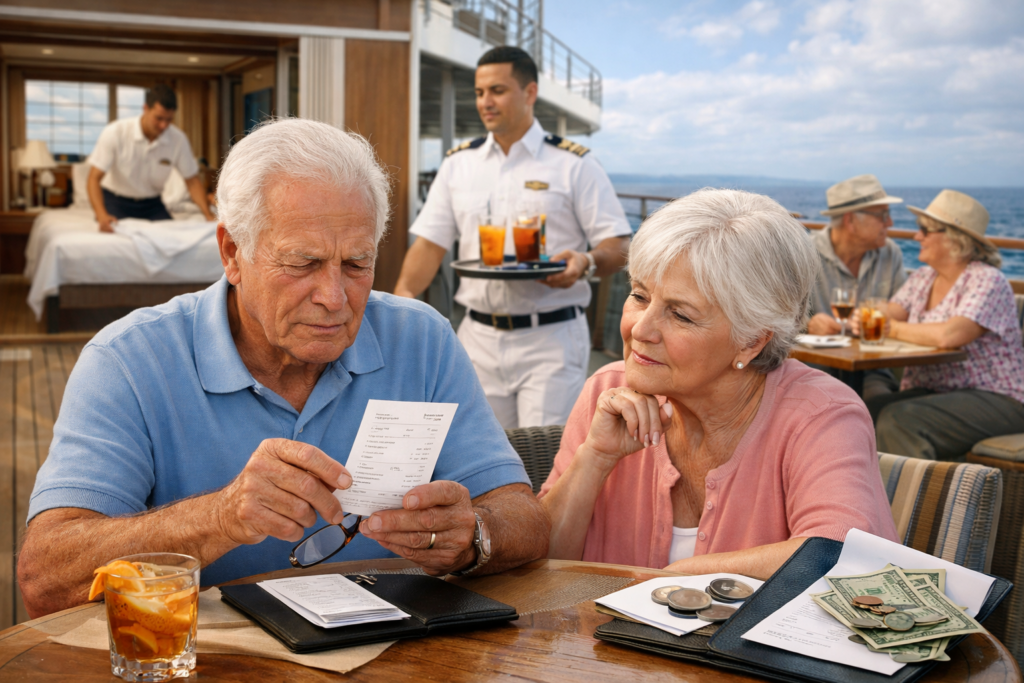
Cruises are supposed to feel easy. You unpack once, the meals appear like magic, and someone seems to know your name by the second day. Then you see it: gratuities, service charges, automatic tips, prepaid tips, “recommended” amounts, “additional tipping,” and a bill that doesn’t always look like what you expected.
If you’re a senior cruiser—or traveling with seniors—this can feel especially stressful. Many older travelers are careful budgeters. Some are on a fixed income. Some simply don’t like awkward money moments, especially when staff are kind and hardworking. And many people wonder the same thing:
What’s required, what’s optional, and what’s truly extra?
This guide clears it up in plain language. You’ll learn how cruise gratuities work, when prepaying makes sense, when extra tipping is actually appropriate, and how to handle exceptional service (or poor service) without guilt. The goal is simple: you should walk onto the ship confident, relaxed, and in control of your costs.
What Cruise Gratuities Actually Are
On land, tipping is usually tied to one interaction: you eat a meal, you leave a tip. You get a haircut, you tip the stylist. It’s visible, direct, and you decide the amount.
Cruises are different because the service is continuous. Your room is cleaned while you’re at breakfast. Your towel animal appears while you’re at a show. A dining team may serve you night after night, remembering your preferences. And behind all of that is a large crew you may never see—dishwashers, laundry teams, galley staff—who keep the ship running smoothly.
To handle this, many cruise lines use a built-in system of “gratuities” that functions more like a daily service fee than a classic tip.
Why cruise lines use this system
Cruise lines prefer a gratuity system for a few reasons:
- It helps ensure a wide range of crew members receive compensation tied to guest satisfaction.
- It reduces constant cash tipping (and the awkwardness that comes with it).
- It creates a predictable revenue stream that supports labor costs across the ship.
Whether you love this system or hate it, it’s important to understand that “gratuity” on a cruise often means a standardized charge that the cruise line adds to your onboard account.
Service charges vs tips: the key difference
You’ll see terms like:
- Automatic gratuities
- Service charges
- Hotel service charge
- Daily gratuity
These usually refer to a set daily amount charged per person, added to your onboard account unless you prepay or your fare includes it.
Then there’s extra tipping, which is the optional “above and beyond” money you choose to give directly to an individual crew member for exceptional service.
The confusion happens because cruise lines may call a fixed fee a “gratuity,” even though it behaves like a built-in charge. That’s why many seniors feel blindsided: it doesn’t feel like a tip when it’s automatic.
Here’s the clean way to think about it:
- Automatic/prepaid gratuities: the ship’s standard system (often expected, sometimes adjustable).
- Extra tipping: your personal “thank you” for standout service (always optional).
Automatic Cruise Gratuities Explained
Automatic gratuities are the most common system on mass-market cruise lines. If you do nothing, these gratuities are typically added to your onboard account each day.
What automatic gratuities are (in plain English)
Automatic gratuities usually work like this:
- A daily amount is charged per person.
- The charge appears on your onboard account.
- It’s meant to cover common service roles like housekeeping and dining staff.
- The amount may vary by cabin category (standard cabin vs suite).
Think of it as the cruise line’s way of saying: “We’ll distribute tips through our system, so you don’t have to tip every time you’re helped.”
How much are automatic gratuities?
Cruise gratuity rates change over time and vary by cruise line, ship, itinerary, and cabin category. Because of that, the smartest approach is to treat them as a daily per-person cost you should confirm at booking.
In general, on many mainstream cruise lines, gratuities often land in a mid-to-high teens per person per day range, and higher for suites. Some cruises also add a service charge to certain purchases onboard, like drinks or specialty dining.
Instead of memorizing a number that might be outdated, build the habit that keeps seniors safest:
- Look at your booking summary for “gratuities” or “service charges.”
- If it’s unclear, call the cruise line or travel agent and ask:
“What is the daily gratuity rate per person for my cabin, and what purchases add service charges?”
That one question prevents most surprise bills.
Who receives automatic gratuities?
This is another big senior concern: “If I pay automatic gratuities, who actually gets it?”
Cruise lines typically distribute this money among service teams such as:
- Cabin housekeeping staff
- Dining room service teams
- Support staff who make the operation work behind the scenes
The exact distribution is handled by the cruise line, not the guest. You’re contributing to a shared system, not handing cash to one person.
Will staff know if you pay or don’t pay?
Many seniors worry about being treated poorly if they don’t tip extra. In practice:
- Crew members are trained to deliver consistent service.
- Many guests never tip extra and still receive excellent care.
- The quality of service is usually driven by training, standards, and overall workload—not a single guest’s tipping choices.
What matters most is this: your behavior and kindness are remembered more than your wallet. A warm greeting, learning someone’s name, and writing a compliment on a survey can genuinely impact a crew member’s work experience.
Can seniors opt out or adjust automatic gratuities?
Some cruise lines allow guests to adjust or remove automatic gratuities by visiting guest services, while others treat them as more fixed. Policies vary, and they can change.
If you are considering adjusting gratuities, do it thoughtfully and with clarity. A few senior-friendly reasons someone might adjust include:
- A service issue that was not resolved after reporting it
- A major accessibility failure that materially impacted the trip
- A billing error (wrong number of guests, wrong cabin category, etc.)
If you’re adjusting purely to avoid cost, it’s worth pausing and asking: “Am I comfortable reducing money that supports crew compensation across multiple roles?” Some seniors are; some aren’t. There’s no need for guilt, but there is value in being intentional.
If you do adjust:
- Speak calmly at guest services.
- Be specific and factual.
- Keep it short: “I’d like to review the gratuity charges on my account.”

Prepaid Cruise Gratuities: Are They Worth It for Seniors?
Prepaid gratuities are exactly what they sound like: you pay gratuities before you sail, usually at booking or before final payment. For many seniors, this is the easiest path because it reduces anxiety and helps keep the onboard bill clean.
What prepaying really does
Prepaying typically means:
- The daily gratuities are covered in advance.
- The charges don’t appear day-by-day on your onboard account.
- You still may see service charges on certain onboard purchases (like drinks), depending on the cruise line.
Prepaying does not usually eliminate every possible service charge onboard. It mainly handles the big daily gratuity portion.
Why prepaying is often a great fit for seniors
Many older travelers like prepaying for three simple reasons:
Budget certainty
You know the cost upfront. That is gold if you’re retired or on a fixed income.
Less stress onboard
No daily tally. No wondering if you’re “doing it right.”
Fewer awkward moments
You’re not trying to figure out envelopes, cash, or who expects what.
If you’re traveling with a group—especially adult children, grandkids, or friends—prepaying also avoids confusion like: “Did everyone pay their share? Are gratuities included for the kids? Who’s covering what?”
When prepaying might not be the best choice
Prepaying can be less ideal in certain situations:
You want flexibility
If you strongly prefer to tip in cash directly, you might not want to prepay.
You are on a cruise type where gratuities are already included
Some premium and luxury cruises include gratuities in the fare. Prepaying might be unnecessary or already built in.
You’re concerned about refund or cancellation details
Refund policies vary. If your trip changes, you’ll want clarity on how prepaid gratuities are handled.
The easiest way to decide is to ask yourself one question:
Do I prefer a smooth, predictable cruise bill—or do I want hands-on control over every tip?
Most seniors prefer smooth and predictable. That’s why prepaying is often a “yes.”
A simple comparison that removes the confusion
Automatic gratuities:
Paid onboard daily unless covered. Convenient, but can feel like a surprise.
Prepaid gratuities:
Paid before you sail. Convenient and budget-friendly.
Extra tipping:
Optional. You decide when exceptional service deserves something extra.
Once you separate those buckets, the stress drops fast.
Extra Tipping on a Cruise: What’s Truly Optional
This is where seniors often feel social pressure. Some people talk like you must tip extra constantly. Others say you should never tip extra because it’s already covered. The truth is in the middle, and it’s simple:
Extra tipping is optional.
It’s a personal “thank you,” not a requirement.
When extra tipping makes sense
Extra tipping makes the most sense when one person’s work clearly improved your trip in a meaningful way. Examples:
Your cabin steward consistently goes above and beyond
They remember your preferences, bring extra hangers without being asked, help with an accessibility request, or solve a comfort issue quickly.
Your dining team makes the experience special
They handle dietary needs flawlessly, pace meals perfectly, or create a warm routine that makes you feel cared for.
Someone helps with a real challenge
A crew member who patiently assists with mobility needs, repeated tray carrying, or special arrangements that go beyond standard service.
In those cases, extra tipping is less about money and more about recognition. Many seniors prefer giving a modest amount plus a sincere note, because it feels respectful without being flashy.
When extra tipping is not necessary
Extra tipping is generally not needed for routine interactions that are already part of the service structure, especially if automatic/prepaid gratuities are in place.
Examples where extra tipping is usually unnecessary:
- Buffet staff doing standard clearing
- General bar service if a service charge is already applied
- Quick counter service onboard
- Standard housekeeping with no special requests
If you tip extra in these cases because it makes you feel good, that’s fine—but don’t feel pressured.
Cash vs envelopes vs “add it to the bill”
Many cruises offer ways to give extra recognition without handing someone cash in public. Seniors often prefer privacy and simplicity.
Common senior-friendly options:
- Cash in a small envelope with a brief thank-you note
- A written compliment using the cruise feedback tools or survey
- A direct thank-you using the crew member’s name (this matters a lot)
If you do use cash:
- Bring small bills before you board.
- Don’t stress about perfection.
- Focus on the gesture and sincerity.
A senior-safe rule for extra tipping
If you want an easy rule that avoids overthinking:
- Tip extra only when you can clearly say, “This person improved my trip.”
- Keep it modest and consistent with your comfort.
- Pair it with a personal thank-you or note.
For many seniors, that means extra tipping happens for one or two people, not dozens.
Cruise Gratuities for Seniors With Special Needs
Cruises can be wonderful for seniors with mobility challenges because the environment is controlled and predictable. But gratuities can get confusing when extra help is involved.
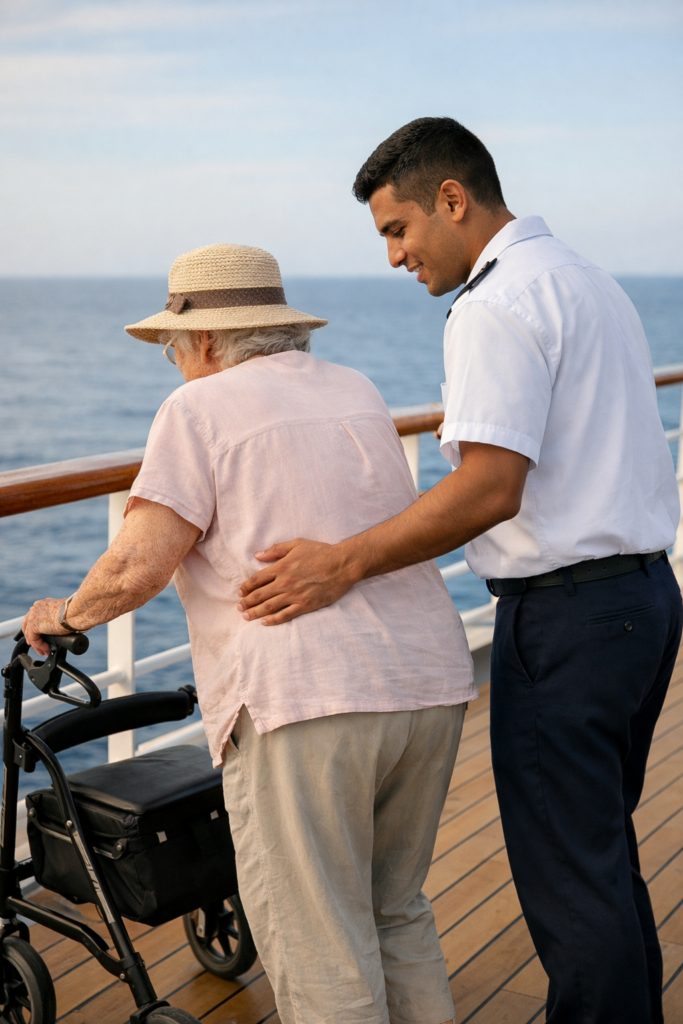
Mobility and accessibility support
If you need extra support—like help with a wheelchair, stability assistance, or repeated help getting around—focus on two ideas:
- Some services are part of the ship’s standard operations.
- Some help goes beyond routine and becomes personal, repeated assistance.
If someone is consistently assisting you beyond normal expectations, an extra tip and a sincere note can be appropriate. But you should never feel you have to “pay for dignity.”
Medical assistance onboard
Most ships have a medical center, and medical visits are typically billed, often at premium rates. Tipping medical staff is generally not part of typical cruise etiquette.
If you want to express gratitude for medical care, a written note or commendation is often the most appropriate route.
Caregivers traveling with seniors
If you’re traveling with a caregiver or companion:
- Decide ahead of time who handles what.
- Keep gratuity decisions consistent to avoid confusion mid-trip.
- Consider prepaying gratuities to keep daily budgeting clean.
The biggest gift you can give yourself here is a calm plan before you sail.
Luxury Cruises and River Cruises: A Different Gratuity World
Not all cruises handle gratuities the same way. This is especially important for seniors because many retirees choose premium, luxury, or river cruises for comfort and ease.
What “all-inclusive” can actually mean
On some premium or luxury cruises, gratuities may be included in the fare. That can be a major stress reducer.
Even then, you may still see:
- Service charges on certain premium purchases
- Optional extra tipping opportunities
- Port-specific tipping customs on excursions
The senior-safe approach is to ask a direct question before you book:
“Are gratuities included in my fare, and what onboard purchases still add service charges?”
Why many seniors prefer these models
All-inclusive gratuity models are appealing to seniors because:
- You avoid daily fee tracking.
- You avoid social pressure.
- You can enjoy service without constantly doing math.
This is especially valuable if you travel to relax, not to manage a ledger.
River cruises
River cruises often feel more personal. The crew is smaller, service can be more intimate, and the tipping culture can look different. Some river cruises recommend tips at the end of the journey, sometimes with guidance. Others include gratuities.
If you’re a senior trying a river cruise for the first time, double-check this early. River cruise gratuity expectations can feel unfamiliar if you’re used to big ships.
Cruise Gratuity Myths Seniors Should Ignore
A lot of cruise gratuity anxiety comes from myths that get repeated online or in cruise groups. Let’s clear the biggest ones.
Myth: “If I don’t tip extra, staff will treat me worse”
Most crew members are professionals working under clear standards. Extra tipping is not required to receive good service. Being polite, appreciative, and easy to work with often matters more than money.
Myth: “You must tip in cash to be respectful”
Cash can be appreciated, but it’s not the only way to show respect. A written compliment, a survey mention, and using someone’s name can be meaningful and sometimes even more powerful.
Myth: “Automatic gratuities go only to one person”
These charges are typically distributed across multiple roles, including people you never meet. That’s part of why they exist.
Myth: “I have to tip everyone”
You don’t. Extra tipping is optional. Most seniors who tip extra choose one or two standout people, not a long list.
How to Handle Exceptional Service Without Feeling Awkward
Exceptional service is one of the joys of cruising. The question is how to respond in a way that feels kind but not uncomfortable.
A graceful way to reward exceptional service
If you want to do something that feels meaningful and simple:
- Give a modest extra tip (if you’re comfortable).
- Add a short thank-you note.
- Mention the person by name in the survey or feedback form.
That combination covers the emotional side and the practical side. It shows gratitude and helps the crew member professionally.
A thank-you note matters more than most people realize
Seniors often underestimate how powerful a note can be. Many crew members keep thank-you notes. They can be deeply motivating, especially for staff who work long hours away from family.
A short note is enough:
- “Thank you for your kindness and care.”
- “You made our trip comfortable and easy.”
- “We noticed your hard work every day.”
No grand speech needed.
How to Handle Poor Service Without Guilt
This is the part many seniors avoid. They don’t want conflict. They don’t want to “cause trouble.” But you paid for a vacation, and you deserve what was promised.
Start with reporting the issue early
If something isn’t right—room cleanliness, accessibility support, dining problems—report it sooner rather than later. That gives the ship a chance to fix it.
A calm approach works best:
- Describe the issue.
- State what you need.
- Ask when it can be resolved.
If it isn’t resolved, consider your options
If the problem persists, you can:
- Speak to a supervisor in the relevant department.
- Visit guest services with a clear description.
- Ask about adjustments (including gratuity adjustments) if appropriate.
The key is to stay factual. The goal isn’t punishment. The goal is fairness.
A senior-friendly mindset that prevents regret
If you’re thinking about reducing gratuities due to poor service, ask yourself:
- Did I report the problem and give a chance to fix it?
- Was the issue one person’s behavior or a larger system failure?
- Am I doing this because of a real service problem or because I’m anxious about cost?
That quick reflection can prevent decisions you later feel uneasy about.

Real-World Senior Scenarios That Make Gratuities Easy
Sometimes the best way to understand tipping is to see it in real situations.
Scenario: The first-time senior cruiser who hates surprise bills
Best approach:
- Prepay gratuities.
- Expect additional service charges on certain onboard purchases.
- Bring a small amount of cash for optional extra tipping only if someone truly stands out.
Result: predictable budget, calm trip.
Scenario: The fixed-income couple cruising once per year
Best approach:
- Treat gratuities as part of the trip cost, like taxes.
- Prepay if possible.
- Tip extra only for exceptional service, and keep it modest.
Result: kindness without financial strain.
Scenario: The solo senior traveler who values privacy
Best approach:
- Prepay or accept automatic gratuities.
- If tipping extra, do it with a note in an envelope.
- Use surveys and feedback forms to recognize staff.
Result: no public awkwardness, still respectful.
Scenario: The senior traveler with mobility challenges
Best approach:
- Confirm accessibility support ahead of time.
- Be clear about needs early in the trip.
- Tip extra only if an individual provides repeated help beyond routine expectations.
Result: dignity, comfort, and gratitude without pressure.
Quick Summary: What Seniors Actually Need to Remember
Cruise gratuities look complicated, but they’re manageable when you separate them into three categories.
Automatic gratuities are the ship’s standard system. They are usually charged daily unless prepaid or included.
Prepaid gratuities are often the easiest choice for seniors because they remove stress and protect the budget.
Extra tipping is always optional. It’s best used for truly exceptional service, usually for one or two people who clearly improved your trip.
If you remember nothing else, remember this:
Required vs optional is not about guilt. It’s about clarity.
Plan your approach before you sail, and you’ll feel confident the whole trip.
Final Thoughts: A Calm, Confident Way to Cruise
Cruising should feel like a reward, not a test. Gratuities are not a moral puzzle you have to solve perfectly. They’re a cost structure, and you’re allowed to understand it, plan for it, and decide how you want to handle it.
If you’re a senior traveler, you’ve earned the right to travel with peace of mind. The best plan is the one that fits your values and your budget:
- Prepay if you want certainty.
- Accept automatic gratuities if you prefer convenience.
- Tip extra only when it genuinely feels deserved.
- Use kind words and crew recognition freely—those are always in style.
Exceptional service should make you smile, not stress. Once you know what’s required and what’s optional, the awkwardness disappears. And then you can focus on what you came for: good food, warm days, and the joy of being taken care of—without worrying about the math.