A Broadway night out is one of New York’s great pleasures. The lights. The crowds. The feeling that you are stepping into something special. For many seniors, it’s also the kind of evening you plan carefully. You pick the show. You think about comfortable shoes. You time dinner so you’re not rushed. And then, right as you’re ready to enjoy the curtain going up, one question can creep in:
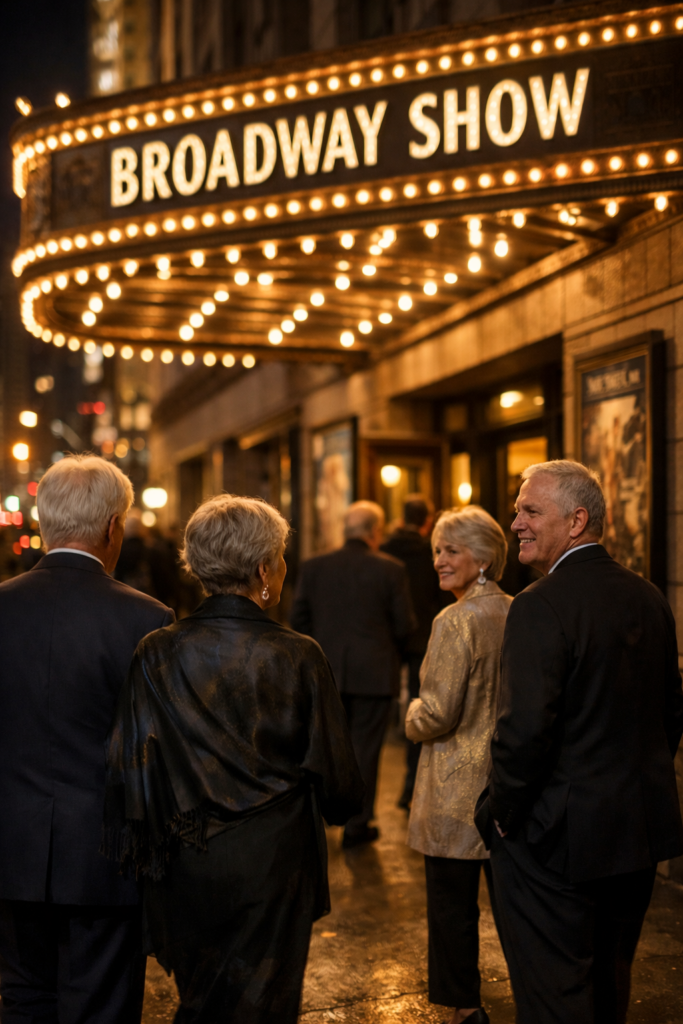
What am I supposed to tip, and what is completely optional?
Broadway tipping can feel confusing because it’s not like a restaurant where the rules are widely understood. The theater has many helpful people, but most of them are not expecting tips. Then there are a few moments where a small tip is common, like coat check and the bar. Add a car service at the end of the night, and suddenly you’re juggling etiquette, timing, and cash.
This guide is designed to make your night easier. It breaks down what’s expected, what’s optional, and what you can comfortably skip without feeling awkward. It’s written with seniors in mind, including fixed budgets, mobility considerations, and the desire to do the right thing without overthinking it. By the end, you’ll know exactly how to handle coat check, intermission drinks, ushers, accessibility assistance, and transportation home, whether you’re going to a Times Square theater or heading to Lincoln Center for a more classical evening.
The goal is simple: you enjoy the show, not the stress.
How Tipping Works at Broadway Theaters
Broadway theaters are full of staff who help keep everything moving smoothly. They scan tickets, guide people to rows, assist with seating, manage crowds, answer questions, and handle special needs. This can create an expectation in your mind that tips must be part of the experience.
In most cases, they are not.
The most important Broadway tipping rule is this: a Broadway theater is not a full-service environment where tipping is built into wages the way it often is in restaurants. Many theater staff members are paid hourly and are doing the job they were hired to do. Kindness, patience, and a simple “thank you” are usually the norm.
Where does tipping show up? In a few areas where the service feels more like hospitality than theater operations. The main ones are:
Coat check, when offered
Bar service, especially during intermission
Transportation, especially if you use a taxi or hired driver
Then there are gray areas where a tip is not expected but can be a thoughtful gesture if someone goes well beyond normal help, such as accessibility assistance that is truly hands-on and personal.
If you remember one idea, make it this: tipping at the theater is mostly about specific services, not about tipping everyone who helps you.
That alone will remove most of the pressure.
Tipping Ushers at Broadway Shows
Ushers are the faces you see most. They greet you at the door, point you toward your seat, and help keep the aisles clear. Many seniors wonder if they should tip them as a courtesy, especially if they remember older traditions or have experienced tipping in other entertainment settings.
Here is the clear answer: tipping ushers at Broadway shows is not expected.
Most audience members do not tip ushers. Ushers are there to assist everyone, and their role is part of the theater’s normal operations. You will not look rude or out of place if you do not tip.
So when would someone tip an usher? It happens, but it is usually tied to a specific kind of extra help.
When a Tip for an Usher Makes Sense
If an usher provides assistance beyond the standard “this way to your row,” you may choose to tip. This is still optional, but it can be appropriate when:
You have a mobility challenge and the usher carefully helps you navigate stairs or tight rows
They guide you to an accessible route and stay with you while you get settled
They assist repeatedly during the evening, not just once
They help in a way that saves you discomfort, strain, or embarrassment
For example, if you arrive with a cane and the theater is crowded, an usher who calmly escorts you, holds the aisle, helps you step into your row, and checks that you are comfortable is providing a level of personal attention beyond the basics. In that moment, a small tip can feel like a thank-you.
How Much to Tip an Usher
If you choose to tip, keep it simple.
Two to five dollars is a reasonable range for a small courtesy tip. It should be discreet and given after the help is complete. Cash is best.
You do not need to announce it. A quiet “thank you so much, I really appreciate your help” with a folded bill is enough.
What Not to Do With Usher Tipping
There are a few situations where tipping can create more awkwardness than kindness.
Do not tip because you feel pressured
Do not tip just because you see someone else do it
Do not tip an usher for routine directions
Do not tip in a way that draws attention or makes the staff member uncomfortable
If you feel uncertain, skip the tip and offer sincere thanks. In the Broadway world, appreciation is not measured only in dollars.
A Senior-Friendly Mindset
If you need help, ask for it. Theater staff are used to assisting seniors, and accessibility requests are normal. You are not “being difficult.” You are simply making your night manageable. And in most cases, the correct etiquette is to accept the help with gratitude, not with tipping.
Do You Tip Coat Check at Broadway Theaters?
Coat check is one of the few areas where tipping is genuinely customary. Not every Broadway theater has a full coat check, and the setup can vary. Some theaters have a more formal coat room. Others have a small check area. Some only offer it in winter or for certain performances.
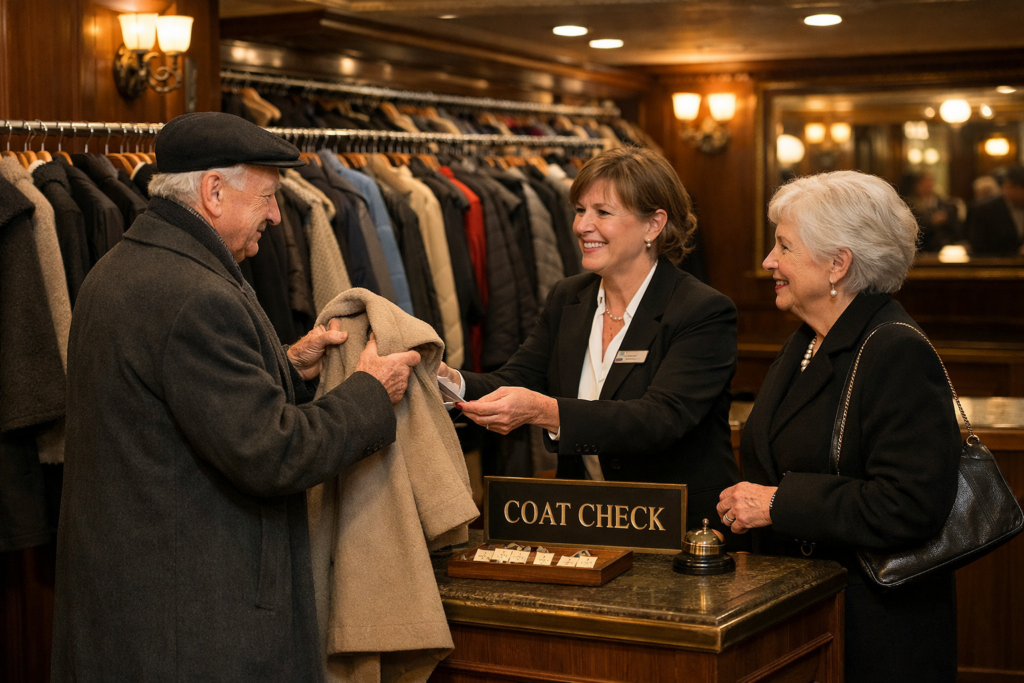
If coat check is offered, a small tip is common.
Unlike ushering, where tipping is optional and uncommon, coat check is more like a service counter. The tip is a courtesy that has long been part of the culture.
When Coat Check Matters Most
Coat check becomes more common when:
It is cold or rainy and many guests arrive with coats
You are carrying heavier outerwear
You have an umbrella or extra items
The theater environment is tight and holding your coat at your seat would be uncomfortable
For seniors, coat check can be a comfort choice. Heavy coats can feel bulky in small Broadway seats, and balancing them during the show can be annoying. Coat check can make the evening physically easier.
How Much to Tip Coat Check
A simple rule works well:
One to two dollars per item is standard.
If you check a single coat, one or two dollars is fine. If you check multiple items, you can scale up modestly. If you hand over two coats, a three to five dollar total tip is common.
If you check a heavy winter coat and a second item like a scarf bundle or umbrella, adding a little extra is reasonable, but you do not need to overdo it.
The key is not the exact number. It is that you acknowledge the service.
When to Tip Coat Check
Traditionally, people tip when retrieving the coat, not when dropping it off.
Tipping at pickup has two advantages:
You know the service is complete
You do not have to think about whether you will need to retrieve multiple times
That said, if the layout makes it easier to tip at drop-off, you can do that too. The goal is simply to leave a small tip at some point.
Lincoln Center vs Times Square: Does Coat Check Differ?
Broadway theaters near Times Square can be crowded and compact. Coat check may be available but limited. You might see a small counter or a row of hooks with staff managing the process.
Lincoln Center venues often feel more traditional and spacious. Coat check tends to feel more formal and consistent. That can make tipping feel more obvious there, but the tipping amounts are similar.
The difference is not the rate. The difference is how “standard” the service feels.
What If You Do Not Have Cash?
This is one of the most common senior concerns, and it is worth planning for.
Many coat check tips are still cash-based. Even if the theater accepts a card for coat check fees, the tip is usually not built into the machine. You might not be offered an easy way to add it.
The simplest solution is to carry a few small bills on Broadway nights. Even five or ten dollars in ones can cover coat check and a quick bar tip without stress.
If you truly cannot tip, do not panic. A polite thank-you is better than nothing. But if you can plan ahead, cash makes the whole evening smoother.
Tipping Bartenders at Intermission
Intermission bars are one of the busiest parts of a Broadway theater. The line forms quickly. People are trying to get a drink and still return to their seats before the lights flash. Staff are working at high speed.

Because this is standard bar service, tipping is expected.
You do not need special Broadway rules. You can follow normal bar etiquette.
How Much to Tip at the Bar
If you buy a drink and pay per drink, tipping one to two dollars per drink is common.
If you open a tab, tipping around twenty percent is standard.
If you order something expensive, like champagne or a premium cocktail, you can still follow percentage tipping if that feels easier. But the truth is, many people stick with the simple per-drink method during intermission because it is fast.
Why Tipping Helps During Intermission
This is not about “buying favor.” It is about how service works under pressure.
During intermission, bartenders are serving a huge number of people in a short time. If you are polite and tip normally, you are part of the rhythm of the bar. You are not slowing things down. You are making the interaction simple and respectful.
For seniors, the biggest benefit of tipping normally is confidence. You can order, pay, tip, and move on without second-guessing yourself.
Pre-Ordered Drinks and Special Setups
Some theaters offer pre-ordered drinks where you can place an order before the show and pick it up at intermission. This can be helpful for seniors because it reduces line time and stress.
If you pre-order, tipping is still customary. The staff still prepared and served your drink. If there is an option to add gratuity, use it. If not, a small cash tip when you pick up the drink is polite.
What If You Only Buy One Water?
Even small purchases can feel awkward for tipping, but the same principle applies. If you buy a bottled water or soda, a one-dollar tip is fine. If that feels excessive, you can round up your total. The main idea is that bar service is a tipped environment.
Senior-Friendly Bar Tips
If you want the intermission bar to be less stressful:
Arrive early and locate the bar before the show begins
Consider ordering before the show if the theater allows it
Keep it simple with one drink order
Carry small bills so you are not stuck doing mental math
If you dislike crowds, skip intermission entirely and relax at your seat
There is no requirement to buy drinks at intermission. Many seniors skip it and still have a perfect night.
Accessibility Assistance and Extra Help
Broadway and Lincoln Center venues are used to helping seniors. Accessibility requests are normal. You can ask for:
Elevator access
Assistance avoiding stairs
Wheelchair seating accommodations
Help finding accessible restrooms
Guidance through crowded areas
Many seniors worry that asking for help creates a social debt that must be repaid with a tip. In most cases, it does not.
Accessibility assistance is part of what a venue offers. It is not a personal favor.
That said, there are situations where staff go far beyond basic guidance, and in those moments, some people choose to tip as a thank-you.
When Accessibility Tipping Might Be Appropriate
A tip can be appropriate if:
A staff member personally escorts you through a complex route
They carry items or provide hands-on assistance that goes beyond directions
They assist you multiple times during the evening
They show unusual patience and care during a difficult moment
For example, if you are unsteady and a staff member carefully stays with you, helps you navigate steps, and makes sure you are safe and comfortable, you may feel genuinely grateful in a way that goes beyond a simple thank-you.
In those cases, a small tip can be kind.
How Much to Tip for Extra Help
If you choose to tip for accessibility assistance, keep it modest and discreet.
Three to five dollars is usually enough for a small thank-you. If someone truly provides extensive help, you might choose to give more, but that is rare.
The goal is gratitude, not obligation.
A Dignity-First Reminder
You should never feel that you must tip to “deserve” assistance.
If you need help, ask for it. The venue should support you. Your comfort matters. Your ticket is not just an admission to the show. It is an admission to an experience, and that includes basic assistance.
If you want to express thanks, you can do it with words. Many staff appreciate that more than you might think.
Tipping Car Service, Taxis, and Rideshares After Broadway
Transportation is often the last step of the night, and it matters even more for seniors because it affects safety and comfort. After a show, streets can be crowded. It may be cold. It may be late. Times Square can feel chaotic.
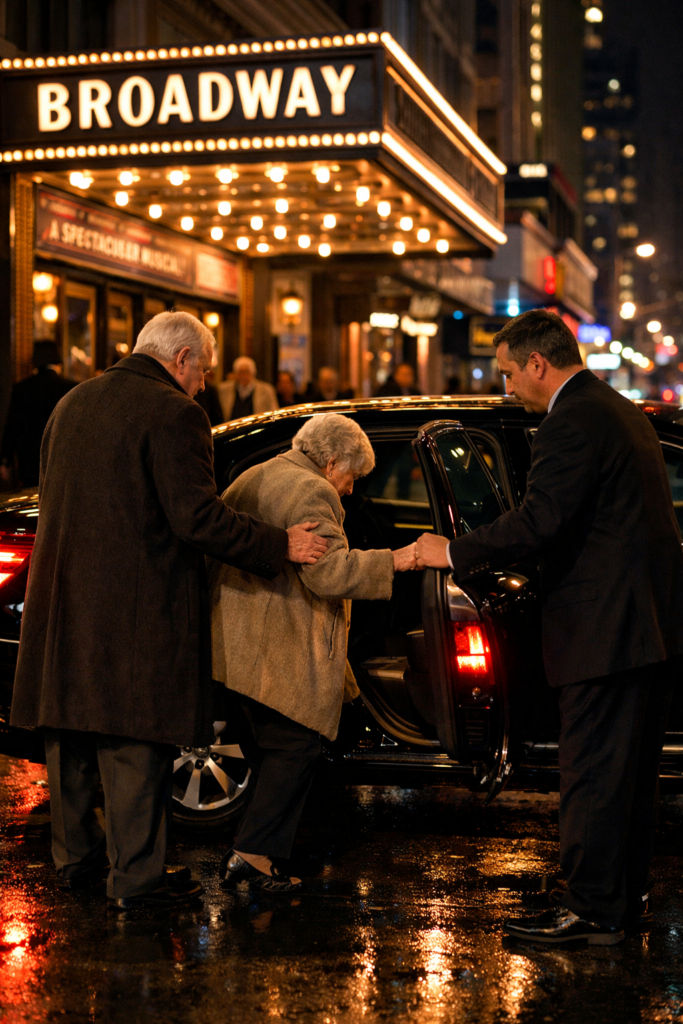
The tipping rules for transportation follow standard New York norms.
Private Car Service
If you hire a car service or use a pre-arranged driver, tipping is expected. The standard range is fifteen to twenty percent.
Some services include gratuity in the total. If that is the case, you do not need to add more unless the service was exceptional. If gratuity is not included, add it.
For seniors, a good driver can be a real comfort. They may help you enter and exit the car. They may wait patiently while you navigate crowds. They may choose a less stressful pickup spot. Those are all reasons to tip well.
Taxis
Taxis are still common in New York, especially around theater districts. Tipping is normal.
A practical approach is:
Tip around fifteen to twenty percent, or round up in a sensible way.
If the ride is short, rounding up by a few dollars is often fine. If the driver helps with a walker, bags, or patiently waits while you settle in, tipping at the higher end is reasonable.
Rideshare Services
Rideshare tipping is a little more flexible because it is app-based and less traditional. Still, tipping is common.
Many people tip ten to twenty percent depending on the ride. If the driver is helpful, patient, or handles a tricky pickup well, tipping more can make sense.
For seniors, one of the biggest benefits of rideshare is clear pickup location and payment simplicity. The drawback is that pickup after a Broadway show can be chaotic. If your driver has to navigate crowds and waits for you, tipping is a polite way to recognize that effort.
Nighttime Safety and Comfort
If you are leaving a show late, your transportation is not just a ride. It is part of your safety plan.
If a driver:
Picks you up right where you need to be
Waits while you move slowly
Helps you enter the vehicle
Ensures you are safely dropped off
That is service you can acknowledge with a solid tip, especially if it reduces stress and physical strain.
Lincoln Center vs Times Square: Does Tipping Differ?
Many seniors enjoy both the Broadway theater district and Lincoln Center, but the atmosphere can feel very different.
Times Square theaters are busy, loud, and packed with visitors. Lines can feel rushed. Intermission bars can feel crowded. Staff are moving quickly.
Lincoln Center often feels calmer and more spacious. It can feel more formal, especially for ballet, opera, or classical performances. Coat check may feel more structured. People may dress slightly more formally.
But here is the practical truth:
The tipping expectations are mostly the same.
You still tip coat check.
You still tip the bar.
You still tip transportation.
You still do not need to tip ushers.
The biggest difference is that Lincoln Center can make everything feel more traditional, which can make you assume tipping is more required. It usually isn’t.
Stick to the same simple rules, and you will be fine.
Common Broadway Tipping Mistakes Seniors Make
Most tipping mistakes are not caused by rudeness. They are caused by uncertainty.
Here are the most common patterns that lead to awkwardness or overspending, and how to avoid them.
Tipping Ushers Out of Pressure
Some seniors tip ushers because they think it is expected. Then they worry they did too little. Or they wonder if they should tip every usher they see.
The fix is simple: you do not need to tip ushers for routine help.
If an usher provides extra hands-on help, you can tip modestly. Otherwise, a thank-you is enough.
Over-Tipping Coat Check
Coat check tips are usually small. Sometimes seniors tip too much because they want to be generous.
Being generous is not wrong. But if it makes you feel uncomfortable afterward, it defeats the purpose of a relaxed night out.
One to two dollars per item is completely fine.
Forgetting Bar Tips in the Rush
Intermission is fast. Seniors who rarely go to bars can forget to tip in the moment.
If you want to avoid that stress, keep a couple of ones in an easy pocket. Or open a tab and tip at the end.
Feeling Embarrassed Asking Questions
If you are unsure where to go, what door to use, or whether there is an elevator, ask.
Theater staff handle these questions all the time. You are not a bother. You are simply making your night workable.
Confidence improves everything.
Quick Senior Broadway Tipping Cheat Sheet
If you only remember one section, make it this one.
Ushers
No tip expected. Tip only if someone gives significant personal assistance. If you tip, consider two to five dollars.
Coat check
Customary. One to two dollars per item. Tip at pickup if possible.
Intermission bar
Expected. One to two dollars per drink, or around twenty percent for a tab.
Accessibility assistance
Not required. Tip only if someone goes far beyond basic help. If you tip, three to five dollars is a common thank-you.
Car service
Expected. Fifteen to twenty percent unless gratuity is included.
Taxi
Expected. Fifteen to twenty percent, or round up sensibly.
Rideshare
Common but flexible. Ten to twenty percent depending on the situation.
A few small bills can remove most Broadway tipping stress.
Broadway Night Out Tips for Seniors Beyond Tipping
A Broadway night is more enjoyable when it is physically comfortable. A little planning goes a long way.
Choose the Easiest Arrival Plan
If you want less rushing:
Arrive early
Locate your entrance and restroom first
Ask about elevators immediately if you need them
Avoid last-minute stair climbing in crowds
Keep Your Hands Free
If you use a cane, walker, or need balance support, coat check can help because it removes bulky items from your lap and hands.
A lightweight crossbody bag can also reduce fumbling.
Don’t Let Intermission Stress You
You do not need to use intermission for errands. You can stay seated, stretch gently, and enjoy the atmosphere.
If you do want a drink, consider pre-ordering if available or arriving at the bar before the line forms.
Pick a Calm Pickup Spot
After a show, Times Square can be intense. If you use a car service or rideshare, consider walking a block or two away from the biggest crowd if you are able. It can make pickup faster and less stressful.
If walking is difficult, ask staff for the best accessible pickup approach.
Conclusion: Enjoy the Show, Not the Stress
Broadway should feel like a treat. It should feel like a night where you get to sit back and enjoy talent, music, storytelling, and the magic of live performance.
Tipping should not be the part that lingers in your mind afterward.
The simple truth is that Broadway tipping is narrower than most people assume. You do not need to tip everyone. You only tip a few specific services. And even then, the amounts can be modest.
If you tip coat check, tip the bar normally, and tip your driver in a standard way, you are handling the evening correctly. If someone gives you truly extra assistance, you can choose a small thank-you tip, but you never need to feel obligated.
Walk in with confidence. Keep a few small bills. And let the night be what it is meant to be.
A great show.
FAQ: Broadway Tipping Etiquette for Seniors
Do you tip ushers at Broadway shows?
No, tipping ushers is not expected. Tip only if an usher provides significant personal help beyond routine guidance.
Is coat check tipping mandatory at Broadway theaters?
It is not mandatory, but it is customary. One to two dollars per item is typical.
How much should you tip at intermission bars?
One to two dollars per drink is common, or around twenty percent if you run a tab.
Do you tip for accessibility seating assistance?
You do not have to. Accessibility assistance is part of the venue’s service. Tip only if someone goes well beyond standard help.
Is tipping different at Lincoln Center performances?
The atmosphere is different, but the tipping expectations are similar. Coat check and bars are the main tip moments.
Should you tip if you only buy one drink?
Yes, a one-dollar tip is still normal for a single drink purchase.
What if you don’t carry cash?
Try to bring a few small bills on Broadway nights. If you cannot, you can still express gratitude verbally, especially for ushers and assistance.
Are theater staff offended if you don’t tip?
Usually not. Ushers do not expect tips. Coat check and bar staff do appreciate tips, but most will not react negatively if you miss it.
Do matinee shows follow the same tipping rules?
Yes. Matinees have the same tipping customs as evening shows.
Is tipping expected for senior discounts or accessibility services?
No. Discounts and accessibility services do not create a tipping obligation. Use tipping only for specific service moments or exceptional help.