
There’s a special kind of pressure that shows up the moment a big family meal is winding down. Everyone is happy. The kids are restless. The conversation is still buzzing. And then the check arrives like a tiny, rectangular stress test.
In many families, seniors and grandparents end up being the “check captain.” Not because anyone demanded it, but because someone has to make sense of the math, the etiquette, and the awkward timing. Maybe you’re the planner. Maybe you’re the host. Maybe you’re the calm voice who can say, “Alright, let’s make this easy.”
Here’s the good news: tipping when everyone splits the bill does not have to be confusing. It can be fair, simple, and drama-free—even with separate checks, shared appetizers, mixed cash and cards, or the classic “I’ll Venmo you later” promise.
This guide is built for real-life big family meals: grandkids, adult children, couples, friends tagging along, and different budgets at the same table. You’ll learn the best methods, the cleanest math, and the most reliable etiquette so the server gets a proper tip and your family leaves on a good note.
Why Tipping Gets Complicated When Everyone Splits the Bill
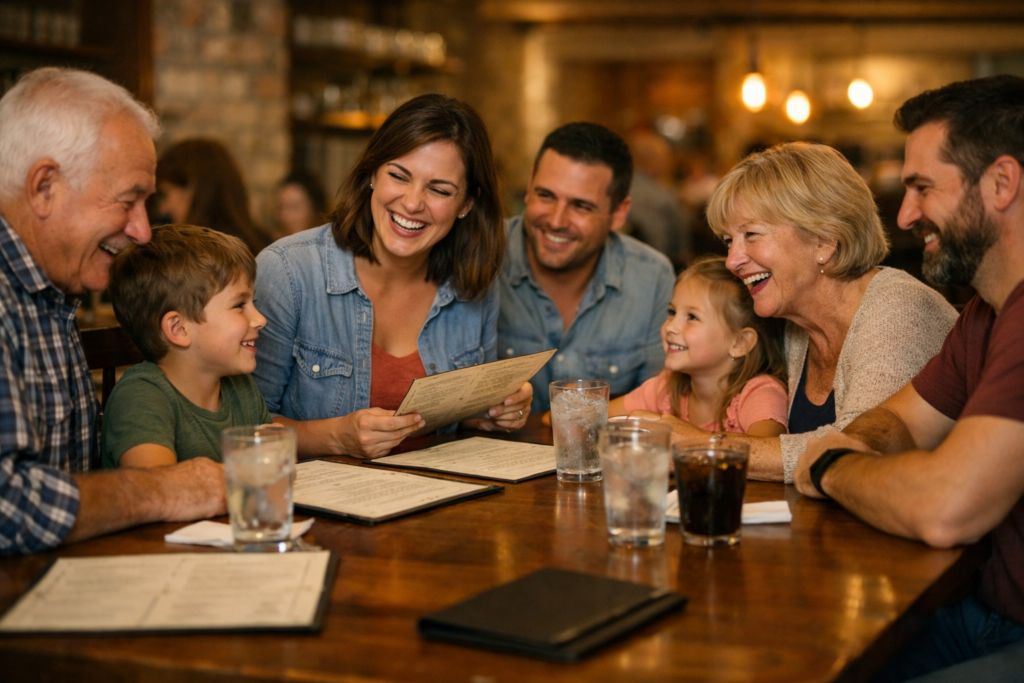
On paper, tipping sounds simple. Add a percentage. Leave it on the table. Done.
In a big family group, it gets complicated fast because the bill is not just a bill. It’s a puzzle with moving pieces.
Separate checks change the rhythm. Everyone is looking at their own total, not the table’s total. That makes it easier for the group to accidentally under-tip without meaning to. One person might tip 15%. Another might tip 10% because they think the service wasn’t perfect. Someone else might assume gratuity is included. Suddenly, a table that should tip a healthy amount leaves far less than what the server earned.
Shared items add another layer. When you split appetizers, desserts, or a bottle of wine, the “fair split” is not obvious. A grandparent might pay for the kids’ meals. An adult child might cover the alcohol. Someone might skip dessert. Someone might order the fancy entrée. You can end up arguing over $4 while forgetting the bigger picture: the server’s work didn’t change just because the payments are messy.
Large groups also take more effort. More water refills. More questions. More substitutions. More trips to the kitchen. More plates to clear. More time. And because your table stays longer than a small party, it can limit how many other tables the server can take. Even if the server is cheerful and professional, big groups are simply more work.
Then there’s the social factor. Nobody wants to seem cheap. Nobody wants to police other people. Many seniors feel responsible for “making it right” without turning it into a lecture. The goal is to leave the table feeling warm, not tense.
That’s why the smartest approach is one that protects the tip first, then handles the split second.
The Golden Rule of Tipping When Splitting the Bill
Here’s the principle that solves almost everything:
The server should receive the same total tip as if one person paid the entire bill.
It doesn’t matter if the table splits the check into eight payments or one. The service happened at the table. The server worked the table as a whole. The tip should reflect that whole.
Think of it like this: the restaurant doesn’t reduce the work because you used separate checks. Your server doesn’t do “half the job” because your daughter paid for her entrée and you paid for your grandkids. The only thing that changed is how the money gets to the restaurant.
So the goal is not “Did each person tip perfectly?” The goal is “Did the table tip correctly in total?”
When you keep that goal in mind, the rest becomes a series of practical choices.
Start Here: The Two Best Methods That Work Every Time
There are many ways to split a tip, but two methods consistently prevent mistakes.
Method One: Tip as a table, then split the total
This is the cleanest, safest method when one person pays the bill and everyone reimburses.
You calculate the tip based on the full pre-tax total (or the full total if that’s your habit), add it to the bill, and then split that combined number among the people who are paying.
This method almost guarantees the server is tipped properly, because one person is responsible for the full tip.
It also reduces awkwardness. Instead of debating percentages, you simply say: “I’m adding the tip first, then we’ll split what’s left.”
Method Two: Separate checks, but agree on a standard tip percentage
This is the best method when the restaurant is already doing separate checks and each person is paying their own bill.
You pick a percentage—usually 18% or 20% for a big group—and everyone tips that percentage on their own subtotal.
This works well when the group is cooperative and you don’t want one person to carry responsibility for the whole tip.
The key is agreement. If everyone tips “whatever they feel like,” the total tip becomes unpredictable.
If you want the simplest rule for big family meals, it’s this:
For large groups, default to 20% unless gratuity is already included.
That one sentence prevents most under-tipping accidents.
How Much Should You Tip for a Big Family Meal?
Most people have heard the basic range: 15% to 20%. In a big family group, leaning higher is usually the more accurate reflection of effort.
A practical guideline:
- 15% is a baseline for decent service in very simple situations.
- 18% is a strong standard tip for normal service.
- 20% is the safest default for large groups and busy service.
- More than 20% is a kind choice for exceptional service or extra effort.
If your table is large, has kids, stays a while, makes special requests, or creates a lot of back-and-forth, 20% is not extravagant. It’s fair.
One more important detail: many restaurants add an automatic gratuity for large parties. This is often around 18% to 22%. If that’s included, you don’t need to add another full tip on top—unless you want to add a small extra amount for truly outstanding service.
The best habit is simple: look carefully for words like “gratuity,” “service charge,” or “automatic gratuity” on the check before you add a tip.
Scenario: Everyone Gets a Separate Check
This is the “each person pays their own” situation. It can be easy, but it can also produce accidental under-tipping if people aren’t careful.
The right way is straightforward: each person tips on their own subtotal, using the agreed percentage.
If you want the simplest version for a family group, say something like:
“Let’s all do 20% today. It’s a big table.”
That’s not bossy. It’s helpful. It prevents the classic problem where one person tips lightly and assumes others will cover the difference.
A clear example:
- Your subtotal: $32.00
- 20% tip: $6.40
- Total with tip: $38.40
If you’d rather tip 18%:
- $32.00 × 0.18 = $5.76
Most payment screens will calculate this for you. But you still want to make sure the percentage is appropriate for a group.
Common mistake to avoid: tipping on the wrong number. Some people tip on the post-discount total, some on the pre-discount total, some after tax. The most common etiquette is to tip on the pre-tax amount. But in practice, tipping on the total is usually close enough and often slightly more generous. In a group setting, generosity tends to prevent problems.
If there were significant discounts or coupons, consider tipping based on what the total would have been without the discount. The server did the same work either way.
Scenario: One Person Pays, Others Reimburse
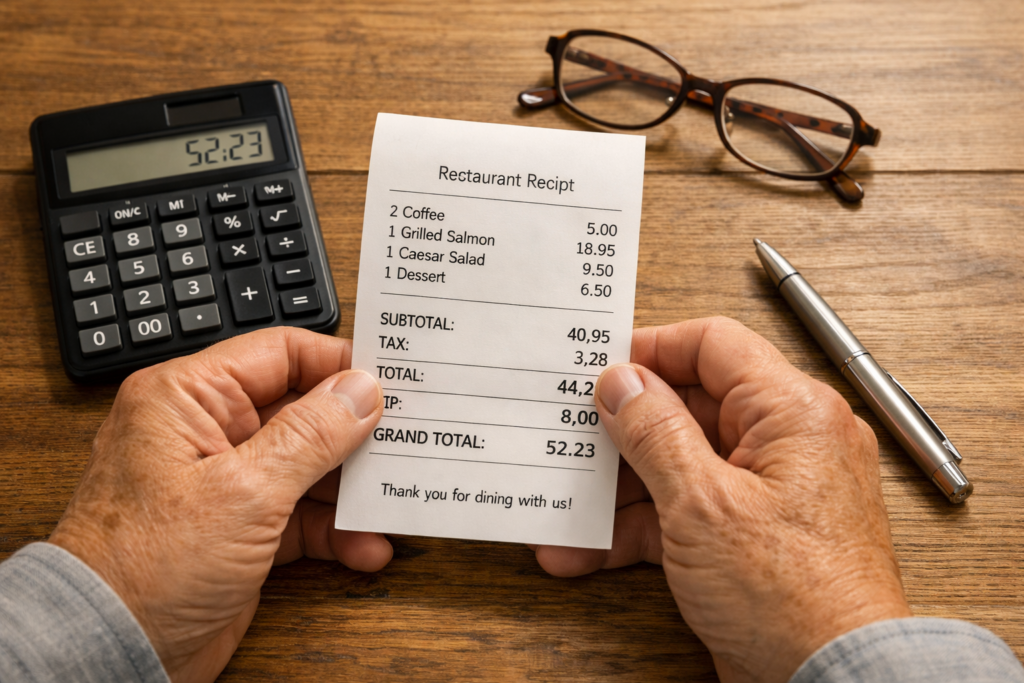
This is extremely common in families. A grandparent pays. An adult child says, “We’ll pay you back.” Or one person puts it on a card to collect points.
This is where a lot of tipping mistakes happen, because people split the bill but forget to split the tip properly.
The clean solution:
Calculate the tip first. Add it to the bill. Split the total.
Here’s a real-life example:
- Total bill before tip: $240
- Tip at 20%: $48
- Total after tip: $288
If six people are splitting evenly, each person pays:
- $288 ÷ 6 = $48
That’s it. One number. No confusion. No missing tip.
If you want to keep it even simpler, you can use a quick mental shortcut for 20%: move the decimal one place to get 10%, then double it.
For $240:
- 10% is $24
- 20% is $48
If you are the check captain, this method makes you feel in control. It’s hard for the group to accidentally under-tip because the tip is handled before the splitting begins.
If people are reimbursing in cash, you can still do this method. Just collect the money based on the total including tip, and pay the bill with the full tip included.
Scenario: Shared Appetizers, Uneven Spending, and the “But I Only Had a Salad” Problem
This is where family meals can get messy.
Someone ordered steak. Someone had soup. Someone had two cocktails. Someone had iced tea. The kids split chicken tenders. The table shared appetizers and dessert. Now the group wants to split “fairly.”
Fairness matters, but there’s a point where the math starts costing more than it’s worth. The best solution is usually a two-step approach:
Tip based on the full table total first, then split the food costs however you want.
Why? Because the server’s work was not “uneven.” The server served the whole table.
Here are a few practical approaches for uneven spending:
The proportional method
Each person pays their own food total plus their share of the tip based on their food total.
Example:
- Person A subtotal: $25
- Person B subtotal: $50
- Table subtotal: $75
- Tip at 20%: $15
Person A tip share:
- $25 ÷ $75 = one third
- One third of $15 = $5
Person B tip share:
- $10
This is fair and accurate, especially if alcohol creates big differences.
The “alcohol separate” method
If the only big difference is alcohol, separate alcohol costs and tip shares.
Some families do this:
- Everyone splits food evenly
- Alcohol is paid by the drinkers
- Tip is still calculated on the full total, including alcohol, and split accordingly
This avoids resentment without harming the tip.
The “host simplifies everything” method
If you are hosting or you want peace more than precision, choose a simple split and move on.
This is a common senior strategy for a reason. When you’re trying to protect the mood of the family meal, simplicity is a gift.
Scenario: Automatic Gratuity for Large Groups
This is the trap that can lead to double tipping or accidental under-tipping.
Restaurants may add a gratuity automatically when the party is large. Sometimes it’s clearly labeled. Sometimes it’s buried in small print.
What to do:
Check the bill for:
- “Gratuity”
- “Service charge”
- “Auto gratuity”
- “Included gratuity”
- “Service fee”
If you see it, look at the percentage or amount. If it’s in the 18% to 22% range, you can usually stop there.
If you want to add extra, keep it small and intentional. For example, if an 18% gratuity is included and your server was excellent, you might add a little extra to bring it closer to 20% or 22%. That can be a thoughtful gesture without accidentally doubling the tip.
Also note: a service charge does not always go fully to the server, depending on the restaurant’s policies. If you’re not sure, you can politely ask: “Is this service charge the tip for the server?” The question is reasonable, and most staff will answer quickly.
Scenario: Cash and Card Mixed Together
This situation often causes tipping confusion because everyone assumes someone else handled it.
A few people pay with cards. Someone leaves cash. Someone says, “I put the tip on my card.” Someone else says, “I left cash for the tip.” Now you have overlap or a gap.
The simplest approach is to pick one person to control the tip.
If you are the check captain, you can say:
“Let’s do the tip on one card so we don’t mess it up.”
Then any cash contributions can be used for reimbursement instead of tipping. That keeps the tip clean and predictable.
If you do tip in cash, make sure the server actually receives it. A cash tip handed directly to the server is the surest method, especially in hectic situations where cash left on the table could be missed.
Scenario: Someone Leaves Early
This happens in big families. A grandchild gets tired. A parent needs to get home. Someone has an early morning.
The tipping risk is that the person who leaves early might not tip at all, or might tip too little because they didn’t see the final bill.
The best approach is preventive:
- Set a group tipping plan early
- Or make the tip the responsibility of the final payer
If separate checks are involved, encourage the person leaving to settle their check with tip before leaving. It’s normal and polite.
If one person is paying and collecting reimbursements, the early leaver should reimburse their portion including tip. That way the table’s tip remains intact.
Tip Math Made Simple (Even If You Hate Math)
You don’t have to be a math person to get this right. You just need a couple of easy tools.
The 20% shortcut
For 20%, take 10% and double it.
- Move the decimal one place left to get 10%
- Double it to get 20%
Example:
- $180 → 10% is $18 → 20% is $36
The 18% shortcut
If you want a quick estimate for 18%, start with 20% and subtract a little.
Example:
- 20% of $180 is $36
- Subtract about $3.60 (which is 2%)
- 18% is about $32.40
You don’t need perfect precision. Payment screens usually calculate it. The goal is to choose a fair percentage and make sure the table covers the full tip.
The “per person” shortcut
If you’re splitting evenly and tipping 20%, a quick way is to add a fifth of the per-person food cost.
Example:
- Each person’s share of food is $40
- A fifth of $40 is $8
- Each person pays about $48
This is not perfect for uneven spending, but it’s a great “good enough” method when the goal is speed and simplicity.
Special Advice for Seniors and Grandparents
If you’re the person who often ends up managing the end-of-meal logistics, you deserve a system that reduces stress.
Here are senior-friendly strategies that work:
Decide the tipping plan before the check arrives
This prevents awkwardness. A quick comment works:
- “Let’s all do 20% today.”
- “I’ll handle the tip, then we’ll split.”
- “Let’s check if gratuity is included.”
Saying it early makes it feel normal, not corrective.
Don’t let small fairness debates steal the moment
It’s easy for family members to get hung up on who ordered what. But most of the time, the difference is small compared to the value of a smooth family meal.
If the group is cooperative, proportional splitting is great. If the group is tired and hungry and the kids are melting down, choose a simple split and protect the mood.
If you’re paying for the grandkids, include their tip too
If you cover kids’ meals, you’re also covering the service those meals required. Tip on the total you’re covering. It’s the cleanest etiquette and avoids a tip gap.
Hosting is a gift, not a negotiation
If you invited everyone out and you want to treat, then treat fully, including tip. If others want to help, accept contributions toward the total including tip. Either way, don’t let it become a tug-of-war.
Common Tipping Mistakes at Big Family Meals
These are the mistakes that happen most often—and how to prevent them.
Forgetting that separate checks can reduce the total tip
If everyone tips “whatever,” the table tip becomes random. Prevent this by suggesting a percentage upfront.
Missing automatic gratuity
Always scan the check for gratuity or service charge. If it’s included, don’t add another full tip by accident.
Assuming someone else tipped
If you didn’t personally see the tip added, it might not be there. In mixed payment situations, put one person in charge of tipping.
Tipping less because the service felt “slow” in a busy restaurant
Large groups often feel slower because there’s more happening. If the server was attentive and kind, the tip should reflect that—even if the kitchen took time.
Overcomplicating the split and running out of patience
When people get tired, tipping mistakes happen. Choose a method that stays simple under pressure.
What Servers Actually Expect From Large Groups
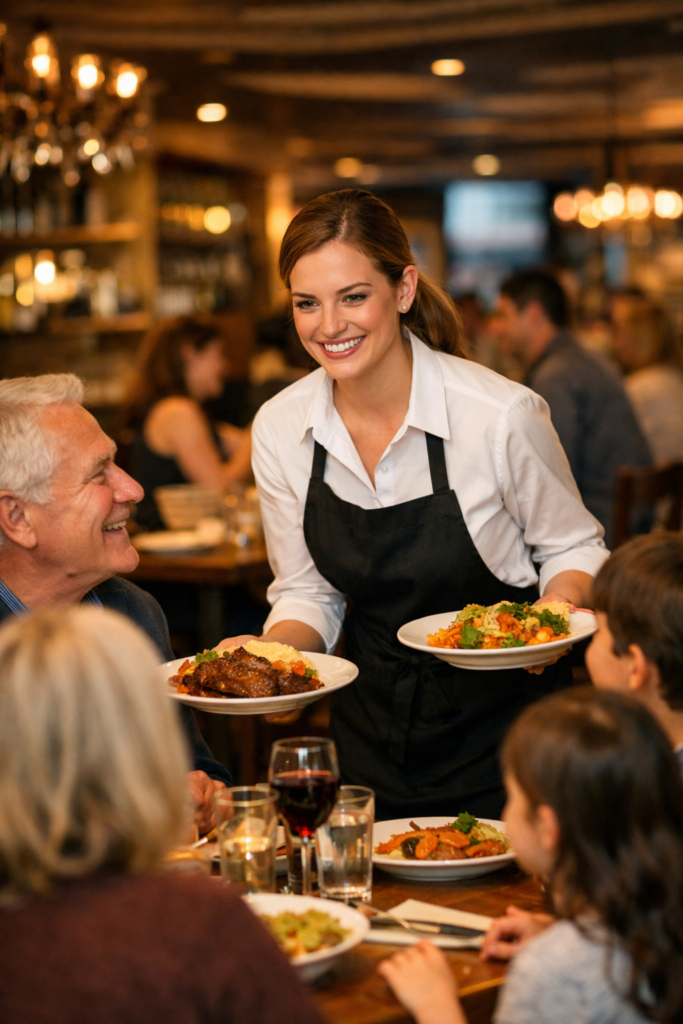
Most servers don’t expect perfection. They expect fairness.
A large family table is one of the hardest tables to serve well. Not because the people are difficult, but because the workload is bigger.
A good server is tracking:
- Multiple drink preferences
- Dietary needs and substitutions
- Timing so food arrives together
- Kids needing extra napkins and refills
- People wanting separate checks
- People changing their minds
- Dessert orders and coffee refills
Even a polite, easygoing family creates a lot of movement for a server.
That’s why a strong tip matters more for large groups than it does for a quick lunch for two. Your tip is not just about politeness. It’s about recognizing time, effort, and the reality that large groups can reduce a server’s ability to take other tables.
If your goal is to be the kind of table servers remember in a good way, here’s the recipe:
- Be kind
- Be clear
- Tip fairly
That combination makes you a “good family” in any restaurant.
Quick Reference: Stress-Free Tipping Rules You Can Use Tonight
Use these rules when you don’t want to think too hard.
Check the bill for automatic gratuity first.
If there’s no gratuity included and you’re a big table, default to 20%.
If one person pays and others reimburse, add tip first and split the total second.
If everyone pays separately, agree on one percentage and have everyone tip that amount.
If cash and cards are mixed, put one person in charge of tipping so it doesn’t get missed.
If the math starts turning into an argument, choose a simple approach and move on. A happy ending to the meal is worth more than perfect pennies.
FAQ
Should everyone tip individually on separate checks?
Yes, that’s usually the easiest approach—especially if the group agrees on a standard percentage like 20%. Each person tips on their subtotal so the table’s total tip stays fair.
What if someone forgets to tip?
If you notice in time, you can quietly cover the difference. If you’re the person paying the bill, it’s safer to handle the tip yourself and have people reimburse you afterward.
Do kids’ meals need tips?
Yes. Kids still receive service, and kids’ meals still take time to deliver and clean up. If you’re paying for the kids, tip on that total as well.
Is tipping required if service was slow?
If the slow pace was caused by the kitchen or the restaurant being slammed, tipping fairly is still appropriate. If the server was rude or truly negligent, you can adjust—but for most family meals, the kinder approach is to stay near your normal percentage.
Should you tip on tax or before tax?
Traditionally, tipping is calculated on the pre-tax amount. In practice, tipping on the full total is common and usually just slightly more generous. Either approach is acceptable in most places.
How do you tip when alcohol is involved?
If alcohol creates uneven totals, consider splitting the bill proportionally or separating alcohol costs. But still tip on the full table total so the server is properly covered.
What if the restaurant adds automatic gratuity?
If gratuity is included, you typically don’t need to add another full tip. If the service was excellent, you can add a small extra amount intentionally, but avoid double tipping by accident.
Is it rude to talk about tipping at the table?
Not if you keep it calm and practical. A simple, friendly comment like “Let’s all do 20% today” is helpful, not rude.
Should seniors tip more at family meals?
You don’t have to, but many seniors choose to tip a bit higher when hosting or when the group is large. It’s a thoughtful way to acknowledge extra work and keep the meal feeling generous.
What’s the safest default tip percentage for large groups?
20% is the safest and simplest default for big family meals when gratuity is not included.
How do you handle tipping when someone leaves early?
Have the person leaving settle their check with tip before they go, or make the tip the responsibility of whoever pays at the end. The key is not letting the early exit create a gap in the final tip.
Conclusion: Make Family Meals Easy, Fair, and Enjoyable
The best family meals aren’t remembered for perfect math. They’re remembered for laughter, stories, and the feeling of being together.
Tipping is just the quiet final step that protects that good feeling. When you focus on the table’s total tip—rather than obsessing over every person’s exact share—you make the process fair to the server and gentle on your family.
So the next time the check arrives, keep it simple:
Check for automatic gratuity. Choose a fair percentage. Make sure the total tip is covered. Then get back to what matters.
Big family meals should end with warm goodbyes, not stress. And with the right tipping plan, they will.