
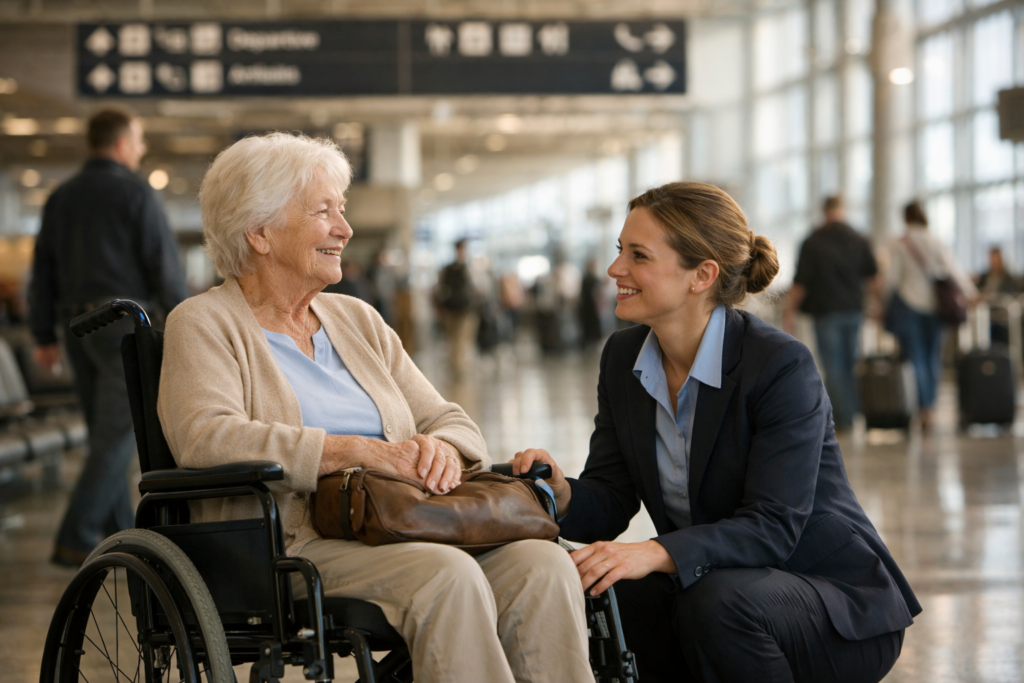
Airports can feel like a different planet when you’re older.
The distances are longer than they look. Signs are harder to read when you’re tired. Lines move slowly, then suddenly speed up. Gates change.
Elevators hide in corners. And if you have knee pain, balance issues, shortness of breath, or you just don’t have the stamina you used to, the airport isn’t just inconvenient — it can be genuinely overwhelming.
That’s why airport wheelchair assistance can feel like pure relief.
Someone shows up.
They know where you’re going. They help you move through the maze.
They get you to the right place. They reduce the stress. Sometimes they even save the entire trip.
Then comes the confusing part.
Should you tip? How much? Who do you tip? When do you do it?
What if you can’t afford much? What if you don’t carry cash? What if you’re traveling internationally?
This is one of the most confusing areas of travel etiquette, especially for seniors. And the worst part is that the uncertainty often hits at the exact moment you’re already stressed, tired, and trying to keep up.
This guide removes the guesswork.
You’ll know what’s fair, what’s normal in the U.S., what’s optional, and how to handle it gracefully — without embarrassment, guilt, or awkwardness.
What Is Airport Wheelchair Assistance — and Who Provides It?
Airport wheelchair assistance is designed to help travelers who have trouble walking long distances or standing for long periods. It’s commonly used by seniors, people recovering from surgery, travelers with chronic pain, and anyone whose mobility is limited for any reason.
It can be requested through the airline and it’s typically arranged before your travel day.
In many airports, you can also request it at the check-in desk if you didn’t pre-book, but pre-booking usually leads to a smoother experience.
What wheelchair assistance often includes
Depending on the airport and the service provider, wheelchair assistance may include:
Getting you from the curb or check-in area to your airline counter
Helping you move through the terminal to security
Assisting you through the TSA process, including navigating the line
Pushing the wheelchair to your gate
Helping you reach an airport restroom stop along the way if time allows
Assisting with transfers between terminals or gates, including elevators and trams
Meeting you after landing and taking you to baggage claim
Taking you to the curb, rideshare pickup, taxi line, or family pickup zone
Some assistance is “partial,” such as from the gate to the baggage claim after you land. Other times it’s the entire journey: curb to gate, and then gate to curb again at your destination.
Who is actually helping you?
This is where confusion starts.
Many travelers assume the person pushing the wheelchair is an airline employee. Sometimes that’s true, but often it isn’t.
At many airports, wheelchair attendants are employed by a contractor hired by the airline or the airport. They may wear a uniform that looks official. They may have an ID badge. But they aren’t always airline staff.
They can be third-party workers whose income structure and tipping expectations are different.
You might also encounter:
An airline employee helping with a special situation
An airport customer service worker
A skycap or curbside check-in worker who also helps with mobility support
A porter-style helper inside the terminal in some locations
Why does this matter? Because tipping norms and policies can vary based on who’s providing the service.
In the U.S., many wheelchair attendants do accept tips and many travelers do tip them. In some settings, the attendant may be prohibited from accepting tips. In other cases, tips may be a meaningful part of their income.
But here’s the key point that will make you breathe easier:
You are never required to tip in order to receive wheelchair assistance.
Wheelchair assistance exists so you can travel safely and with dignity. Tipping is a separate decision.
Is Tipping Airport Wheelchair Assistance Required?
No. Tipping is not required.
You cannot be denied wheelchair assistance for not tipping.
You should never be pressured into tipping.
If you ever feel that someone is treating you poorly because you didn’t tip, that reflects on them — not you.
In the U.S., tipping is often customary for wheelchair attendants, but “customary” is not the same thing as “mandatory.”
There are three helpful categories to keep in mind:
Essential services you are entitled to (wheelchair assistance falls here)
Optional gratitude for personal service (tipping falls here)
Unfair pressure or manipulation (you should not accept this)
If a tip is given, it should be because you want to show appreciation and you feel comfortable doing so — not because you feel forced.
The difference between “expected” and “appropriate”
You’ll often hear travelers say, “You’re supposed to tip.”
What they usually mean is that tipping is common enough that many attendants appreciate it and many travelers choose to do it.
But you can also think of it this way:
If someone helped you kindly and safely through a difficult airport, tipping can be a generous thank-you.
If the service was minimal or rushed, tipping is optional.
If you are on a tight budget, tipping is optional.
If you don’t have cash, tipping is still optional.
Your goal is not to follow some invisible rule perfectly. Your goal is to handle a human situation with clarity and respect.
A quick note about disability and access rights
In the United States, assistance for travelers with disabilities or limited mobility is protected and expected.
The purpose of those protections is to ensure people can travel without being punished for needing support.
That’s why it’s important not to let tipping anxiety ruin the whole experience. The assistance is there because it should be there.
How Much Should You Tip a Wheelchair Attendant at the Airport?
This is the heart of the question. And the best answer is simple:
Tip based on the amount of help you received, the time involved, and what you can comfortably afford.
Here are practical ranges that most senior travelers can use without overthinking.

A simple guideline that works in most U.S. airports
For short assistance, like gate-to-gate or a quick escort:
A tip in the range of $5 to $10 is common.
For moderate assistance, like check-in to gate through security:
A tip in the range of $10 to $15 is common.
For long assistance, like curbside pickup to gate with multiple stops, or long terminal transfers:
A tip in the range of $15 to $25 can be fair.
For exceptional help, such as someone who truly saved your trip or went far beyond basic duties:
Some travelers choose $20 to $30 or more, but it is always optional.
These ranges aren’t law. They’re a practical map so you can stop guessing.
What affects the “right” amount?
Think about these factors. They matter more than any strict dollar figure.
Distance and time
Some airports are enormous. A 20-minute push through crowded terminals is very different from a 3-minute escort.
Complexity
Did you change terminals? Use a shuttle? Navigate multiple elevators? Make several stops?
Help with stress points
Did the attendant help you find the right line at TSA? Did they keep you calm? Did they explain what was happening?
Physical effort
Some wheelchairs require more pushing due to slope, crowds, or baggage.
Kindness and patience
If someone treated you with dignity and care, that matters.
Your personal budget
If you’re on a fixed income, your “right amount” is smaller — and that is okay.
Cash vs card vs no tip
In most airports, tipping is done in cash. Wheelchair attendants almost never have a card reader for tips.
If you don’t carry cash, you have a few options:
Tip what you can with the cash you do have, even if it’s small
Ask a traveling companion who might have cash
Use an ATM if it’s easy and you feel safe doing so
Choose not to tip and express sincere gratitude instead
You are not obligated to go hunting for cash in a stressful airport.
And if you give a tip, it doesn’t have to be perfectly “matched” to the service. A simple, respectful amount is enough.
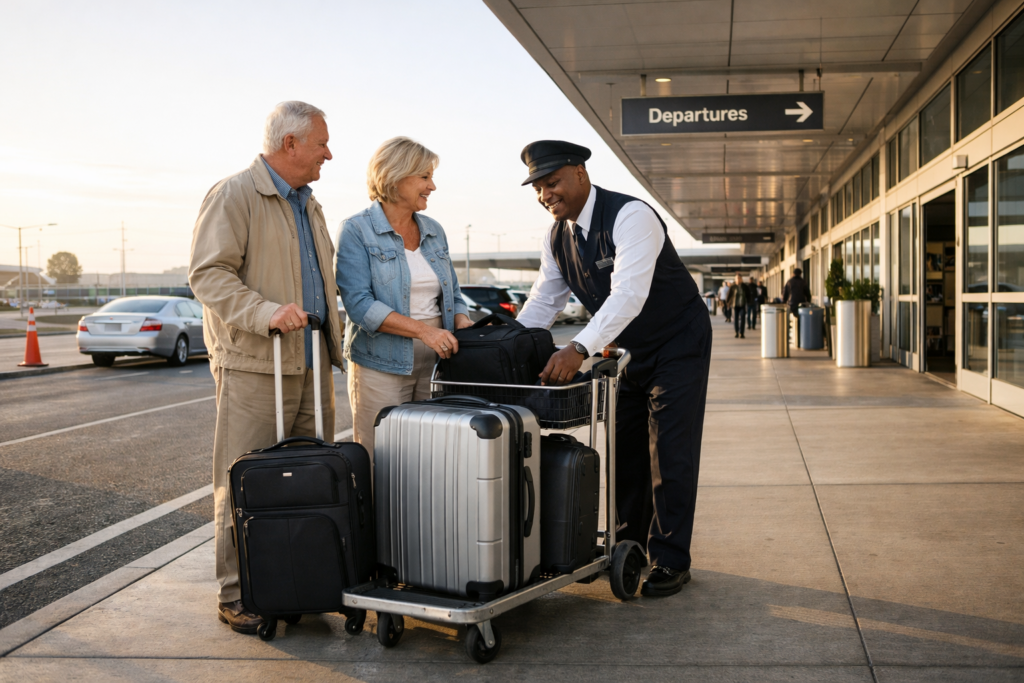
Skycaps, Curbside Check-In, and Porters: Different Roles, Different Tips
Wheelchair assistance can overlap with other airport help, especially at curbside check-in.
This is where many seniors accidentally double-tip or feel unsure about who deserves what.
Let’s clarify the roles.
What a skycap does
Skycaps usually work at curbside check-in. They help with:
Checking bags
Printing boarding passes
Handling luggage quickly
Sometimes guiding you toward the right entrance
Skycap tipping is often done per bag or per service.
Typical skycap tips (U.S.)
A common tip range is:
$2–$5 per bag for basic help
$5–$10 total for multiple bags or extra effort
More if they handle heavy luggage, special items, or complicated situations
This is separate from wheelchair assistance.
When one person does both jobs
Sometimes, the same person helps with your bags and then pushes the wheelchair. Sometimes it’s two different people.
If one person clearly did both services, you can tip in a way that reflects both. You don’t have to tip twice separately unless you want to. A single tip that feels fair for the combined help is fine.
If it was two different people, you can tip each person based on what they did.
The easiest way to avoid confusion is to notice the handoff.
If one helper completes their job and a different person arrives to push the wheelchair, those are two separate services.
If it’s the same person from curb to gate, that’s one continuous service.
When You Should Tip More — and When It’s Okay Not To
This section matters because many seniors are generous by nature, but also don’t want to feel taken advantage of.
A good way to think about tipping is: reward effort, kindness, and time — not the fact that you needed help.
Times a higher tip can be fair
You had a long route through a huge terminal
You had a tight connection and they moved efficiently while keeping you safe
They waited with you during a delay and stayed patient
They helped you communicate with airline staff
They assisted with multiple stops and didn’t rush you
They showed genuine care and respect
If the attendant made a difficult day feel manageable, that’s meaningful.
Times it’s okay not to tip
The help was extremely brief and minimal
The attendant was rude or careless
You were pressured or made to feel uncomfortable
The attendant refused tips
You genuinely cannot afford it
You don’t have access to cash and it would add stress to get it
Tipping is gratitude, not a debt.
If you decide not to tip, you can still be polite and kind. A simple thank-you and a calm goodbye is enough.
What If You Can’t Afford to Tip? A Guilt-Free Answer for Seniors
Many older travelers live on a fixed income. That’s real. And travel already costs more than it used to.
If you can’t afford to tip, you are not a bad person.
Your dignity matters. Your safety matters. The help exists so you can travel.
Options that still show appreciation
Say thank you clearly and warmly
Use the attendant’s name if you saw it on a badge
Tell them they made the trip easier
Leave positive feedback with the airline or airport
If you received outstanding help, mention it to a supervisor when you have time
A kind word can genuinely brighten someone’s day — and it costs nothing.
What to avoid
Avoid apologizing repeatedly.
Avoid explaining your finances.
Avoid feeling like you have to justify yourself.
A simple “Thank you so much, I really appreciate your help today” is enough.
Common Mistakes Seniors Make When Tipping Airport Assistance
Most tipping awkwardness comes from a few predictable mistakes. Once you recognize them, they’re easy to avoid.
Over-tipping out of anxiety
Some seniors tip too much because they worry they’ll look cheap.
But tipping should feel comfortable.
If you tip so much that you feel stressed afterward, you’ve defeated the purpose.
A fair, modest tip is often better than an overly large one given out of fear.
Asking “Is this enough?”
This puts the attendant in an awkward position. If they say yes, it might feel insincere. If they hesitate, it feels uncomfortable.
Instead, simply offer what you’ve chosen and move on kindly.
Tipping too early
If you tip before the assistance is complete, you might feel strange if the service changes or ends abruptly.
In most cases, tipping at the end is smoother.
Not knowing who to tip
If there were multiple attendants, tip the person who provided the direct assistance.
If there was a handoff midway, you can tip each person modestly, or tip the person who did the majority of the help.
No need to make it perfect.
International Airports: Does the Tipping Rule Change?
Yes — tipping norms can change dramatically outside the U.S.
In many parts of Europe, tipping is smaller or not expected the same way.
In some countries, staff may refuse tips or look uncomfortable accepting them.
In other places, tipping might be appreciated but still not common.
A practical approach for seniors traveling internationally
If you’re unsure, use this simple method:
Start with a small, respectful amount if you choose to tip
Offer it quietly at the end
If they refuse, smile and thank them
Do not insist
If you’re traveling with family, you can also ask them what’s normal where you are.
And remember: in many places, gratitude and politeness are more important than cash.
How to Tip Gracefully Without Awkwardness
This is where many seniors want help. You want to do it politely and discreetly.
Here’s how to make it smooth.
Timing
The easiest time to tip is at the end of the assistance, when you’ve arrived at your destination point: gate, baggage claim, curb, or pickup zone.
How to hand it over
Hold the cash folded in your hand
Make eye contact
Say thank you
Hand it over calmly
No big announcement is needed.
Simple, natural phrases that work
“Thank you for taking such good care of me today.”
“I really appreciate your help.”
“Thanks for making this easier.”
If you are not tipping, you can still be warm:
“Thank you so much for your help today. I truly appreciate it.”
That’s enough. You don’t owe an explanation.
A Senior-Friendly “Quick Guide” You Can Remember in the Moment
If you only remember one section of this article, let it be this.
In most U.S. airports:
Short help: $5–$10
Longer help through security and to the gate: $10–$20
Very long help or exceptional care: $15–$25+ if you want to
If you can’t tip: a warm thank-you is still respectful.
If someone pressures you: that’s not okay.
Extra Situations Seniors Ask About (Real-World Scenarios)
Airports rarely go perfectly. Here’s how to handle common situations without panic.
What if the attendant rushed you?
Safety comes first. If you feel unsafe, speak up. You can say:
“Could we go a little slower, please?”
If the service felt careless, tipping is optional.
What if you waited a long time for help?
This is usually a staffing issue, not your fault. Once someone arrives, you can still tip based on the assistance you receive — not the delay.
What if your attendant stopped and waited while you used the restroom?
That’s extra time and patience. Many seniors choose a slightly higher tip in that case, if they can afford it.
What if you had multiple attendants?
If two people each helped significantly, you can tip each person a smaller amount instead of one large tip. For example:
$5 to the first, $5 to the second
Or $10 to the main helper, $5 to the brief helper
No need to stress. Just be fair.
What if a family member is traveling with you?
If your family member is carrying bags and doing most of the work, the attendant’s job may be lighter. You can tip modestly based on the actual help provided.
Frequently Asked Questions
Do you always tip airport wheelchair attendants?
No. Tipping is optional. It is common in the U.S., but it is not required.
How much should seniors tip on a fixed income?
Tip what feels comfortable. Many seniors choose $5–$10 for short help and $10–$15 for longer help. If you can’t tip, a sincere thank-you is still appropriate.
Is tipping required by airlines?
No. Airlines provide wheelchair assistance as part of accessibility services. Tipping is separate.
Can attendants refuse tips?
Yes. Some policies or personal preferences lead attendants to refuse tips. If they refuse, simply thank them and move on.
Should I tip for short distances?
If the help was brief, a small tip is fine, but it’s optional. Many people tip $5, or nothing if it was extremely minimal.
What if multiple attendants help me?
You can tip each person modestly if each provided real assistance. If one person did most of the work, tip that person.
Do I tip again after landing?
If you receive separate assistance after landing, many travelers tip again — especially if the help is significant. But it’s optional.
Are tips shared among staff?
It depends on the employer. Many attendants keep their own tips, but some organizations pool tips. You usually won’t know, so just tip based on service.
Is it rude not to tip?
Not necessarily. It can be normal not to tip if you can’t afford it, don’t have cash, or the service was minimal.
What’s the safest amount to give without overdoing it?
In most U.S. airports, $10 is a simple, safe “middle” amount for meaningful assistance. For short help, $5 is often enough.
Conclusion: The Goal Is Respect, Not Perfection
Airport wheelchair assistance exists to help you travel safely and with dignity. Needing help is not something to feel embarrassed about. And tipping should never feel like a test you might fail.
If you want a simple approach you can trust, use this:
Tip modestly when someone helps you through a difficult airport.
Tip a little more when the help was long, complex, or especially kind.
Don’t tip when you can’t afford it, don’t have cash, or the service was poor.
Always give a sincere thank-you.
That’s it.
Travel is already demanding. You deserve clarity, not confusion. And you deserve to arrive at your gate feeling calmer, not worried about whether you handled some hidden rule correctly.
If this guide helped, bookmark it for your next trip — or share it with a friend or family member who travels with assistance. It can turn a stressful airport day into something much more manageable.