
Seniors love shopping day trips. They’re simple. They’re social. And they feel like a “mini vacation” without the stress of airports or overnight hotels. But there’s one part that can quietly ruin the mood before you even step into a store:
Tipping.
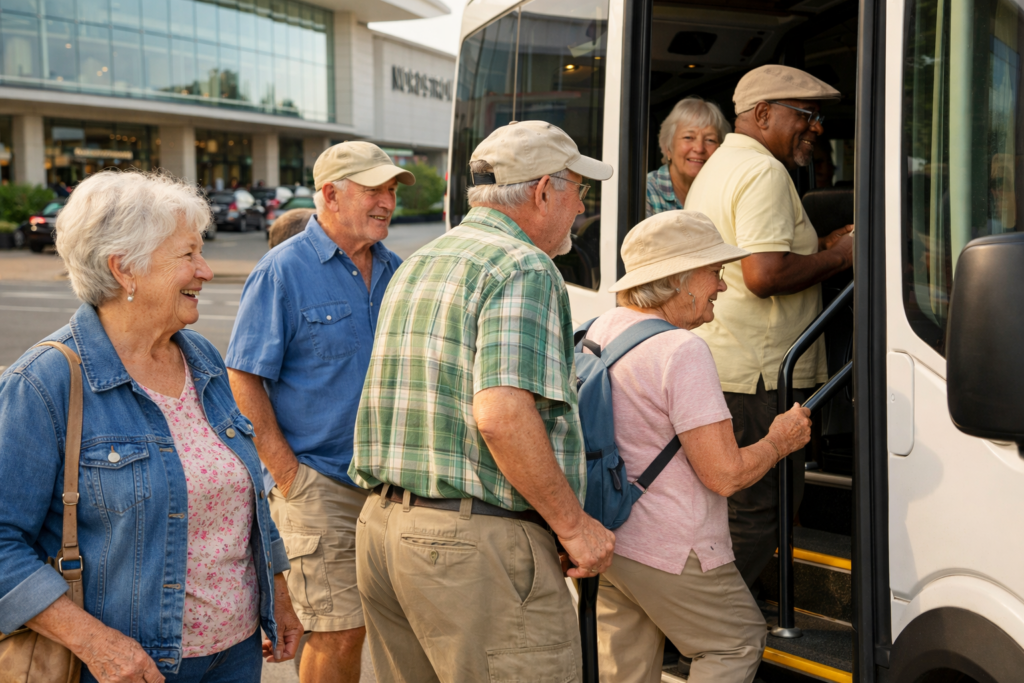
If you’ve ever wondered what’s polite on a mall shuttle, whether you should tip at a food court screen, or how to thank someone who helps with a wheelchair or heavy bags, you’re not alone. Tipping rules feel inconsistent on purpose, and those payment tablets can make anyone feel pressured.
This guide is designed for seniors (and family members who help plan senior day trips) visiting two of the most popular shopping destinations within about 50 miles of New York City:
- The Mills at Jersey Gardens (often called “Jersey Gardens”)
- American Dream Mall (the mega mall with attractions, big brand stores, and a huge indoor footprint)
You’ll get simple, practical answers. You’ll also get backup reasoning, so you feel confident no matter what kind of shuttle you’re on.
And yes—this article directly answers the question behind the main search people type in: shuttle driver tip NJ to NYC.
Why Seniors Actually Take These Shopping Day Trips (And Keep Taking Them)
Shopping isn’t just shopping on a senior day trip. It’s an outing. A routine. Sometimes a tradition.
They’re close enough to feel easy
Within roughly 50 miles, these trips can be a same-day round trip from:
- Manhattan, Brooklyn, Queens, Staten Island
- North Jersey towns near Newark, Elizabeth, Jersey City, Hoboken
- Parts of Long Island and Westchester (depending on traffic and shuttle routes)
No complicated travel planning. No packing for multiple days. No late-night driving home.
They’re comfortable for different mobility levels
Both malls are largely indoors and built for high foot traffic, which also means:
- Wide walkways
- Lots of places to sit
- Accessible restrooms
- Elevators and ramps
- Customer service desks and staff presence
If you or someone in your group tires easily, these features matter more than “how many stores are there.”
They work well for groups
Many senior day trips happen through:
- Senior centers
- Faith communities
- Neighborhood social groups
- Family “let’s all go together” outings
Group trips create a shared schedule—and shared questions like, “Are we tipping the driver? How much?”
They feel safe and predictable
There’s something calming about a destination with clear signage, familiar brands, and a reliable pick-up point. That predictability is a big reason seniors choose malls over more complicated day trips.
Jersey Gardens vs. American Dream: Why the Tipping Situation Feels Different
Even though both are shopping destinations, the “tipping moments” can feel different depending on the vibe and how you got there.
Jersey Gardens: outlet-shopping energy
Jersey Gardens is often a “shopping-first” trip:
- Outlet-style browsing
- People carrying more bags
- More “I found deals!” excitement
- Many visitors come specifically to shop hard and head home
That often means more luggage-style behavior: shopping bags, extra tote bags, maybe even a folding cart. Drivers and helpers may do more lifting and organizing.
American Dream: shopping plus attractions
American Dream is a hybrid destination:
- Big stores, yes
- But also attractions, entertainment zones, and “let’s look around” energy
People may carry fewer bags and spend more time walking. That can change how much “extra help” is needed on the transportation side—but it can increase interactions inside the mall.
Bottom line
Tipping is not about the mall itself. It’s about:
- The shuttle type
- The level of service
- The amount of assistance you receive
- The length and complexity of the trip
So let’s break it down in a way that feels obvious.
First, Know Your Shuttle Type (Because That Changes Everything)
Most tipping confusion comes from not knowing what kind of shuttle you’re actually on. Here are the common types seniors use for these day trips.
Fixed-route shuttle (ticketed, semi-public)
This is the “buy a seat, ride the route” experience:
- You pay a set price per person
- It runs on a schedule
- You’re one of many riders who may not know each other
- The driver’s job is mainly safe driving and sticking to the route
Tipping here is usually optional but appreciated, especially if the driver helps with bags or boarding.
Private group shuttle (senior center, church, organized trip)
This is the “we booked this bus for our group” experience:
- You’re traveling with people you know
- The driver may wait for your group and manage timing
- There’s more personal interaction
- The driver may help more, simply because groups ask for more help
Tipping is more expected because the driver’s role is broader and the day is longer.
Charter bus (larger coach, professional service)
This is often a full-size coach bus:
- Luggage compartments
- Higher capacity
- A professional, formal feel
- The driver is usually on duty for the full day
Tipping is commonly expected, and amounts are often higher because the driver commits a full workday to your group.
Promotional / casino-style bus
Sometimes a trip feels “sponsored” or promotional:
- Special low-cost seats
- Vouchers or perk-like offers
- A quick “in and out” vibe
Tipping is often not expected, but you can still tip if you receive extra help.
The Core Question: How Much Should You Tip a Shuttle Driver on a Shopping Day Trip?
Let’s make this simple, then explain why.
A clear tipping range that works for most seniors

For a day trip like Jersey Gardens or American Dream, use this as your default:
- $2–$5 per person for a basic shuttle ride with normal service
- $5–$10 per person for a full-day group trip or a driver who actively helps
- $10–$20 total if you’re traveling as a couple or small group and the driver provides extra assistance (bags, mobility help, special care)
If you’re searching specifically for shuttle driver tip NJ to NYC, the practical “most people do this and nobody is offended” answer is:
- $3–$5 per person is a solid, safe standard for a typical NJ/NYC shopping shuttle
- Go higher when the driver provides meaningful help or the trip is long and group-based
When you should tip more (and why it’s fair)
Increase your tip if any of these happen:
The driver helps with bags
Shopping trips create heavy, awkward loads:
- Multiple shopping bags
- Fragile items
- Large boxes
- People juggling canes or walkers while carrying bags
If the driver lifts, organizes, or repeatedly helps, your tip is paying for real effort, not just politeness.
The driver helps with boarding or mobility needs
A patient driver who:
- Waits while you step carefully
- Lowers steps or positions the vehicle
- Helps you steady yourself
- Gives you extra time without rushing
…is giving service beyond “drive from point A to point B.” That’s worth extra.
The driver acts like a host
Some drivers:
- Explain the pickup location clearly
- Remind everyone about the return time
- Answer questions kindly
- Keep the group calm and organized
That adds value. It also reduces stress—especially for seniors who worry about getting left behind.
The trip is a full-day commitment
If the driver is essentially “your driver for the day,” tipping is closer to a tour-driver situation than a quick commute.
When tipping is truly optional (and you can relax)
If your shuttle experience looks like this:
- You scan a ticket, sit down, ride, get off
- No bags handled
- No special help
- Minimal interaction
…then tipping is genuinely optional. If you still want to tip, a couple dollars is nice, but you are not doing something wrong if you don’t.
The Best Time and Way to Tip Without Feeling Awkward
A lot of seniors don’t mind tipping. They mind the awkwardness.
Here’s how to make it easy.
Tip at the end, not the beginning (most of the time)
For shopping day trips, tipping at the end makes sense because:
- You can base it on the actual service
- You can tip more if the driver helped with bags on the return
- It feels like a “thank you” rather than a “please take care of me”
Use a simple, calm handoff
You don’t need a speech. Just:
- A smile
- “Thank you for getting us here safely”
- Hand the tip discreetly
If you want to be extra polite without making it dramatic:
- “I really appreciate your help with the bags today.”
Cash is still king
Even in 2025, many drivers prefer cash tips because:
- It’s immediate
- No processing issues
- No awkward “tip screen” moment
If you can, bring:
- Several $1 bills
- A few $5 bills
That gives you flexibility without forcing you to overtip.
What if you only have larger bills?
If you only have a $20 and want to tip $5:
- It’s okay to ask, “Do you have change?”
- But don’t assume they do
A simple planning trick: keep a small “tipping envelope” or zip pouch in your bag with small bills before the trip starts.
Group Trips: The “Pooling Tips” Question Seniors Ask Every Time
On organized senior trips, you’ll often hear:
- “Are we collecting for the driver?”
- “How much is everyone giving?”
- “Is gratuity included?”
Here’s the simplest system that avoids drama.
Ask once: “Is a tip already included?”
Some trips build it into the cost. If so, you may still give a small extra tip for exceptional help, but you don’t have to.
If tips are pooled, keep it simple and fair
For a typical shopping day:
- $3–$5 per person pooled is common
- If it’s a charter bus or an all-day driver with lots of help: $5–$10 per person
One person collects in an envelope. The envelope is handed to the driver at the end with a quick thank-you.
If the group is inconsistent, don’t let it ruin your day
Some people tip. Some don’t. Some tip a lot. Some can’t.
Your goal is not to control everyone. Your goal is to do what feels fair for the service you personally received.
What About Tipping on the Way There vs. the Way Back?
This matters on shopping trips because the return ride is often where the work happens.
The return trip usually involves more assistance
On the way back:
- People are tired
- Bags are heavier
- There’s more loading and organizing
- Boarding takes longer
That’s why tipping at the end is usually the best move.
Exceptions: tip earlier if you fear you’ll forget
If you know you’ll be distracted later, tipping earlier is fine. A safe approach:
- Give a modest tip on arrival ($2–$3)
- Give the rest at the end if you receive extra help
Food Courts: The Most Confusing Tipping Zone in Modern America
Food courts should be the easiest part of the day.
And yet, they’re where seniors feel the most pressured—because of those screens.
Let’s reset expectations.

Counter service is usually not a tipping situation
If you:
- Order at a counter
- Pick up your food yourself
- Carry your tray
- Clean up after yourself
…then tipping is typically not required.
If you searched “tip at food court counter service,” the practical answer is:
- No tip is expected
- A small tip is optional if someone helps you
Why those screens show tipping anyway
Many systems are standardized. They ask for tips everywhere because:
- The software is built that way
- Businesses hope customers will tip
- People feel rushed and press “20%” to escape the moment
You are allowed to hit:
- “No tip”
- “Skip”
- Or a small custom amount
You’re not being rude. You’re following normal etiquette.
When a small tip makes sense at a food court
Consider a small tip (like $1–$2) if:
- Someone goes out of their way to help you
- They carry your tray
- They accommodate a special request patiently
- They fix an order issue kindly and fast
Coffee, snacks, and dessert counters
For coffee counters, ice cream stands, pretzel counters:
- Tipping is optional
- A $1 tip is a friendly gesture if you feel like it
- No tip is fine if service is standard
How to handle tip prompts without stress
Here’s a script that works:
- “No tip today.”
- Tap “No tip.”
- Move on.
If you want an even easier approach: use cash at places that feel awkward and avoid the screen altogether.
Sit-Down Restaurants Inside or Near the Malls: Different Rules
Some seniors do a full sit-down meal as part of the day trip. That’s not a food court situation.
Table service usually means tipping is expected
If a server:
- Takes your order at the table
- Refills drinks
- Brings food to you
- Clears plates
Then the standard is typically:
- 15–20% depending on service and local norms
Watch for automatic gratuity
Some restaurants add gratuity for:
- Large groups
- Special events
- Certain tourist-heavy locations
If gratuity is included, you can still tip extra for outstanding service, but you don’t have to.
Help Services Seniors Encounter on These Trips (And What to Tip)
Shopping day trips often involve small acts of help that feel “too minor to tip” but also “too kind to ignore.”
Here’s how to decide.

Wheelchair assistance
You might see:
- Mall wheelchairs available to borrow
- Staff who help escort someone
- A family member pushing a wheelchair (not a tipping situation)
- Occasionally a staff member who truly assists for a stretch of time
If a staff member provides hands-on assistance beyond pointing you to the wheelchair area, a polite tip is reasonable:
- $2–$5 for brief help
- $5–$10 for meaningful escorting or repeated help
If you’re unsure whether tipping is allowed, you can do this:
- Offer sincere thanks
- Ask quietly, “Are you allowed to accept tips?”
If they say no, a warm thank-you is enough.
Store associates who carry items or provide special care
Most store associates are not expecting tips. However, if someone:
- Walks you to a product
- Helps you compare options patiently
- Carries a bulky item to a pickup area
…a tip is usually not required, but a compliment or a “thank you, you made my day easier” goes a long way. If you want to show appreciation:
- Ask for their name and mention it to a manager
- That can help them more than cash in some stores
Package holding, customer service desks, and information help
These roles are generally not tipped. But if someone spends extra time helping with:
- Lost items
- Mobility guidance
- Coordinating assistance
- Solving a complicated issue
A small tip may be appreciated—again, only if allowed.
Restroom attendants (rare, but possible)
If you encounter a restroom attendant or someone actively helping maintain comfort:
- $1 is a common courtesy tip
The Senior Tipping Mindset That Makes Everything Easier
Many seniors grew up with a simpler tipping world. Today’s tipping culture can feel pushy.
Here’s a mindset that protects your peace.
Tipping is for service, not for guilt
You are not tipping to “prove you’re a good person.”
You are tipping to thank someone who provided real help.
Small tips are still respectful
If you’re on a fixed income:
- A small, consistent tip is perfectly fine
- You don’t have to match what someone else gives
It’s okay if others tip differently
One person’s tip is not a rule for everyone.
Your goal:
- Be fair
- Be kind
- Don’t let tipping steal the fun from the trip
Real-World Scenarios (So You Know Exactly What to Do)
This section is intentionally practical. Read the scenario that matches your trip style.
Scenario 1: Solo senior taking a ticketed shuttle

You buy a round-trip seat. You board. The driver is polite. No extra help needed.
What to do:
- Tip is optional
- If you want to tip: $2–$5 at the end is a safe range
- Say: “Thank you. Have a good day.”
Scenario 2: Couple traveling together on a shuttle
You travel as a pair. You have several bags on the way back. The driver helps load and unload.
What to do:
- Tip a bit higher: $10 total is a common, comfortable choice
- If the driver did a lot: $15–$20 total is generous without being extreme
Scenario 3: Senior center group trip with an all-day driver
Driver waits during the day, keeps the schedule, helps several people board safely.
What to do:
- Pool tips if your group does that
- A fair per-person range: $5–$10 depending on how hands-on the day was
- One envelope, one handoff, one thank-you
Scenario 4: Mobility assistance plus shopping bags
You’re using a cane or walker. You move slowly. The driver patiently helps you with steps and bags.
What to do:
- Tip higher because the service is personal
- $10 is a strong baseline, and $15–$20 is reasonable for extensive help
Scenario 5: Food court tip screen pressure
You ordered at a counter, carried your tray, and the screen asks for 20%.
What to do:
- Tap “No tip” without guilt
- If someone helped you personally: tip $1–$2 or select a small custom amount
Quick Tipping Cheat Sheet (Print This in Your Head)
Shuttle Driver (NJ ↔ NYC shopping trip)
- Normal ride, no extra help: $2–$5 per person
- Full-day group trip or lots of help: $5–$10 per person
- Couple/small group with lots of assistance: $10–$20 total
Food Court Counter Service
- Normal order/pickup: No tip expected
- Extra help or special care: $1–$2 optional
Sit-Down Restaurant
- Table service: 15–20% (check for included gratuity)
Wheelchair / Escort Help
- Brief help: $2–$5
- Ongoing help: $5–$10 (if allowed)
A Few Smart Senior Day-Trip Tips That Prevent Tipping Problems
These aren’t “tipping rules.” They’re trip-savers.
Bring a small bill kit
Pack:
- 10–15 one-dollar bills
- 4–6 five-dollar bills
It covers:
- Driver tip
- Snack tip
- Small courtesy moments
Keep tips separate from spending money
Use a small envelope labeled “Tips.”
This keeps you from accidentally tipping too much or feeling stuck.
If you’re unsure, tip modestly and be kind
A modest tip with a sincere thank-you is almost always received well.
Don’t let tip screens decide your values
Those screens are designed to rush you.
You can slow down. You can read. You can choose “No tip.”
FAQ: Seniors and Shopping Day Trip Tipping
Do seniors have to tip shuttle drivers from NJ to NYC?
No. It depends on the shuttle and the service. For many ticketed shuttles, tipping is optional. But a small tip is appreciated, especially if the driver helps.
How much should I tip a bus driver on a shopping trip?
A safe standard is $2–$5 per person for basic service, and $5–$10 per person for full-day group trips or a driver who helps a lot.
Is tipping expected on American Dream Mall shuttles?
Often it’s optional, but appreciated. If the driver provides extra help with boarding or bags, tipping becomes more appropriate.
Should I tip at food courts if I order at the counter?
Usually no. Counter service does not typically require tipping. Tip only if someone provides extra personal help.
What if I can’t afford to tip?
You’re not alone. Tipping should never cause financial stress. A sincere thank-you is still meaningful. If you can tip, even a couple dollars is kind.
Is $2 too small to tip a shuttle driver?
Not at all. For a basic ride with no extra help, $2 can be perfectly fine—especially if you’re consistent and polite.
Do I tip wheelchair assistance at malls?
Sometimes, if a staff member provides hands-on help beyond pointing directions. A small tip like $2–$5 is reasonable if allowed.
Are tips shared among drivers?
It depends. Some companies share tips, some don’t. You don’t need to worry about this—tip the person who helped you.
Can I tip with a credit card?
Sometimes, but not reliably. Many drivers prefer cash. For food courts, the screen may offer tipping—use your judgment based on service type.
What if no one else on the bus tips?
Do what feels fair to you. Group behavior varies widely. Your tip is about your values and the service you received.
Should I tip on both the ride there and the ride back?
Usually tipping at the end is best, because the return trip often involves more help with bags and boarding. Tip earlier only if you fear you’ll forget.

Final Thoughts: Enjoy the Day Trip—Don’t Let Tipping Steal the Fun
A senior shopping day trip should feel light. It should feel safe. It should feel like a treat.
If you remember just one thing, remember this:
Tip for real service. Skip tipping when it’s just a screen trying to pressure you.
For most Jersey Gardens and American Dream Mall trips, the simplest, most polite approach is:
- $3–$5 per person to the shuttle driver (more if they truly help)
- No tip at food court counter service unless someone goes out of their way
- Small tips for hands-on assistance when it’s allowed and meaningful
Bring a few small bills, keep it simple, and enjoy your day.