Tipping in the U.S. can feel like a moving target. One place wants 15%. Another suggests 20%. A tablet spins around with three big buttons and a watchful glance. And if you’re traveling with family—especially if you’re the person who “handles the bill”—the pressure can feel even stronger.
This guide is built to remove that stress.
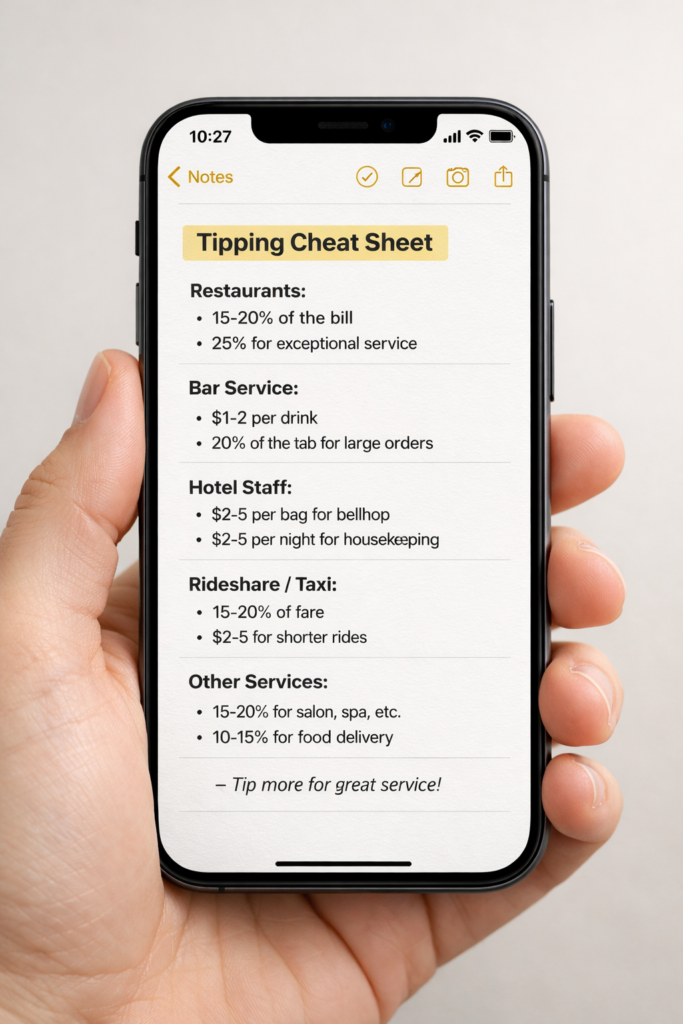
It gives you a simple tipping cheat sheet you can screenshot, plus clear explanations for the moments that usually cause confusion: service charges, takeout, hotels, delivery, and those tip screens that pop up everywhere. You won’t need perfect math. You won’t need to memorize a dozen rules. You’ll just need a few simple defaults that work almost anywhere.
If you want the quick version, here it is.
The quick tipping rule most people can rely on:
- Restaurants (sit-down): 18% is a safe “standard,” 20% for great service, 15% for basic service.
- Delivery: usually $3–$8, more when it’s heavy, far, late, or bad weather.
- Hotel housekeeping: $3–$7 per night (leave daily if you can).
- Rideshare/taxi: often 10%–20% depending on help, wait time, and distance.
- Coffee/counter service: optional; $1–$2 is kind if you want to tip.
Now let’s make it easy to use in real life.
How to Use This Tipping Cheat Sheet
Think of tipping like a small “thank you” budget for service. You’re not trying to win an etiquette contest. You’re trying to be fair, consistent, and comfortable.
Here’s the easiest way to use this guide:
Save it in a way you can actually access.
- Screenshot the cheat sheet sections.
- Bookmark this page.
- If you like paper, print it and keep it in a travel folder or glove box.
Choose one default and stick with it.
- If you pick 18% as your restaurant default, you’ll be “right” in most situations without thinking.
- If you prefer 20% because it’s easier (move the decimal and double), that’s fine too.
Use flat dollar tips whenever percentages are annoying.
- Delivery, coffee, hotel staff, and valet tips are often easier as fixed amounts.
If you’re traveling with family, assign one “tip captain.”
- One person handles tips for the day.
- It prevents awkward moments like “Did someone tip housekeeping?” or “Who tipped the shuttle driver?”
Most tipping stress comes from uncertainty. This guide is designed to replace uncertainty with a few reliable defaults.
The One-Page Tipping Cheat Sheet You Can Screenshot
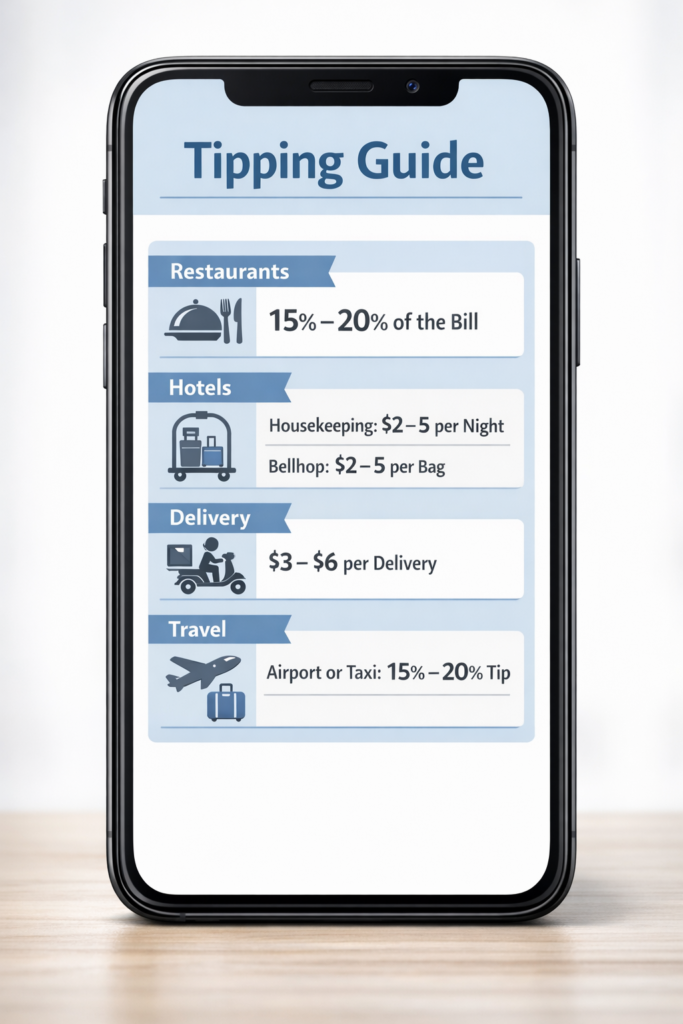
Below is the cheat sheet in plain language. You can treat it like a quick reference.
Restaurants and Food Service
Sit-down restaurant (server takes your order, refills drinks, brings the check):
- 15% = basic/okay service
- 18% = solid standard
- 20% = great service
- More than 20% = optional, for truly exceptional service or special situations
If you want the simplest one-rule approach:
- Tip 18% most of the time.
- Go 20% when it was clearly great or the staff went out of their way.
- Use 15% if things were slow or messy but still reasonable.
Buffet:
- Often 10%–15% because the service is different (drinks, clearing plates, sometimes seating help).
Bar (beer/wine/simple drink):
- Usually $1–$2 per drink
- Or 15%–20% if you’re running a tab with cocktails
Coffee shop / counter service:
- Tipping is usually optional
- If you tip: $1 for a coffee, $2 for something more involved
Takeout / pickup:
- Also typically optional
- If the order is large, complicated, or you’re a regular: $1–$5 is a nice gesture
Delivery and On-the-Go
Food delivery:
- Simple default: $3–$8
- More when:
- it’s far
- it’s heavy (multiple bags)
- it’s late-night
- it’s bad weather
- it’s a big family order
Grocery delivery:
- Often $5–$15 depending on size and effort
- Large, heavy, or many stairs = tip higher
Taxi / rideshare:
- Common range: 10%–20%
- If they helped with bags, waited patiently, or drove carefully: tip toward the higher end
Hotels and Travel
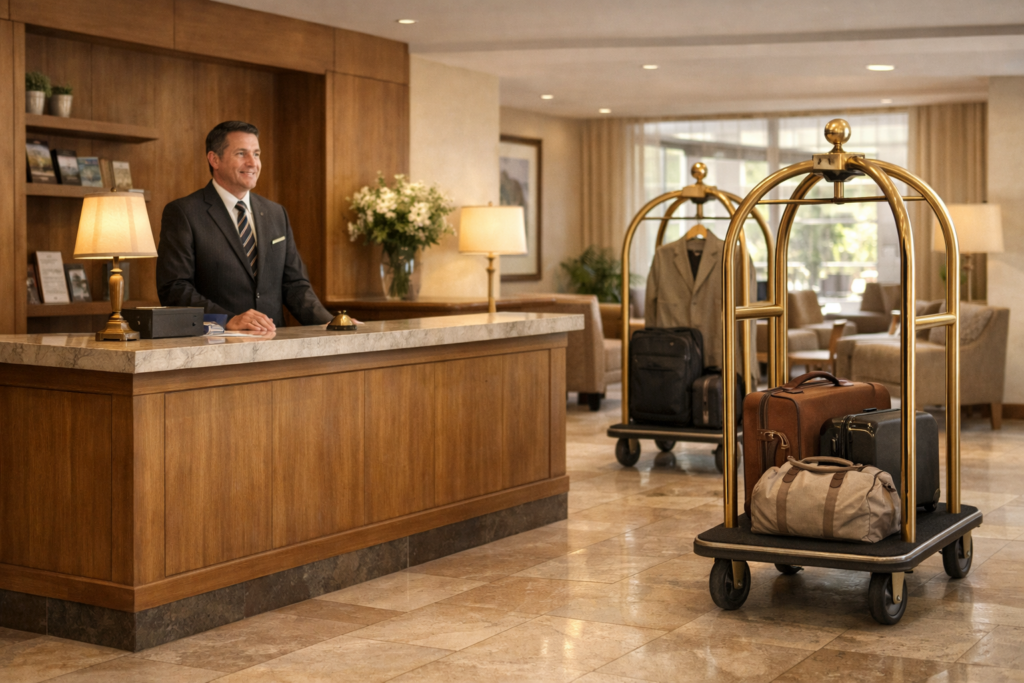
Hotel housekeeping:
- Common: $3–$7 per night
- Best practice: leave it daily, because staff can rotate
Bellhop / luggage help:
- Often $2–$5 per bag depending on how much help and how far
Valet:
- Common: $2–$5 when your car is returned
- More if it’s busy, raining, or they were especially quick/helpful
Concierge:
- Simple help (directions, quick question): sometimes no tip needed
- Big help (hard reservations, special arrangements): $5–$20, depending on effort
Personal Services
Haircut (barber/hairdresser):
- Common: 15%–20%
Nails:
- Common: 15%–20%
Massage:
- Common: 15%–20% (unless clearly stated as no tipping)
That’s the cheat sheet. Now let’s make it even easier: simple math shortcuts.
Simple Tipping Percentages (No Math Required)
A lot of people dislike tipping because it turns a relaxing meal into a mini math test. The good news: you don’t need perfect math.
The Easy Percentage Rule
If you only remember one rule for sit-down restaurants, make it this:
Tip 18% most of the time.
Why 18%? Because it’s widely accepted as a “standard” tip in many places, and it keeps you out of awkward territory.
Then adjust like this:
- 15% when the service was minimal or clearly not good (but not a disaster).
- 20% when it was great or you were well cared for.
The Two Fast Ways to Calculate Tips
The 20% trick (easiest):
- Move the decimal one place left (10%).
- Double it (20%).
Example:
- $50 bill → 10% is $5 → 20% is $10.
The “$5 per $25” shortcut:
- Roughly 20% is $5 for every $25.
- $25 → $5
- $50 → $10
- $75 → $15
- $100 → $20
It’s not perfect math, but it’s close enough for normal life.
When Flat Dollar Tips Are Better Than Percentages
Percentages are best for sit-down restaurants and salons. Flat amounts are often better for:
- Coffee
- Delivery
- Hotel housekeeping
- Valet
- Bellhops
- Shuttles
Flat tips remove the math and keep you consistent.
When You Do NOT Need to Tip
This is where a lot of frustration comes from. Tipping used to be limited to certain industries. Now tip prompts appear in places where tipping was never expected.
Here’s the simple truth: not every tip screen means you have to tip.
Situations Where Tipping Is Usually Optional
Counter service
- You order at a counter, pick up your own food, bus your table.
- A tip can be nice, but it’s usually not required.
Retail checkout screens
- Some stores add tip prompts even though they’re not traditional tipped jobs.
Self-service kiosks
- If you did the work (ordering and pickup), tipping is optional.
Quick grab-and-go
- Pre-made items, minimal interaction, no table service.
If you don’t want to tip in these cases, you can choose:
- No tip
- Or a small amount like $1 if you feel good about it
Situations Where Tipping Might Already Be Included
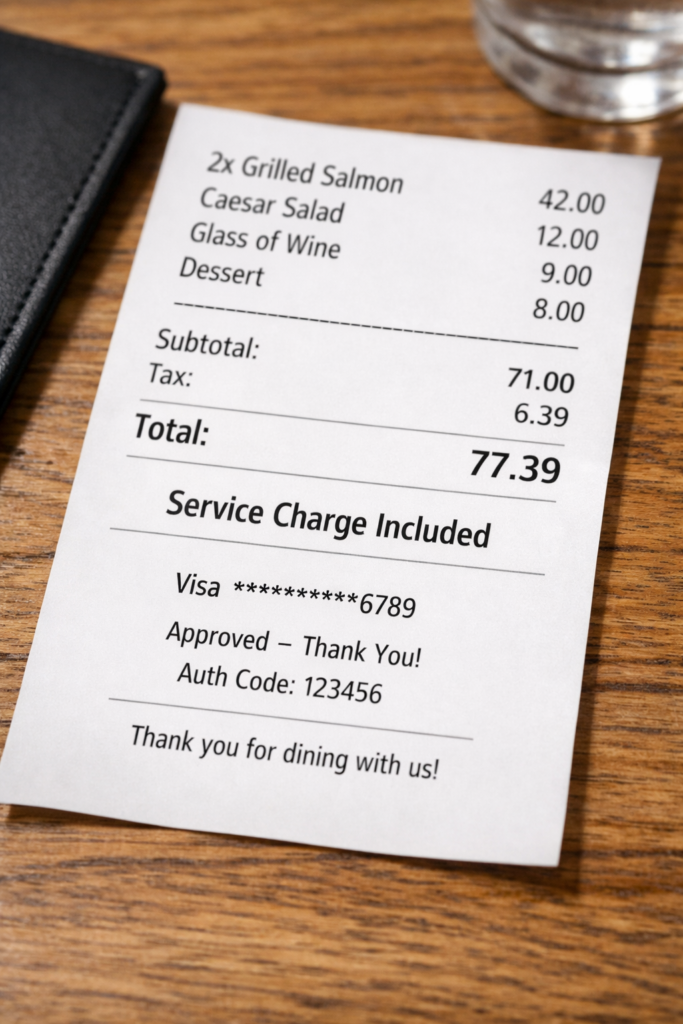
Automatic gratuity
- Often added for large parties (commonly 6 or more).
- It appears on the receipt as “gratuity” or “service charge.”
Service charge
- This is tricky because it can mean different things in different places.
- Sometimes it’s shared with staff, sometimes it’s not. But in many restaurants, it functions like a built-in tip.
Resorts, cruises, tours
- Many include daily service charges automatically.
- Always check your bill or booking details.
How to Check Without Awkwardness
You do not have to guess.
Look for these phrases:
- “Service charge”
- “Gratuity included”
- “Automatic gratuity”
- “Hospitality fee”
If you’re unsure, a simple question works:
- “Just checking—does this include gratuity?”
That question is normal. Staff hear it every day.
Common Tipping Mistakes (And How to Avoid Them)
Tipping problems usually come from two places: pressure and confusion. Let’s remove both.
Over-Tipping Out of Pressure
Tip screens can feel like a test. The percentages can look huge. The employee is standing there. You feel rushed.
Here’s a good rule:
Decide your tipping habits before you’re in the moment.
If you know your defaults, pressure loses its power.
Try these defaults:
- Sit-down restaurant: 18% standard
- Coffee/counter service: optional, $1 if you want
- Takeout: optional, $1–$5 for large orders
- Delivery: $3–$8 depending on effort and distance
Under-Tipping by Accident
This happens when:
- You assume gratuity is included but it isn’t.
- You split the bill and assume “someone else tipped.”
- You tip on the tablet but forget there was also a cash tip.
Best prevention:
- One person handles the tip when dining as a group.
- Check the receipt for “gratuity included.”
- If you tip cash, write “cash” on the receipt tip line so you don’t accidentally tip twice.
Tipping the Wrong Person
This is surprisingly common in travel situations.
Examples:
- You tip the front desk for something housekeeping did.
- You tip the wrong staff member in a busy hotel.
- You tip someone who isn’t allowed to accept tips (rare, but possible).
When in doubt, ask:
- “Is tipping customary for this?”
It’s a simple question and it saves you from guessing.
Cash vs Card Tipping
Many people wonder: is cash better?
Sometimes, yes. But it’s not required.
When Cash Is Helpful
Cash tips can be especially useful for:
- Hotel housekeeping (leave it in the room daily)
- Valet
- Bellhops
- Quick service moments where a card tip is awkward
Cash can also feel more “direct.” It’s immediate and clear.
When Card Tips Are Totally Fine
Card tips are standard for:
- Sit-down restaurants
- Bars (tabs)
- Salons
- Rideshare apps
- Delivery apps
If the choice is “card tip or no tip,” card tip is fine.
The Best Approach for Most People
If you want a simple plan:
- Keep a small stack of $1s and $5s for travel and hotels.
- Use your card for restaurants and services.
- Don’t stress beyond that.
Tipping While Traveling (Especially With Family)

Travel adds new tipping situations: hotels, shuttles, luggage help, and tourism services. It also adds confusion because different places do things differently.
Here’s how to make travel tipping simple.
Airports and Transportation
Airport shuttle drivers
- If they handle bags: tip.
- If it’s a simple ride: a smaller tip is fine.
- Common range: $2–$5 (more for lots of bags)
Porters and curbside bag check
- Often $2–$5 per bag depending on help and volume
Taxis and rideshare
- 10%–20%, higher when they help with luggage or wait for you
Hotels and Resorts
Hotels are the big one. Here’s the clean, simple version:
Housekeeping
- Tip $3–$7 per night
- Leave it daily if you can
- Put it in a visible spot with a note like “Housekeeping—thank you!”
Bellhop / luggage help
- $2–$5 per bag depending on help
Valet
- $2–$5 when the car is returned
- More if it’s busy, late, or poor weather
Concierge
- Small request: sometimes no tip needed
- Big request: tip based on effort, often $5–$20
Group and Family Trips: The “Tip Captain” System
This is a game-changer for family travel.
Pick one person per day to handle:
- hotel tips
- shuttle tips
- luggage tips
- tour tips
Why it works:
- No duplication
- No forgetting
- Less awkwardness
If family members want to contribute, they can reimburse later. In the moment, one person is in charge.
Printable and Screenshot-Friendly Tipping Guide (Make It Easy to Reuse)
If this guide is going to help you, it needs to be reusable.
The best “cheat sheet” habits are simple:
- Save it where you’ll actually look (favorites, photos, notes app)
- Keep cash tips ready when traveling
- Pick defaults you can remember
Here’s a super simple set of defaults you can adopt today:
- Sit-down restaurants: 18% standard
- Great service: 20%
- Delivery: $3–$8
- Hotel housekeeping: $3–$7 per night
- Valet: $2–$5
- Coffee/counter: optional, $1–$2
You’re done. That covers most of life.
FAQs About Tipping
How much should I tip at a restaurant?
For sit-down restaurants in the U.S., 18% is a solid standard. Tip 20% for great service and 15% for basic service.
Is 15% still acceptable?
Yes, in many places it’s still acceptable for average service. But in many parts of the U.S., 18%–20% is more common today, especially in busy areas and cities.
Do I tip on tax or before tax?
Most people tip on the total bill because it’s easier. Tipping before tax is fine if you prefer, but consistency matters more than perfection.
Should I tip if service was bad?
If the service was truly bad and the staff did not try to fix it, tipping less can be reasonable. But if the issue was the kitchen, delays, or things outside the server’s control, consider tipping closer to your standard.
Do I tip for takeout?
Takeout tipping is usually optional. If you want to tip, a small amount like $1–$5 is common—especially for big or complicated orders.
Is tipping required by law?
No. Tipping is not legally required. It is a social expectation in many service settings in the U.S., especially restaurants, where staff often rely on tips as a major part of income.
Do seniors get different tipping expectations?
The tipping expectations are generally the same. What matters most is being consistent and respectful. This guide is designed to make it easier, not to pressure anyone.
Should I tip hotel housekeeping daily?
If you can, yes. Housekeeping staff may rotate, so tipping daily helps the person who cleaned your room that day.
Is it rude not to tip?
It depends on the situation. Not tipping at a sit-down restaurant is usually seen as rude unless there was a serious problem. Not tipping at a retail counter or a self-service kiosk is often completely normal.
What if I truly can’t afford to tip?
If tipping would harm your budget, choose lower-cost options where tipping isn’t expected—like counter service or cooking at your lodging. If you’re at a sit-down restaurant, tipping something small is still kind, but you should never feel forced into financial strain.
Conclusion: Calm, Simple, and Confident
Tipping doesn’t need to be stressful. You don’t need to memorize a hundred rules. You don’t need to do perfect math. You just need a few simple defaults that work in most situations—and permission to ignore the noise.
Here’s the core idea to keep:
Pick a standard tip that feels fair, and use it consistently.
If you want the simplest version:
- Tip 18% at sit-down restaurants.
- Tip $3–$8 for delivery.
- Tip $3–$7 per night for hotel housekeeping.
- Tip $2–$5 for valet and luggage help.
- Treat counter-service tips as optional.
Screenshot this page. Share it with family. Keep it as your calm, reliable reference—especially when you travel.